
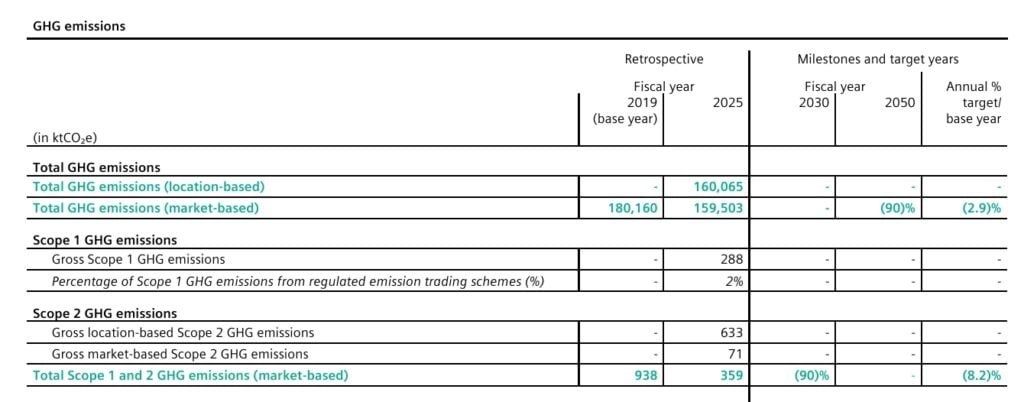
Siemens made major progress toward its 2030 climate goals. On December 3, the company said that products sold over the past three years will help customers avoid 694 million metric tons of carbon emissions over their lifetime. That amount is close to Germany’s yearly emissions. Siemens also cut its own operational emissions by 66% compared to 2019, beating its 2025 target earlier than planned.
For the second year in a row, the company helped customers avoid more emissions than it produced across its full value chain. This shift shows how sustainability now strengthens the company’s business and competitiveness.
Sustainability Becomes Part of Siemens’ Core
Eva Riesenhuber, Global Head of Sustainability at Siemens, expressed herself in the press release,
“With more than 90 percent of our business enabling customers to achieve a positive sustainability impact in our three key impact areas, we’re uniquely positioned to empower them to become more competitive, resilient, and sustainable. Even further, our Sustainability Statement 2025 provides measurable proof that our impact on societal infrastructure goes beyond our customers and our own business transformation to reach, ultimately, our planet and society.”
The company uses its DEGREE framework to guide 14 sustainability targets. DEGREE covers six areas: decarbonization, ethics, governance, resource efficiency, equity, and employability. Siemens reports that more than 90% of its business portfolio helps create a positive impact in areas such as energy efficiency, circularity, and people-focused solutions.
Furthermore, it aims to cut scope 1 and 2 emissions by 90% by 2030 and reach net-zero across its full value chain by 2050. It also plans to reduce scope 3 emissions by 30% by 2030 compared to 2019.
Its scope 1 and 2 targets match a 1.5°C and scope 3 target aligns with a well-below-2°C pathway. A full 1.5°C scope 3 target would require a 46% cut, which may not be realistic across all markets today.
Emission Reduction Plan
Its 2025 sustainability report highlighted that for scopes 1 and 2, Siemens focuses on: electrifying its vehicle fleet, improving energy performance in buildings, and reducing fuel use in operations.
- Between 2025 and 2030, the company plans to invest €320 million in capital spending and €410 million in operating costs for these initiatives.
Similarly, for scope 3, it targets reductions through: low-carbon materials, smarter product design, engaging suppliers on sustainability, and improving circularity and recovery at product end-of-life.
- Its gross scope 3 emissions stood at 159,144 ktCO₂e in 2025.
Because Siemens sells many electric-powered products, customer emissions during product use depend on how fast global power grids decarbonize. Siemens says this is an important factor that could influence its long-term scope 3 progress.
Strong Gains in Circular Design and Resource Efficiency
Circularity remains a major focus for Siemens. In fiscal year 2025, the company expanded its Robust Eco Design approach to 67% of its product and service portfolio. This marked a 13% jump from the previous year.
More than 25,000 Siemens products earned the EcoTech label. These products meet strict environmental standards related to sustainable materials, lower energy use, and better recycling options.
At a sustainability forum, Ross Colon, CEO of Siemens Thailand, said Siemens’ technology helps customers avoid about 144 million tons of CO₂ every year. This amount is higher than the emissions in Siemens’ full supply chain. Colon said technologies like digital twins and AI-powered energy tools already offer strong solutions. “The technology we need is here today,” he said.
- READ MORE: Nvidia’s (NVDA) Stock Rose on Q3 Strong Results: $57B Revenue, $100B AI Infrastructure Plan
Siemens Limits Carbon Credit Use to Residual Emissions
Siemens follows science-based climate targets validated by the Science Based Targets initiative (SBTi) and prioritizes cutting emissions first to reach Net-Zero.
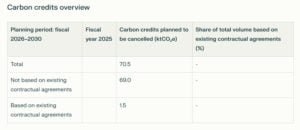
- Total carbon credits planned to be cancelled over fiscal 2026–2030 are 70.5 ktCO₂e, of which 1.5 ktCO₂e are already covered by existing contractual agreements.
- Meanwhile, from fiscal 2030, after reducing Scope 1 and 2 emissions by 90%, Siemens will address remaining emissions with high-quality carbon credits.
- Starting in fiscal 2050, it will offset any remaining Scope 1, 2, and 3 emissions, which will account for no more than 10% of its base-year emissions, using carbon credits that meet SBTi eligibility rules.
These credits are independently verified and follow strict standards for transparency, additionality, permanence, and avoiding double-counting. They also comply with rigorous rules for measuring, monitoring, and reporting greenhouse gas reductions.
Verified Credits Support Emission Goals
Additionally, Siemens recognizes credits certified by leading programs, including Verra’s Verified Carbon Standard, the Gold Standard, and Plan Vivo, as well as other standards such as ISO. It also applies safeguards, such as excluding projects started before 2016, checking project methods like reforestation species, and screening all involved parties.

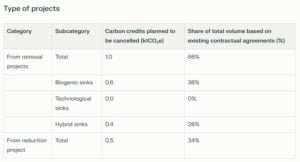
For projects beyond its GHG reduction targets, Siemens follows the Oxford Offsetting Principles. Its portfolio includes different types of credits, with a growing share of permanent removal credits each year. All credits meet verified standards and undergo internal due diligence similar to that applied for credits linked to emission reductions.
- As a result, in fiscal 2025, Siemens retired 2.0 ktCO₂e of carbon credits outside its value chain.
Helping Customers Avoid Over 1 Billion Tons of Emissions by 2030
Along with reducing its own footprint, Siemens wants to help customers cut emissions at a massive scale. The company aims to enable more than 1 billion tons of cumulative avoided emissions from 2023 to 2030. These savings come from technologies such as efficient motors, automation systems, smart infrastructure, and electrification projects.
It hails customer impact as essential to global decarbonization, especially as industries move toward net-zero targets.
Climate and Innovation Drive Siemens’ Future
Siemens’ progress shows how fast corporate climate action is evolving. The company treats sustainability as a driver of growth, not a cost. With validated science-based targets, strong gains in circularity, and large customer emissions savings, Siemens positions itself as a major player in the global net-zero transition.
The company still faces challenges, including supply chain emissions and the speed at which customers adopt clean electricity. But Siemens remains confident that innovation, digital tools, and smart engineering can support the next stage of climate progress.
Overall, Siemens shows that climate action can strengthen both the planet and the bottom line — and that the transition to a low-carbon future is already underway.
The post Siemens Cuts Emissions 66% and Helps Customers Avoid 694 Million Tons of CO₂ appeared first on Carbon Credits.


