

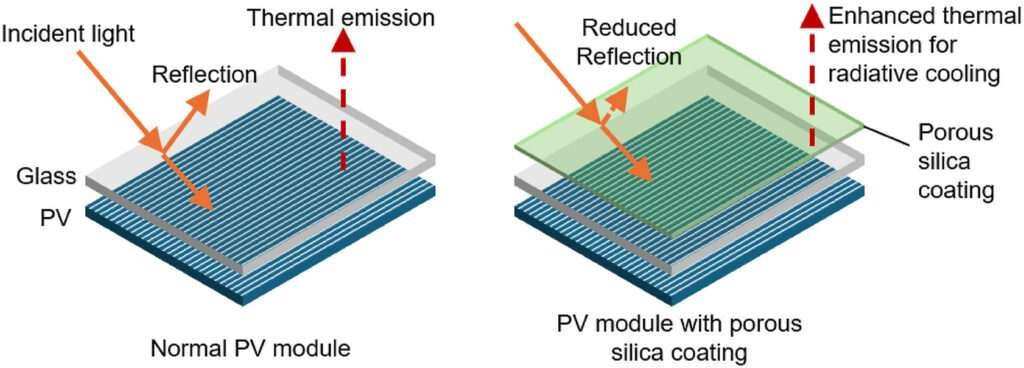
Researchers from Germany and Namibia have developed a porous silicon dioxide (SiO₂) coating for photovoltaic (PV) cover glass that combines anti-reflective properties with passive radiative cooling. The coating is designed to increase light transmission while improving the thermal performance of solar modules.
“The novelty of this work is that we demonstrate a porous silica coating that can simultaneously reduce optical reflection and enhance mid-infrared thermal emission from PV cover glass,” corresponding author Gan Huang told pv magazine. “In this way, the coating addresses two important loss mechanisms in PV modules: front-surface reflection and heat accumulation.”
The researchers said the next step is to integrate the coating with complete PV modules and evaluate its impact on electrical output and operating temperature under outdoor conditions.
“Our next step is to integrate these coatings with PV modules and test their effect on electrical output and operating temperature under outdoor conditions,” Huang said. “We are also interested in developing scalable large-area coating methods suitable for industrial PV cover glass, as well as studying long-term durability and possible anti-soiling effects.”
For the initial experiments, the researchers applied a sol-gel coating to low-iron soda-lime glass substrates. They prepared separate acid- and base-catalyzed silica sols using tetraethyl orthosilicate (TEOS), ethanol and water, with hydrochloric acid and ammonium hydroxide used as catalysts, respectively.
Pluronic F127 was added to the acid-catalyzed sol as a pore-forming template. The researchers tested three F127 concentrations: 0.25 g, 0.40 g and 0.60 g.
The resulting porous structure was intended to reduce optical reflection while increasing thermal emission in the mid-infrared range, enabling the coating to address both optical and thermal losses at the front surface of PV modules.
After aging, the two sols were combined and left for 24 hours, after which approximately 0.5 mL of the resulting mixture was deposited onto each glass substrate by spin coating at 500 rpm for 20 seconds, then at 1,500 rpm for 20 seconds. The process was repeated up to three times, with five minutes of drying between coatings, before the samples were sintered at 450 C for one hour to remove the organic template and stabilize the porous silica layer.
The materials and optical properties of the coatings were characterized using scanning electron microscopy, Fourier transform infrared spectroscopy, and spectrophotometry.
“A thin porous silica coating can increase solar transmittance, which is beneficial for PV power generation, while additional coating thickness can further enhance thermal emissivity for cooling,” explained Huang. “However, too much coating thickness can reduce transmittance due to scattering. This shows that the coating thickness and microstructure need to be carefully optimized for PV applications.”
The strongest overall balance was achieved with a two-layer coating containing 0.40 g of Pluronic F127, which delivered 91.0% solar transmittance and 90% mid-infrared emissivity, compared with 89.8% transmittance and 87% emissivity for bare glass. A single-layer coating reached similarly high transmittance, at 90.9% to 91.0%, while thicker coatings pushed emissivity as high as 96%, around 10% higher than bare glass, but at the cost of lower solar transmission.
For PV applications, a roughly 1.2-percentage-point gain in transmittance was observed. “Assuming that the photocurrent scales approximately linearly with transmitted solar irradiance, a PV module with an efficiency of 20% could show an absolute efficiency increase of approximately 0.25%, reaching ~20.25%, from this optical gain alone,” the group highlighted.
The coating was presented in “Porous Silica Coatings for Radiative Cooling and Anti-Reflection for Enhancing Solar Photovoltaics Performance,” published in Optical Materials. Researchers from Germany’s Karlsruhe Institute of Technology and the University of Namibia have contributed to the study.
The post Silicon dioxide coating boosts PV module light transmission, thermal performance appeared first on pv magazine Global.


