
- AI is now constrained by electricity, not compute
- Grid buildout is too slow for hyperscale demand growth
- On-site power solutions are expanding fast, including traditional fossil-based generation, as grid access lags
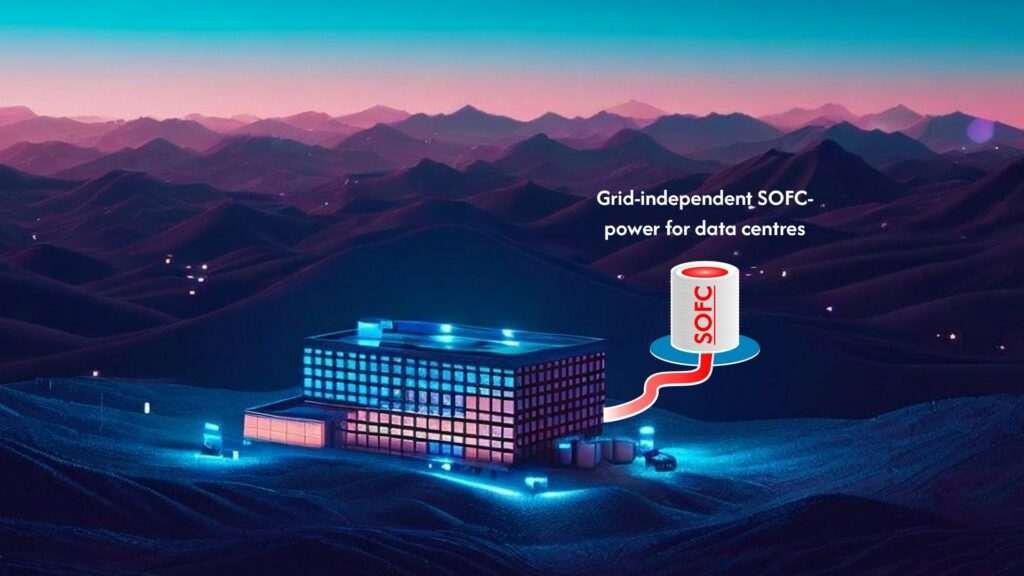
- Solid Oxide offers scalable, low-carbon, grid-independent power for AI infrastructure
Silicon Valley is heading into summer with last year’s power-curbing measures still fresh. Google, Meta, and Amazon’s data centres agreed to throttle operations and adopt smarter energy management approaches, while local businesses and households endured rolling curtailments to keep the grid from snapping. The North American Electric Reliability Corporation (NERC) has already issued fresh alerts warning of risks posed by large computational loads on the grid.
Big Tech has long operated on the assumption that physics was a negotiation. If demand rises, supply will follow. If chips get faster, constraints will fade. If the electricity grid is slow, it will be upgraded. The emerging reality is more rigid. Electricity is the lifeblood of the region’s sprawling data centres and AI infrastructure, and shortages or delays directly slow the deployment of new technology. Electricity is now constrained less by ambition than by permitting, transmission, and fragmented build-out timelines.
Grid operators are starting to sound more like weather forecasters warning of an approaching storm. According to the NERC in its latest long-term reliability assessment published January 2026, the rapid expansion of data centres supporting AI is emerging as a material stressor for grid planning margins. AI workloads do not sip power steadily. They gulp it in sudden, coordinated bursts that resemble industrial load shocks more than normal commercial demand, while the facilities themselves are also scaling from hundreds of megawatts towards multi-gigawatt campuses more comparable to heavy industry than traditional commercial infrastructure.
A key shift is timing. Electricity systems are built around predictable aggregation. AI demand is increasingly discontinuous, arriving in dense clusters that strain local infrastructure even when national averages look manageable. In Silicon Valley, according to the California Energy Commission, the grid still leans heavily on natural gas to keep everything humming after sunset, but solar, wind, hydro and batteries are rapidly claiming a larger share of the load as California pushes to scrub carbon from its power mix.
The tech industry is beginning to absorb the implication. Microsoft, in internal infrastructure planning, has been reassessing whether its ambition to match electricity use with carbon-free supply by 2030 can keep pace with faster-than-expected AI-driven load growth. The constraint is not a change in targets, but the growing difficulty of aligning them with the physical realities of generation and grid expansion. Clean power scales like infrastructure; AI scales like software, and software is winning!
Local governments are also losing patience. Across the United States, multiple jurisdictions have paused or restricted new data centre approvals amid electricity shortages and rising prices, according to municipal filings and industry trackers. In parts of Silicon Valley, including Santa Clara County, several newly completed or recently energised facilities are operating below intended capacity, not because of lack of demand but because grid connections and transmission upgrades are being phased in over time. Full relief is not expected until the end of this decade.
The numbers explain why the system is straining. Estimates from Lawrence Berkeley National Laboratory suggest US data centres consumed roughly 4–5% of national electricity in 2025. Under high-growth AI scenarios, that figure could reach 8–15% by 2030. However, a single hyperscale facility (classed as a very large data centre, typically housing tens of thousands of servers) is increasingly being designed at gigawatt scale. Meta’s Richland Parish campus alone is linked to more than 2GW of planned gas generation, while data centre projects such as Hyperion and also Prometheus in New Albany are targeting roughly 1-5GW footprints. For comparison, Estonia’s entire peak national electricity demand is around 1.5GW! Meanwhile, more than 2,000 gigawatts of generation capacity are stuck in US interconnection queues, according to federal grid data, waiting years simply to plug in.
The result is a ginormous structural mismatch. Silicon Valley can now deploy compute clusters at a pace normally associated with software rollouts, while power infrastructure still expands on decade-long industrial timelines.
Building around the grid instead of waiting for it
One response is to stop asking permission by deploying more decentralised and flexible power infrastructure. The Federal Energy Regulatory Commission has described interconnection delays as a critical bottleneck, with large projects in congested regions often waiting five years or more. Increasingly, technology firms are treating this less as a constraint and more as an instruction. If the grid is too slow, they will simply build around it through captive generation and private microgrids.
This is why on-site generation is suddenly incredibly desirable. Developers of distributed energy technologies increasingly view AI campuses as evolving into power plants with servers attached. Off-grid systems allow data centres to bypass constrained transmission networks and operate more independently while improving efficiency and resilience. Recent reports that Elon Musk’s xAI deployed nearly 50 trailer-mounted gas turbines at its Mississippi data centre under a regulatory loophole illustrate just how aggressively hyperscale operators are pursuing any available source of fast-track power.
From combustion to oceans to orbit
Combustion-based generation is reappearing as a pragmatic but uncomfortable bridge solution. Gas turbines and large-scale backup engine generators are largely being deployed for continuous on-site electricity where grid access is delayed. These solutions can also be installed quickly, but their logic is purely expedient. Combustion of natural gas produces carbon dioxide, nitrogen oxides and particulates, turning a local fix into a distributed emissions source.
At hyperscale, the local impact becomes very difficult to ignore. A 2GW AI campus powered continuously by gas-fired reciprocating engines or turbines could consume roughly 17.5 terawatt hours of electricity annually and emit in the region of 7–9 million tonnes of CO₂ per year depending on efficiency and load profile, alongside substantial NOx emissions that directly affect local air quality. Again, in carbon terms alone, that approaches the annual emissions footprint of a small industrialised nation. Of course, this calculation is much lower when renewable energy is included in the supply mix. However, wind and solar are variable on short timescales, and without sufficient storage, transmission interconnection, or complementary firm capacity, they cannot on their own guarantee fully continuous supply for always-on, high-density loads such as data centres.
At the outer edge sits space-based solar power, periodically revived by figures such as Musk and explored in various NASA concepts. In orbit, solar panels avoid night and weather. In theory, orbital arrays could deliver continuous gigawatt-scale power. In practice, launch costs and engineering complexity keep it far from commercial reality. Meanwhile, another US firm, Panthalassa, is piloting autonomous data centres in the middle of the ocean that are powered by kinetic wave energy. An exciting proposition were they to solve the maintenance challenge in such harsh environments.
Enhanced geothermal systems are also attracting attention because they offer stable baseload electricity without the intermittency challenges of wind and solar, yet they face high upfront drilling risk and site dependence. Small modular nuclear reactors continue to be explored despite unresolved questions around cost, regulation, waste handling and commercial maturity.
A very credible long-term contender
Solid Oxide fuel cell technology stands out as one of the most compelling long-term power solutions for data centres. Unlike combustion-based systems, Solid Oxide cells generate electricity electrochemically, enabling highly efficient, low-to-no carbon power generation with dramatically lower local air pollution. Electrical efficiencies are significantly higher than conventional gas turbines or reciprocating engines, while the high operating temperature also enables valuable waste heat recovery for integrated cooling and thermal management within data centre campuses. Their modular architecture allows systems to scale incrementally alongside compute demand, an increasingly important advantage as AI campuses expand from conventional data centre footprints towards multi-gigawatt industrial clusters.
Fuel adaptability further strengthens SOFC appeal. Systems can operate on natural gas today while remaining compatible with clean hydrogen, green ammonia and other low-carbon fuels as energy infrastructure evolves. Critically for AI infrastructure, Solid Oxide systems provide stable baseload power with high reliability and energy independence, reducing exposure to grid congestion, transmission delays and electricity price volatility. In addition, the technology is reversible. Solid Oxide cells can also run in reverse (SOEC) to make clean hydrogen from renewable-powered electricity. This hydrogen can be stored for long periods and used later for power, helping connect data centres to emerging hydrogen energy systems and move toward fully carbon-free, self-sustaining infrastructure.
AI is not the peak. It’s the first signal!
Zooming out, however, two narratives now compete. One says data centres are the problem, a concentrated load straining regional grids. The other says they are the first visible symptom of a broader shift. The canary in the coal mine. The real strain will come when everything else electrifies too. Electrification of transport, heating and industry would be far larger. A fully electrified US vehicle fleet alone would require more than 1,000 terawatt hours of additional annual electricity.
On this reading, Silicon Valley is not so much the villain of the energy crunch. It is the early warning flare. Data centres are visible, concentrated and politically exposed, which makes them appear disproportionately important. They reveal strain first because they fail locally and visibly. What appears today as an AI power crisis may ultimately prove to be the opening phase of a much broader infrastructure bottleneck affecting the entire electrified economy.
The deeper shift is structural. The world is electrifying while building an always-on digital layer of computation. According to scenarios from the International Energy Agency, global electrification could add tens of thousands of terawatt hours of demand by mid-century, requiring a near doubling of the electricity system.
In that context, AI is not the peak of demand. It is the first sharp edge of it!
The conclusion should not be that Silicon Valley misjudged technology. It is that it misjudged sequence. The grid, originally built for a fossil-fuel world of slow demand growth, is being asked to expand under conditions where demand is accelerating, spatially uneven and politically entangled. And for the first time, Silicon Valley is discovering that software no longer scales faster than physics.
Luckily, there are solutions.
If you would like to explore solid oxide fuel cell tech for your data centre project, please contact sales@elcogen.com
The post Silicon Valley exposes the limits of power appeared first on Bridging the Energy Transition.


