
A new analysis by Ember shows that solar energy, combined with battery storage, could meet up to 90% of India’s electricity demand at a lower cost than what most states currently pay for power. The findings highlight a major shift: clean energy is no longer just sustainable—it is becoming the most economical option.
ezstandalone.cmd.push(function () { ezstandalone.showAds(119); });
India’s solar journey has already begun, but the real opportunity lies in scaling it up and making it available round the clock.
India’s Solar Potential Is Massive but Underused
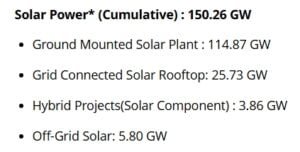
India’s cumulative solar capacity as of March 2026 was 150.26 GW. While this sounds significant, the Ember report states that it represents only about 4% of the country’s estimated 3,343 GW ground-mounted solar potential. In simple terms, India has barely tapped into its solar resources.
ezstandalone.cmd.push(function () { ezstandalone.showAds(127); });
This untapped capacity is enormous. The total feasible solar potential could generate nearly three times the country’s electricity demand in 2024. Even more striking, this estimate uses only a small portion of available land—just 6.7% of suitable wasteland, which is less than 1% of India’s total land area.
Moreover, this figure excludes other major opportunities. Rooftop solar alone could add over 600 GW, while floating solar projects may contribute up to 300 GW. Technologies like agrivoltaics, which combine farming with solar panels, could further expand capacity.
ezstandalone.cmd.push(function () { ezstandalone.showAds(128); });
Solar power is already making a visible impact. In 2025, it contributed 9.4% of India’s electricity. During peak sunny hours, it met nearly a quarter of demand. However, the challenge remains clear: solar stops working after sunset. To fully unlock its potential, India must solve the “night problem.”
Why Solar + Storage Makes 90% Clean Power Possible
Now, battery storage is the missing piece. It allows excess solar power generated during the day to be stored and used at night. Thanks to falling battery costs, this solution is now economically viable.
ezstandalone.cmd.push(function () { ezstandalone.showAds(129); });
- According to Ember’s modeling, solar combined with batteries can meet up to 90% of India’s electricity demand at a levelized cost of electricity (LCOE) of about INR 5.06 per kWh. This is cheaper than the average power purchase cost in many states today.
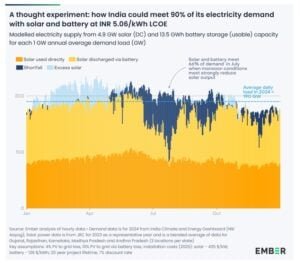
However, reaching 100% solar is not as simple. Each additional percentage beyond 90% requires significantly more solar panels and storage capacity. This leads to rising costs, making 90% the most practical and cost-effective target.
To meet this level of demand, India would need around 930 GW of solar capacity. This is still less than one-third of its total feasible ground-mounted potential. Alongside this, about 2,560 gigawatt-hours (GWh) of battery storage would be required.
ezstandalone.cmd.push(function () { ezstandalone.showAds(130); });
In practical terms, for every 1 GW of average demand, the system would need about 4.9 GW of solar capacity and 13.5 GWh of storage.
- SEE MORE: India’s Solar and Renewable Energy Outlook to 2030: Impact of the US-India 18% Tariff Cut on Exports
Seasonal Patterns Shape Solar Performance
Solar energy does not perform the same way throughout the year. Its effectiveness depends heavily on seasonal patterns and weather conditions.
ezstandalone.cmd.push(function () { ezstandalone.showAds(131); });
The Ember report further highlighted that during the early months of the year, from January to April, solar radiation is strong. In this period, solar and batteries can meet nearly 100% of daily electricity demand. Batteries store excess energy during the day and release it at night, ensuring a stable supply.
In peak summer months like May and June, electricity demand rises by about 10%. Even then, solar and storage can still meet around 88% of demand.
The real challenge appears during the monsoon season. Cloud cover reduces solar output significantly, especially in July. During this time, solar and batteries can meet only about 66% of demand.
ezstandalone.cmd.push(function () { ezstandalone.showAds(132); });
This limitation is not due to battery capacity. Instead, it is caused by reduced solar generation over several cloudy days. Batteries can shift energy from day to night, but they cannot store large amounts of power for extended low-sunlight periods.
This is why a balanced energy mix is essential.
Wind and Hydro Will Fill the Gaps
India does not need to rely on solar alone. Other clean energy sources can complement solar power effectively.
Wind energy is especially important. It tends to generate more power during the monsoon months, when solar output is low. This natural balance helps stabilize the overall energy system.
ezstandalone.cmd.push(function () { ezstandalone.showAds(133); });
Hydropower and nuclear energy can also provide steady, reliable electricity. Together, these sources reduce the need for excessive solar and battery capacity, keeping costs under control.
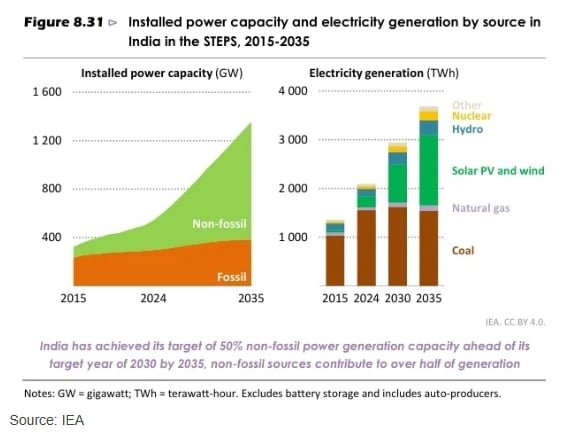
As a result, solar becomes the backbone of the system, while other clean sources fill in the gaps. Looking ahead, solar will play a major role in meeting energy demand. Around 50% of India’s additional electricity demand through 2030 is expected to come from solar power.
State-Level Trends Show Strong Potential
The feasibility of solar-plus-battery systems varies across states. This depends not only on sunlight availability but also on how and when electricity is used.
ezstandalone.cmd.push(function () { ezstandalone.showAds(134); });
States like Andhra Pradesh, Maharashtra, Karnataka, Telangana, and Tamil Nadu show strong alignment between solar generation and electricity demand. In these regions, demand peaks during sunny months, making it easier for solar to meet a large share of electricity needs.
For example, demand in these states is often 10% to 29% higher than average during high-solar months. At the same time, demand drops during the monsoon, which helps offset lower solar output.
Other states like Gujarat, Rajasthan, and Madhya Pradesh also show favorable conditions. Their demand remains relatively stable throughout the year, which makes solar integration smoother.
ezstandalone.cmd.push(function () { ezstandalone.showAds(135); });
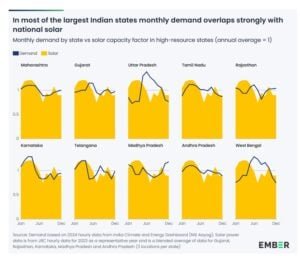
However, not all states are equally suited. Uttar Pradesh and West Bengal face more challenges. In these regions, electricity demand peaks during the monsoon, when solar output is weakest. This mismatch makes it harder for solar-plus-storage systems to meet demand efficiently.
These differences explain why the same solar and battery setup performs better in some states than others.
Transmission Will Unlock National Benefits
India’s renewable energy strategy already reflects a smart approach. Large-scale solar projects are being developed in high-resource states with strong sunlight and available land. At the same time, the country is expanding its transmission network to move electricity across regions.
ezstandalone.cmd.push(function () { ezstandalone.showAds(136); });
This interconnected system allows solar-rich states to supply power to areas with higher demand or lower solar potential. It also improves the overall efficiency of the grid.
As transmission infrastructure grows, the benefits of solar and storage will spread across the country.
The analysis makes one thing clear: India has the resources to transform its power system. Solar energy, backed by battery storage, can deliver clean, reliable, and affordable electricity at scale.
ezstandalone.cmd.push(function () { ezstandalone.showAds(137); });
- In the broader context, the Asia-Pacific region led the global BESS market, generating USD 17.31 billion in 2025 and expected to reach USD 21.32 billion in 2026.

However, the transition will require careful planning. Seasonal variations, regional differences, and the need for complementary energy sources must all be considered.
Still, the direction is clear. With falling costs and abundant resources, solar plus storage is no longer a future possibility—it is a present-day solution.
ezstandalone.cmd.push(function () { ezstandalone.showAds(138); });
India now stands at a turning point. By scaling up solar and investing in storage and grid infrastructure, the country can move closer to a low-cost, low-carbon energy system that meets demand day and night.
The post Solar Plus Batteries Can Meet 90% of India’s Electricity Needs, Says Ember appeared first on Carbon Credits.


