

Adding wind power to hybrid systems combining photovoltaics and battery storage can reduce the cost of meeting 90% of electricity demand by nearly one-fifth, according to an analysis by UK-based think tank Ember.
The median cost falls from $0.105/kWh (€0.095/kWh) to $0.086/kWh (€0.078/kWh) when wind generation is included, primarily due to reduced storage requirements.
The study examines 10 years of meteorological data, region by region and hour by hour, combining solar and wind generation with battery storage to assess the cost of meeting 80%, 90% and 99% of electricity demand. The model assumes constant baseload demand throughout the year.
Wind power’s main contribution is to reduce periods when solar generation falls short of demand. In Canada, the battery storage capacity required to achieve 90% coverage falls from 24 hours to 10 hours of demand. In the United States and Europe, it declines from 20 hours to 12 hours, while in China it falls from 18 hours to 12 hours. In India, where wind has a smaller impact on storage requirements, the figure remains at 14 hours.
With wind power included, three-quarters of global electricity demand can be met at 90% coverage for less than $0.10/kWh (€0.091/kWh). Without wind generation, that share falls to approximately half.
The analysis estimates that, under conservative assumptions, global wind energy potential is at least 19 times total global electricity demand. Regions accounting for 93% of global electricity consumption have at least 1 GW of developable wind potential within their territories and coastal zones, while regions representing 82% of demand have at least 10 GW.
The model applies a uniform cost of capital of 7% to compare resources and technologies across regions. When regional costs of capital are applied, the median cost of achieving 90% coverage rises from $0.099/kWh (€0.090/kWh) to $0.104/kWh (€0.094/kWh) in Europe, and from $0.076/kWh (€0.069/kWh) to $0.126/kWh (€0.114/kWh) in Africa.
Seasonal complementarity
The complementary generation profiles of solar and wind power are particularly significant at higher latitudes. Solar output becomes more seasonal farther from the equator, while wind generation tends to be stronger during months when solar output is lower.
In Europe, for example, wind power produces 44% of its annual output between November and February, compared with just 12% for solar. Combining the two technologies results in a more even distribution of electricity generation throughout the year.
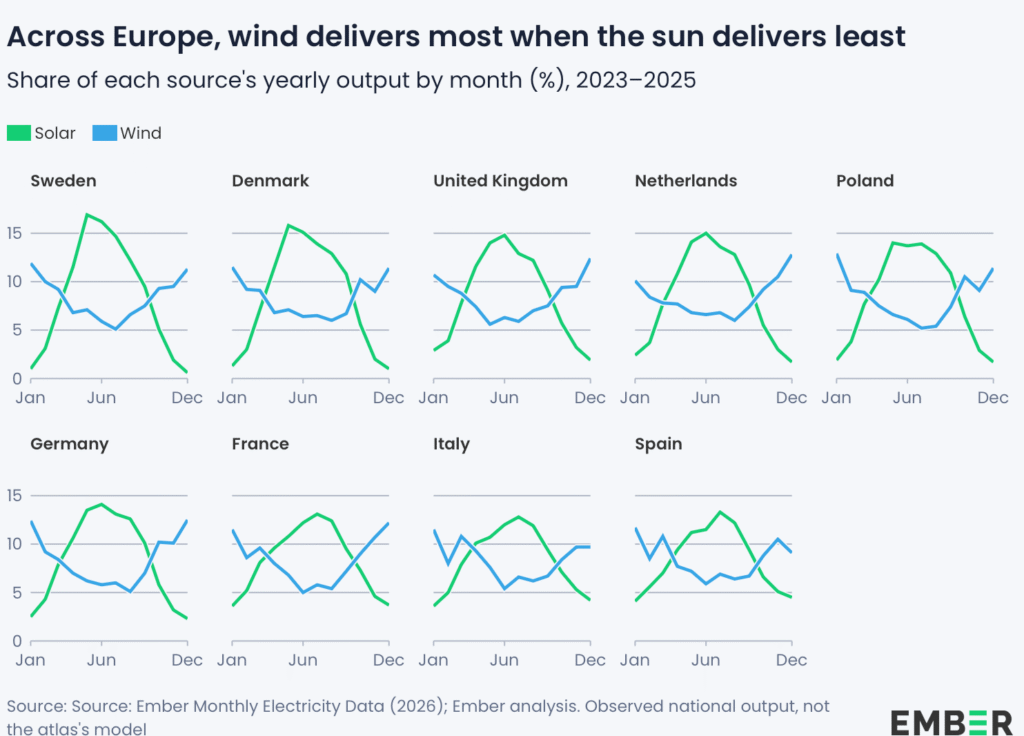
Percentage of annual generation by month and technology (%), 2023–2025
North of 45° latitude, adding wind power reduces the median cost of achieving 90% coverage by 40%, from $0.164/kWh (€0.149/kWh) to $0.099/kWh (€0.090/kWh).
In Chile and Argentina, south of 40°S, the reduction is approximately one-third, with costs falling from $0.094/kWh (€0.085/kWh) to $0.063/kWh (€0.057/kWh).
Periods of low generation
Ember also examines how frequently solar and wind power experience prolonged periods of low generation simultaneously. The study defines a “low-generation week” as seven consecutive days during which output from a given technology remains below half its average over the 10-year period analysed.
Globally, when weighted by electricity demand, a week of low solar generation occurs approximately four times a year, compared with eight times for wind. However, low-generation weeks for both technologies coincide, on average, only once every four years.
This complementarity is also evident during extreme weather conditions. In Germany, the worst combined solar and wind generation week of the decade produces a deficit equivalent to approximately five days of average electricity demand, compared with six days when either technology is used alone.
Reduced need for backup generation
Combining solar, wind and battery storage also reduces the need for backup generation during periods of insufficient renewable output.
According to the model, a solar-plus-storage system that meets 90% of electricity demand has an average cost of $0.105/kWh (€0.095/kWh).
At $0.098/kWh (€0.089/kWh), a system incorporating wind power can achieve 95% coverage, halving the amount of demand that must be met by backup generation.
For 90% coverage, the demand-weighted average cost of a solar-and-wind system with backup generation is $0.093/kWh (€0.084/kWh), compared with $0.140/kWh (€0.127/kWh) for a system relying solely on solar and batteries. With wind included, the average cost is $0.089/kWh (€0.081/kWh).
Replacing planned coal and gas capacity
Ember’s analysis identifies 845 GW of coal- and gas-fired power generation capacity currently in the planning stage. With wind power included, renewable energy systems combining solar, wind and battery storage could provide an alternative to 90% of this planned capacity at a cost below $0.100/kWh (€0.091/kWh), compared with 71% for systems without wind.
Of the planned capacity, 706 GW – approximately five-sixths of the total – is located in regions where solar, wind and battery storage could deliver firm power at less than $0.100/kWh (€0.091/kWh). Without wind power, that figure falls to 520 GW.
Outlook to 2050
Ember estimates that the cost of firm power generation from solar and wind, supported by battery storage, could fall from $0.089/kWh (€0.081/kWh) today to $0.052/kWh (€0.047/kWh) by 2050, based on the regional cost projections used in its model.
By 2050, adding wind power is projected to continue reducing the cost of firm electricity in regions accounting for two-thirds of global electricity demand. At latitudes north of 45°N, the median cost savings from including wind power could reach $0.024/kWh (€0.022/kWh).
The post Solar, wind and batteries can deliver firm power at $0.086/kWh, says Ember appeared first on pv magazine Global.


