
By Mike Steenhoek, Executive Director, Soy Transportation Coalition
U.S. soybean farmers continue demonstrating the ability to produce a robust and quality crop for domestic and international customers. These customers continue demonstrating strong demand for U.S. soybeans and the products derived from them. However, for farmers to be profitable, it is not simply confined to supply and demand. A third component is required, which is the connectivity between supply and demand. Our system of roads, bridges, highways, interstates, freight railroads, inland waterways, and ports provide that connectivity.
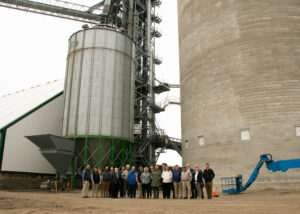
Soybean leaders tour Port Milwaukee. Photo credit: Bethany Baratta
Each link in the soybean supply chain is accompanied by a cost per bushel to transport the product from one location to another. When adding each of these costs – truck, rail, barge, ocean, etc. – a total transportation cost emerges. The higher that cost number is, the more our transportation system becomes an obstacle to farmer profitability. The lower that cost number is, the more our transportation system facilitates farmer profitability. Therefore, the goal of the Soy Transportation Coalition (STC), the American Soybean Association (ASA), and other soybean farmer organizations when formulating our transportation strategy is to promote “subtraction math” vs. “addition math.” Every initiative we promote and pursue should contribute to the ultimate outcome of subtracting the number of cents per bushel or ton of transporting soybeans and soy products. When we do so, U.S. soybean farmers are better positioned to be profitable.
A consistent effort in promoting subtraction math by the STC and ASA has been increasing the cost-effectiveness and efficiency of truck transportation by responsibly expanding weight limits. An amendment, introduced by Congressman Dusty Johnson (R-SD), was successfully included in the BUILD America 250 (Building Unrivaled Infrastructure and Long-term Development for America’s 250th) Act to allow states to participate in a voluntary pilot program to permit six axle, 91,000 lbs. semis to operate on federal interstates. ASA policy has long supported the utilization of six axle, 91,000 lbs. semis on the interstate system.
The increase in the cost of diesel fuel has been one more leak in the profitability bucket for farmers as they navigate the many challenges of remaining in business. A farmer with 1,000 acres (500 acres of soybeans and 500 acres of corn) with a 40-mile (80-mile roundtrip) journey to the initial delivery location will pay $2,000 more annually in diesel fuel to transport soybeans and corn to the elevator or processor due to the increase in fuel costs. A grain elevator handling six million bushels (two million bushels of soybeans and four million bushels of corn) with a 40-mile (80-mile roundtrip) journey will pay almost $100,000 more annually in diesel fuel. The increase in fuel costs is not simply a number on a sign. They have real consequences on the profitability of individual farmers and agriculture, in general.
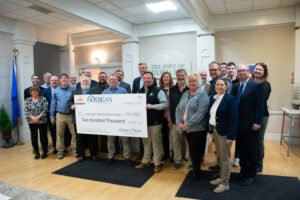
Soybean farmer leaders present a ceremonial check to help with costs to expand the Agriculture Maritime Export Facility at Port Milwaukee. Photo credit: Bethany Baratta
Another demonstration of soybean farmers promoting subtraction math was the Phase II expansion of the Agriculture Maritime Export Facility at Port Milwaukee. Soybean farmer leaders were in Milwaukee on March 31, 2026, to present a ceremonial check in the amount of $200,000 to help assume some of the pre-engineering, design, research, and analysis costs associated with the expansion. The facility, owned and operated by The DeLong Company, originally became operational in 2023. The Phase II expansion, which enhanced the capacity to export U.S. soybeans and soybean meal, was completed on April 2, 2026. By investing in this project, soybean farmer leaders helped address several major priorities of the soybean industry: increasing soybean meal export capacity, increasing resilience of the supply chain, and diversifying international markets.
ASA and other soybean farmer leaders promoted the facility’s grant application to the U.S. Maritime Administration – underscoring the argument that one of the most effective ways to promote the competitiveness of U.S. soybean and soy product exports is to strategically invest in its supply chain. The Phase II project expansion was ultimately the recipient of a $9.3 million grant through the U.S. Maritime Administration’s Port Infrastructure Development Program (PIDP). By promoting such projects, soybean farmers are promoting subtraction math due to the supply chain having increased capacity, greater resilience, and greater diversification.
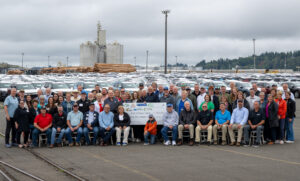
Port of Grays Harbor Check Presentation. Photo credit: Joe Murphy
A third example of soybean farmers promoting subtraction math is the expanded soybean meal export terminal at the Port of Grays Harbor in Aberdeen, Washington. AGP, the Omaha-based cooperative that owns and operates 11 soybean processing facilities in the Midwest, announced in March of 2022 a major expansion and upgrade to its export terminal at the Port of Grays Harbor. AGP constructed additional storage at its Terminal 2 facility and developed a new ship loader at Terminal 4. The expansion allows the AGP terminal to increase annual soybean meal exports from 3 million to over 6 million metric tons.
Given the significant benefit these investments provide to U.S. soybean farmers, soybean farmer leaders contributed $1.3 million to help offset some of the pre-engineering, design, and site development costs of the Port of Grays Harbor Terminal 4 Expansion and Redevelopment Project. In addition, ASA and other soybean farmer leaders supported the Port of Grays Harbor’s grant application to the U.S. Maritime Administration. The port was ultimately the recipient of a $25.5 million grant through the agency’s PIDP program. By helping promote the increase in soybean meal export capacity at the Port of Grays Harbor, subtraction math is concurrently being promoted.
While the U.S. soybean industry can appropriately claim to be the highest quality, most reliable supplier to the global marketplace, so much of the success of the industry is a function of cost – not only the cost of production, but also the cost of transportation. By making that cost of transportation smaller via promoting subtraction math, the STC, ASA, and other soybean farmer organizations are positioning the industry for success in a very uncertain marketplace.
The post Soybean Farmers Promote ‘Subtraction Math’ in Addressing Supply Chain Challenges appeared first on American Soybean Association.


