
For too long, we’ve asked the How2Recycle label to do too much of the lift on consumer education, GreenBlue Executive Director Paul Nowak said during a conversation with John Glasgow at SPC Impact 2026.
Despite the incredible reach and brand recognition of How2Recycle labels, ask any industry insider, and they’ll tell you that actual recovery rates are still wanting. Right now, about 76% of recyclable materials are being lost at the household level. Pair that with new regulations in California mandating recycling rates of 65% for materials, and the industry has our work cut out for us.
Here’s what we know: In small surveys, we see that labeling alone is effective at helping people recycle right. But when you pair the label with education, we see higher rates of correct recycling behavior and cleaner packaging disposal.
The code we need to crack now isn’t really about information; the label has that. We need to earn consumers’ attention, to compel them to look at the label and follow its instructions. At SPC Impact 2026, we heard from Vault49 Co-Founder John Glasgow on how the industry can do just that.
Meeting people where they are
Recycling isn’t easy. And communications suggesting otherwise might invalidate consumers’ everyday experiences of navigating conflicting signals, like two packaging formats that look the same, one with a label, one without. Plus, trust in institutions — recycling included — has reached all-time lows.
We know there’s a large segment of the population that’s thoughtful and pragmatic yet caught in a swirl of doubts about recycling’s efficacy, with limited bandwidth to figure out what to do with packaging. To reach them with clear, convenient sorting guidance, How2Recycle partnered with award-winning creative agency Vault49 to build a campaign. Our goal? Meet these consumers where they are and help them feel good about how they get waste and recycling out of their homes.
Attention before information
At SPC Impact, Glasgow unpacked the breakdown of traditional recycling and sustainability communications. In short, the green palettes, paper textures, and infographics are “getting lost in a sea of sameness.”
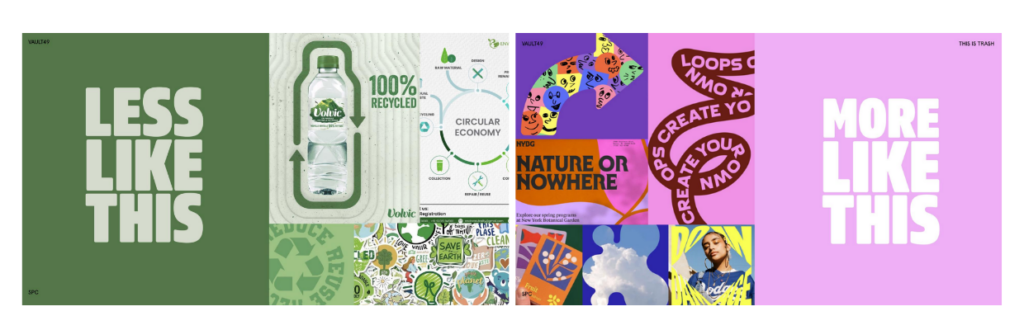 Worse yet, we’re seeing climate apathy make people feel powerless to make a meaningful difference. And to be clear, How2Recycle isn’t shifting the problems of waste and recycling onto individuals. Instead, we’re hoping to help people feel good about doing what they can right now, while continuing our work with parent nonprofit GreenBlue to help build stronger systems, clearer guidance, and more recoverable packaging to scale.
So, what’s the big idea We need radical joy. We need humor, positivity, and cultural familiarity that feels refreshingly novel in a sustainability setting.
We need to call out trash. 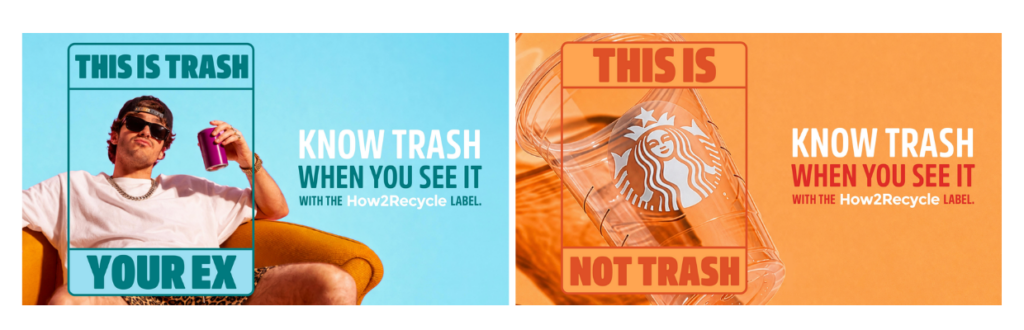
“Brick to forehead” messaging,
What makes this campaign different is that it’s designed to break through the fatigue and sameness that dominate sustainability messaging today. Instead of relying on guilt, statistics, or complicated instructions alone, the campaign leans into humor, positivity, and cultural familiarity to make recycling guidance feel visible, memorable, and actionable. As Glasgow put it during the session: “This is trash, this is not trash… It’s super simple, brick to forehead messaging.”
“We wanted this to look and feel different,” Glasgow said. The campaign strives to emphasize boldness, vibrancy, and celebration over doom and sacrifice — not to oversimplify or minimize recycling’s challenges, but to help people feel motivated to participate in the system that exists today while broader infrastructure improvements continue.
The campaign’s creative is modular, too. Glasgow showed how different regional activations could play on local affiliations, e.g., “The Orioles are Trash,” the Tennessee Titans? While we were in Nashville, they were certainly not trash.
What’s next for the campaign: Get involved
The session closed with a reminder that behavior change happens gradually. “We can’t expect habits to change overnight, but we can give people a place to start,” Glasgow said. Our goal isn’t necessarily to change every recycling behavior at once, but to help people make one better decision at a time.
Labeling is still a critical bridge helping get materials into the right stream. But if the industry wants to see more consistent participation in recovery systems — and judging by the conversations at SPC Impact, people do — recycling communication may need to become more visible, culturally relevant, and emotionally engaging.
Of course, we understand that behavior change is challenging, both for packaging professionals working to build clearer systems and for consumers trying to recycle right. This campaign alone won’t solve every recovery challenge overnight, but while broader infrastructure improvements continue, clear, engaging guidance is still an important step the industry can take today.
Want to take that step with us? Help shape the future of consumer recycling education and this campaign by getting involved with SPC’s Consumer Education Collaborative.
The post SPC Impact Session Recap: Newsflash, That’s Trash appeared first on GreenBlue.


