
Indian startup StrainX Bioworks has raised $13 million to scale a precision fermentation platform producing high-value nutritional and flavor ingredients as it prepares to enter its commercialization phase.
The round was led by Prime Venture Partners and Leo Capital with participation from Good Startup, Sparrow Capital, Sun Icon Ventures, Dholakia Ventures, and WindT (IIT Delhi) Angels.
StrainX hopes to partner with global food and beverage companies and ingredient suppliers that want to collaborate on product adoption, ingredient integration, and broader commercial partnerships.
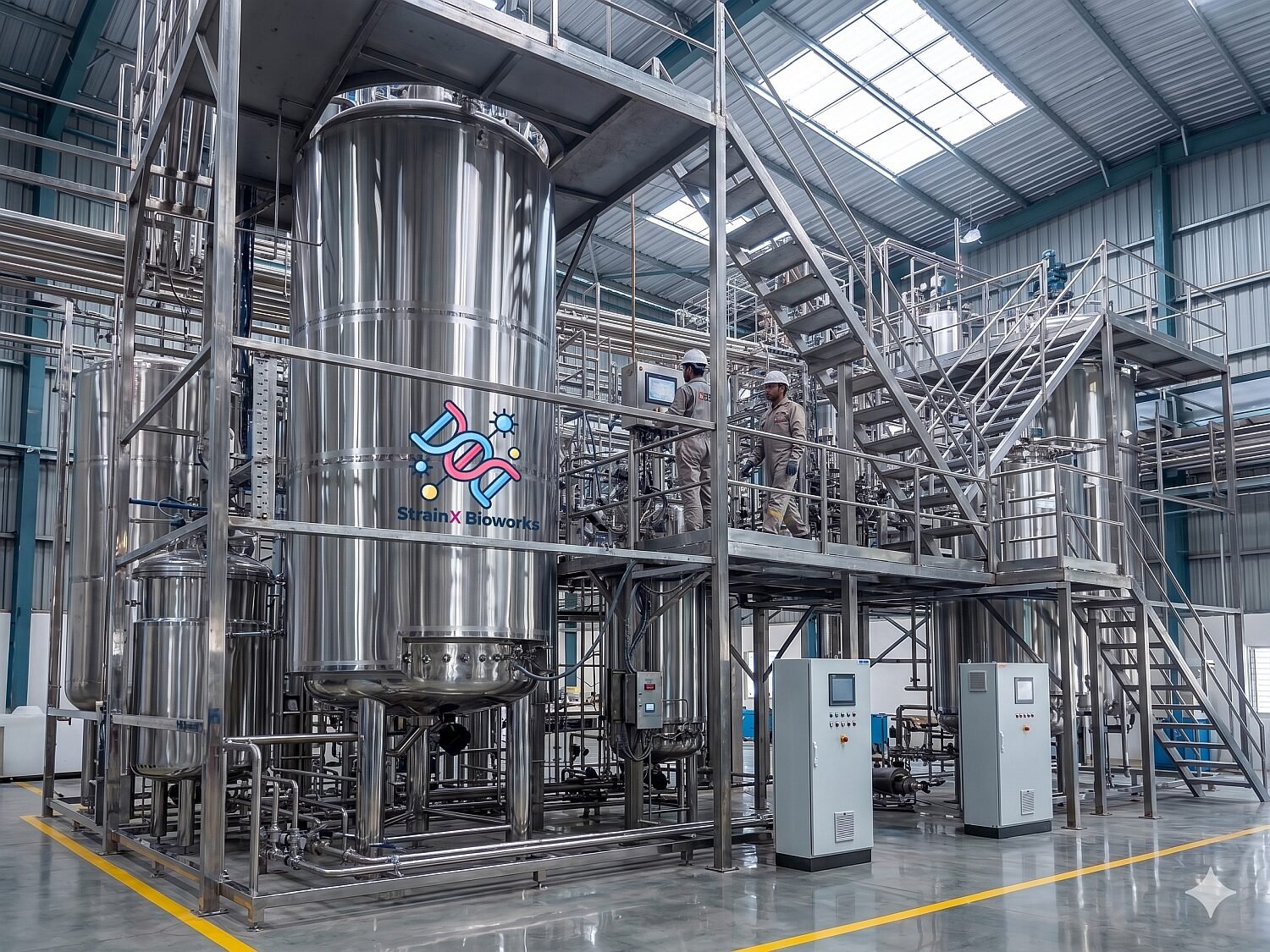
“We already have 10,000-liter fermentation capacity operational, and we have generated repeatable results at that level,” cofounder Akshay Mittal told AgFunderNews.
“Our facility in Bhopal has been designed modularly so that we can scale toward 100,000 liters in a structured and efficient way towards the middle to the end of next year.”
“India is evolving from a biotech manufacturing base into a global hub for synbio and precision fermentation based category defining innovation. At StrainX, we are building that future. Our focus has been to build the scientific and technical depth required to play at that level.” Alok Malaviya, PhD, cofounder and CTO, StrainX
A full-stack fermentation play
While firms such as Laurus Bio and Symbiotec are building new biomanufacturing capacity in India to offer CDMO (contract development and manufacturing organization) services to food and nutraceuticals clients, StrainX is building its capabilities in-house, said Mittal, who cofounded the firm with Alok Malaviya, PhD, in 2023.
“In India, there are still limited high-quality precision fermentation manufacturing options for non-pharma applications. Existing infrastructure is often designed around pharma or other categories, which does not always fit the downstream and process requirements of food proteins and ingredients.”
But equally importantly, he said, StrainX sees scale-up as a core part of its value proposition. “We develop our own technology, handle our own scale-up, build our own manufacturing, and take products through development and commercialization ourselves. We believe this level of integration is critical if you want to own the innovation, creating meaningful cost advantage and long-term value in food ingredients.”
Building in-house formulation expertise around the application of its ingredients is also key to its mission, said Mittal, especially for molecules that customers do not have much experience with.
“Our view is that simply supplying an ingredient sample and leaving all the application work to the customer is not enough. We believe adoption happens much faster if we do a significant part of that work ourselves or together with the customers.”
StrainX has not publicly disclosed the first two ingredients it aims to commercialize but has already secured self-GRAS status for one in the US and submitted a dossier to the FDA. Initial target markets will include the US and India, he said.
With respect to our first molecule, we have trials going on with maybe 20-25 companies already both in India and the US and we should be able to commercialize in next few months. The second molecule is 12-18 months later.
“Our goal is to build a globally relevant precision fermentation and food ingredient company from India. We want to scale manufacturing, commercialize multiple molecules over time, and build long-term strategic relationships around our platform.”
India’s fermentation edge
New biomanufacturing capacity tailored to food and nutra ingredients rather than pharmaceuticals is needed around the globe, said Mittal. However, India has key advantages as a manufacturing base due to its cost structure, existing manufacturing ecosystem, equipment and supplier base, talent pool, and access to raw materials.
“I believe that India is going to be the fermentation capital of the world. There are multiple reasons. One is that manufacturing costs, both the setup and opex, are at least one third or one quarter of what it costs in Europe or the US. Installation and commissioning are also a lot less expensive here. Two, there’s the ecosystem and the talent here both to set up and run these kinds of facilities. And three, we have easy access to the raw materials you need to go in the fermentation, carbon, nitrogen, phosphorus, which can be procured at a very competitive price.”
The Indian government has also been very supportive of biotechnology and biomanufacturing, said Mittal, who believes that some non-dilutive funding from the government, coupled with the $13 million capital infusion, could “take us to 100,000 liters very comfortably.”
He added: “But it won’t be all in one go. We have designed the facility to take it to, say, 40,000-L and then 80,000-L and then 100,000-L. The utilities and downstream processing have been designed for complete setup, but fermentation and some of the other critical equipment can be scaled in a modular fashion.”
For downstream processing, the facility will have centrifugation, microfiltration, ultra filtration, ion exchange chromatography, nano filtration, and spray drying, he said.
Further reading:
India will see IPOs in agritech before America or Europe, says Omnivore’s Mark Kahn
Planetary explores collaboration to unlock low-cost mycoprotein production in India
Biomanufacturing’s valley of death has a new bridge in India, says Symbiotec
The post StrainX Bioworks nets $13m to scale biomanufacturing platform: ‘India is going to be the fermentation capital of the world’ appeared first on AgFunderNews.


