
Stripe rust has once again been identified across Ontario’s winter wheat acres.
While yield impact will vary based on infection timing and effective control, experts say the pathogen is adapting to warmer temperatures.
Why it matters
Stripe rust is a serious wheat pathogen, and its adaptation to warmer temperatures gives it more of the season to grow and reproduce — raising the risk to Ontario’s winter wheat.
Stripe rust is a fungal disease that can, when severe, reduce wheat yields by 70 per cent or more. Originating in the southern United States, the disease is an “obligate fungus,” meaning it requires a living host to grow and reproduce. Most Ontario infections are the result of stripe rust spores reaching the province via the wind.
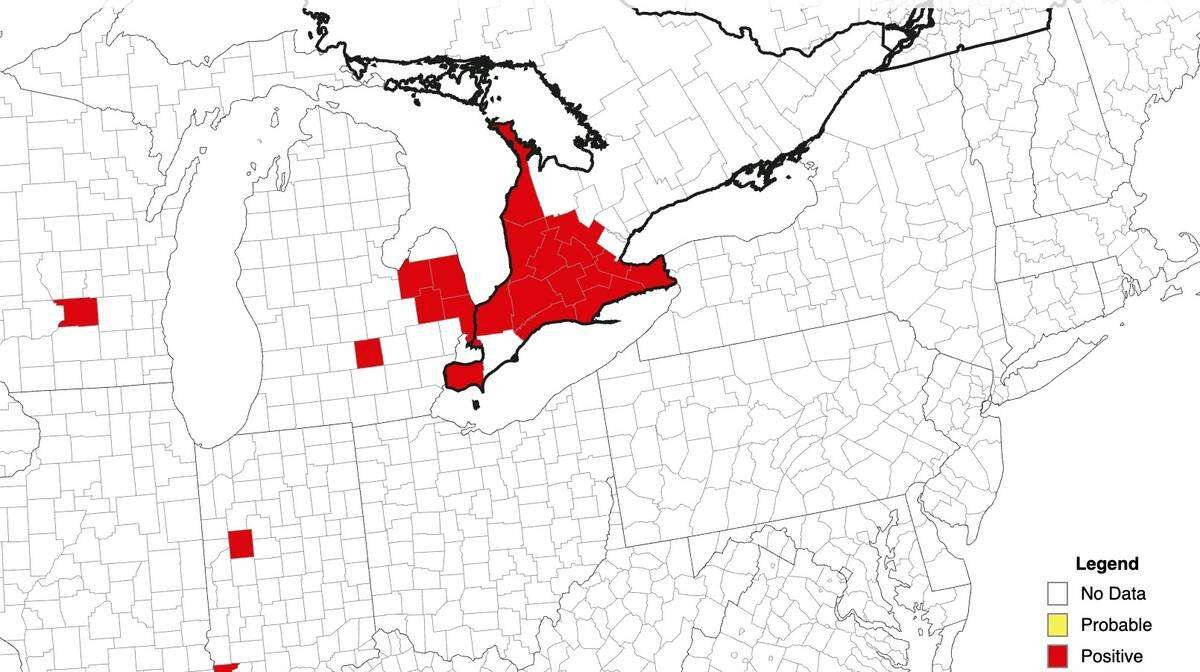
As of early June, Field Crop News reports stripe rust infections in the counties of Huron, Oxford, Wellington, Bruce, Perth, Waterloo, Brant, Essex, Lambton, Middlesex, Elgin, Hamilton, Niagara and Haldimand. Previous early stripe rust infections occurred mid-May in 2016, 2017, 2024 and early May in 2025. Tolerant varieties and foliar fungicides kept the diseases at bay in those years.
Overwintering a possibility
Albert Tenuta, field crop pathologist with the Ontario Ministry of Agriculture, Food, and Agribusiness, says the geographical spread and timing of stripe rust identification suggest the majority of infections this year were the result of airborne spores reaching Canadian shores. Individual cases of overwintered stripe rust are possible, however.
In Huron and Bruce County, independent agronomist and certified crop advisor Kim Lawlor says the disease very well could have overwintered.
“Some of the winter wheat went in and had a fair bit of growth to it. There was good biomass under that snow,” she says, adding anyone with spring wheat “will definitely want to watch it” for signs of infection.
“Are we properly controlling volunteer wheat post-harvest, for example? Potentially, we’re just doing things that help it appear more regularly…Once it’s already in the crop, it really does need to be preventatively treated.”
Tenuta stated some stripe rust populations are adapting to hotter temperatures. Where growth once ceased between 10 and 12 degrees Celsius, now it can continue “into the 20s.”
What to look for: yellow-orange pustules running in stripes along the leaf
Yield risk: up to 70 per cent or more in severe infections
What’s new: some populations now keep growing into the 20s °C, up from a 10–12 °C ceiling
Control: tolerant varieties and foliar fungicide; once it’s in the crop, treat preventively
Submit a sample: contact OMAFA’s Albert Tenuta and Joanna Follings, or Gursahib Singh at the University of Guelph
Pathogen strains
Wheat varieties tolerant to stripe rust and in-season fungicide applications are tools that growers can use to limit risk, but there are concerns that the pathogen could form new races bypassing the tolerances of some previously effective wheat varieties. This is a concern in the Pacific Northwest, in particular, given its climate and year-round “green bridge” that enables stripe rust reproduction. It does not appear that wheat growers need to worry this season.
“We’re working on race profiling from this year. We see from last year’s results that it’s still the same profile we’ve seen. It’s the same story in the United States. We do not see that shift. Varieties are holding in terms of resistance genes,” said Tenuta.
“We’re working closely with United States Department of Agriculture, Washington State and others in categorizing race profiles and comparing them. We’re now in the process of building that capacity in Ontario as well.”
Growers with stripe rust in their wheat are invited to provide samples for analysis. Contact Albert Tenuta and Joanna Follings (ministry cereals specialist), or Gursahib Singh (field crop pathology, University of Guelph) for more information.
The post Stripe rust is back in Ontario’s winter wheat — and it’s adapting to warmer temperatures appeared first on Farmtario.


