
Cocoa is one of the world’s most valuable agricultural commodities, with global production exceeding 5.2 million metric tons in 2023. Around 70% of cocoa comes from West Africa, mainly Côte d’Ivoire and Ghana, where millions of smallholder farmers depend on it for their livelihoods.
However, challenges like deforestation, child labor, and volatile prices threaten both the industry and farming communities. With global chocolate consumption projected to grow by over 4% annually, the importance of shifting towards sustainable cocoa farming has never been greater.
Understanding of Sustainable Cocoa Farming
Sustainable cocoa farming is a holistic approach to growing cocoa that balances environmental health, social equity, and economic viability. Instead of maximizing short-term yields by clearing forests and using heavy chemicals, sustainable practices aim to build resilient agroecosystems. This means protecting forests (often home to cocoa farms), preserving wildlife, ensuring fair incomes for farmers, and empowering rural communities.
In contrast, traditional cocoa farming has often led to rapid deforestation, soil exhaustion, and farmer poverty. For example, an estimated 60% of global cocoa comes from Cote d’Ivoire and Ghana, where intensive farming has wiped out much of the native forest.
Today most West African cocoa farmers earn less than $1 a day, and only about 10–13% of cocoa households meet a “living income” benchmark.
Millions of families (about 6 million people worldwide) depend on cocoa for their livelihood, so the crisis of low prices, poverty and declining yields is also a threat to the future of chocolate itself. The goal of sustainability is not just ethical – it’s essential.
By restoring soil, planting shade trees, and diversifying incomes, sustainable cocoa farming secures higher-quality beans and more stable livelihoods for farmers. In the pages that follow, we explore how farmers, companies, governments and consumers are working together (and sometimes still struggling) to make cocoa farming sustainable.
Sustainable Cocoa Farming Three Pillars
Sustainable cocoa farming is a holistic approach that ensures the long-term health of the cocoa industry by focusing on three interconnected areas: environmental protection, social equity, and economic viability. It’s a stark contrast to the old, destructive methods that prioritize high yields at all costs. The conventional approach, which often involves clearing entire forests to plant cocoa in full sun, has a devastating environmental footprint.
Between 2001 and 2015, Ghana lost over a third of its forest cover to cocoa expansion,
and this is a challenge that continues to threaten biodiversity and contribute to climate change. Sustainable practices, on the other hand, are designed to heal the land and empower the farmers, creating a more resilient and equitable system for everyone involved.
1. Environmental Sustainability
Globally, around 90% of cocoa is produced by 5–6 million smallholder farmers, with West Africa contributing about two-thirds of total supply. However, this has come at a steep environmental cost, as an estimated 80% of forests in Côte d’Ivoire have been lost since 1960 largely due to cocoa expansion.
In recent years, governments and industry programs have planted millions of shade trees and promoted agroforestry systems to restore biodiversity and sequester carbon. These efforts show that environmental sustainability is now central to the survival of cocoa farming.
i. Agroforestry and Shade-Grown Cocoa: One key strategy is to grow cocoa under a canopy of shade trees rather than in open sun monocultures. Shade-grown systems retain a multi-layered canopy of native and fruit trees that provide habitat for wildlife, protect pollinators, and keep soil fertile. By mimicking natural forests, agroforestry dramatically improves biodiversity – farms with even 30–40% canopy cover support far more birds and beneficial insects than bare fields.
Such mixed plantings also conserve water and moderate microclimate (trees buffer heat and wind), which helps cocoa trees survive in a changing climate. In fact, industry programs now actively supply millions of tree seedlings to cocoa farmers: for example, Ghana and Côte d’Ivoire distributed over 10 million young trees to farmers in recent years to expand cocoa agroforests and boost carbon storage.
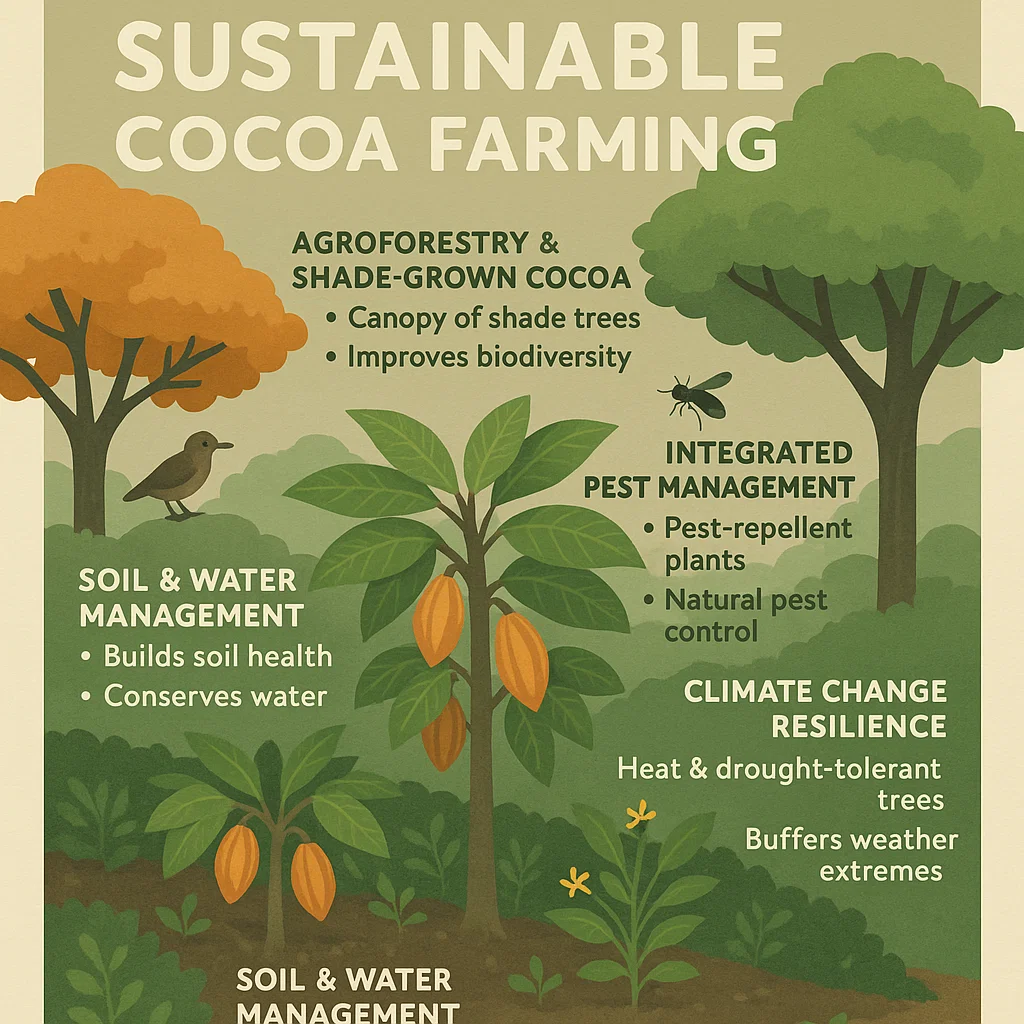
ii. Soil and Water Management: Healthy soil is crucial for long-term yields. Sustainable farms build soil organic matter through composting, cover crops, and mulching instead of relying on synthetic fertilizers. This not only keeps nutrients in the ground but also prevents erosion and runoff.
Efficient water management is also practiced: farmers may use rainwater harvesting and drip irrigation to conserve moisture, and they avoid polluting streams with runoff from fertilizers or pesticides.
iii. Reducing Chemicals with Integrated Pest Management: Conventional cocoa often uses chemical pesticides to control bugs and fungal diseases. Sustainable growers minimize pesticides by using Integrated Pest Management (IPM): for example, planting pest-repellent plants (like marigolds), releasing natural predators (such as predatory ants or wasps), and pruning diseased branches.
Research suggests that shaded cocoa systems inherently need fewer chemicals – farms with partial shade tend to have fewer pest outbreaks and thus require less pesticide use. In this way, agroforestry and IPM protect water sources and farm workers’ health by cutting agrochemical use.
iv. Climate Change Resilience: Cocoa is highly sensitive to heat, drought and rainfall shifts. Climate-smart practices are increasingly needed. Farmers adopt drought-tolerant cocoa tree varieties and plant a diversity of shade trees that buffer weather extremes. The canopy reduces heat stress on young cocoa trees, and richer soils hold water longer during dry spells.
In addition, sustainable farms actively sequester carbon: for instance, Ghana’s recent climate program paid farmers nearly $5 million for sequestering about 972,000 tons of CO₂ by improving cocoa agroforestry. These efforts help make cocoa farms part of the climate solution rather than a problem.
2. Social Sustainability
About 40–50 million people worldwide depend on cocoa for their livelihoods, yet poverty remains widespread among cocoa households. These social issues underline why sustainability in cocoa farming must address not only the environment but also human well-being and equity.
Studies show that the average cocoa farmer in West Africa earns less than 6% of the final price of a chocolate bar, while only about 10–13% of households meet the living income benchmark.
i. Living Income for Farmers: A core goal of sustainable cocoa is to ensure farmers earn a living income – enough to cover food, housing, education and healthcare. Currently the vast majority do not. For example, only about 13% of cocoa farm households in Côte d’Ivoire and 10% in Ghana meet living income levels. By raising productivity and providing premium prices, sustainable initiatives aim to bridge this gap.
Cooperative training programs teach good agricultural practices (like pruning old trees and replanting high-yielding varieties), which can roughly double yields. Even so, typical farm outputs today are often only 400–500 kg of cocoa beans per hectare, whereas models for a living income assume about 800 kg/ha. Improving farms and giving farmers price premiums (through certifications or direct contracts) are therefore crucial steps toward true living incomes.
ii. Community Development and Farmers’ Well-being: Sustainability also means investing in rural communities. Fairtrade premiums and corporate sustainability funds often pay for village schools, clean water projects, health clinics and farmer field schools. For example, some companies support Village Savings and Loan Associations (VSLAs) – local credit groups where farmers pool savings and can borrow small loans.
In one recent year, nearly 7,925 cocoa farmers (77% of them women) were organized into 293 VSLA groups, providing access to credit and training in financial management.
Such community-driven development builds infrastructure and social capital, giving farming families better education and health opportunities.
iii. Labor Rights and Child Labor: The cocoa sector has faced intense scrutiny over labor abuses, especially child labor. Sustainable cocoa farming requires ending exploitative practices. International agencies estimate about 1.56 million children are still working in hazardous conditions on cocoa farms in Ghana and Côte d’Ivoire – countries that together produce 60% of the world’s cocoa.
Sustainable programs aim to eliminate these worst forms of child labor by improving household incomes and providing education. Similarly, forced labor and trafficking must be eradicated. Fair contracts and legal labor safeguards are part of the solution.
iv. Gender Equity: Women are vital to cocoa production but often marginalized. Surveys in Côte d’Ivoire show women perform about 70% of farm labor yet receive only around 20% of the income. Sustainable farming initiatives work to empower women by ensuring equal access to land, inputs and training.
For example, women’s leadership programs in co-ops (like Fairtrade Africa’s Women’s School of Leadership) help women negotiate better terms and take on leadership roles. Achieving gender equity boosts overall productivity and family well-being.
3. Economic Sustainability
The global cocoa and chocolate industry is valued at more than $130 billion annually, but the benefits are unevenly shared. Many cocoa farmers earn less than $1.50 a day despite supplying a product that generates massive profits further along the value chain. Sustainable economic strategies are therefore critical to bridge the income gap and make cocoa farming viable for future generations.
i. Improving Productivity and Yields: A sustainable cocoa farm must be profitable. Farmers adopt better planting material and farm management (sustainable intensification). This includes planting high-yielding, disease-resistant cocoa clones, spacing trees optimally, and using organic fertilizers. Such “Good Agricultural Practices” can significantly raise yields without harming the environment.
As noted, many farms are still far below potential: yields of ~400–500 kg/ha suggest a large opportunity for improvement. Sustainable projects often provide nursery grafted seedlings and training so that underproductive farms can be rejuvenated. The goal is to get more beans from each farm to increase income without expanding into forests.
ii. Diversification of Income: Relying on cocoa alone is risky, so sustainable farmers often grow other crops alongside cocoa. Intercropping with plantains, cassava, coffee, or timber trees provides food, income and shade. Diversification gives farmers a safety net if cocoa prices fall or if a crop fails.
Support programs back this approach: in one initiative, 15,087 farmers received assistance to develop alternative income enterprises such as fruit orchards or handicrafts, based on tailored business plans. Over 7,900 farmers were helped to form micro-enterprises using cocoa byproducts (e.g. roasting leftover shells into charcoal). By diversifying, farmers can reduce poverty and invest more in their cocoa plots.
iii. Access to Finance: Transitioning to sustainable methods can require upfront investment (e.g. new seedlings, compost pits, irrigation). Microfinance and credit schemes help farmers make these investments. Beyond VSLAs, some programs link farmers directly to finance: for example, special credit lines allow co-ops to get loans for farm equipment.
These financial tools make it easier for farmers to adopt new techniques and protect against price shocks. Moreover, committing to long-term buyer relationships (forward contracts, direct trade) gives farmers more predictable income than selling spot on volatile markets.
iv. Post-Harvest Processing and Value Addition: Careful handling after harvest can greatly boost farmers’ income. Proper fermentation of cocoa beans (in piles or boxes) and careful drying (on solar tables or beds) improve bean quality, which fetches higher prices.
Sustainable projects often set up communal fermentation facilities or train farmers in good post-harvest practices. For example, cooperatives may build drying houses to protect beans from rain and mold, ensuring premium-grade cocoa. These investments in quality help farmers earn more for each kilo of beans. Large chocolate companies have also made sourcing commitments. Many have pledged to buy only “deforestation.
Implementation and Certification
Over 3.5 million farmers are now involved in certified cocoa schemes such as
- Fairtrade
- Rainforest Alliance
- Organic. Certification
has become a key driver of sustainability, with consumers increasingly demanding traceable and responsibly sourced chocolate. At the same time, governments and companies are building stronger systems to enforce sustainable practices, with the EU’s Deforestation Regulation set to transform cocoa supply chains by 2025.
To ensure best practices, many farmers and companies work under sustainability standards. Fairtrade, Rainforest Alliance (UTZ), and Organic certifications each set requirements on farm management, labor and environmental care. For example,
- Fairtrade guarantees a minimum price for beans and pays a “Fairtrade Premium” that farmers can invest in community projects or farm improvements..
- Rainforest Alliance focuses strongly on biodiversity and worker welfare, requiring shade trees, wildlife corridors, no child labor, and good working conditions.
- Organic certification ensures no synthetic pesticides or fertilizers are used. Direct trade models (used by some artisan chocolate makers) go a step further: farmers sell directly to buyers at negotiated prices, cutting out middlemen.

These certifications have pros and cons. They can deliver higher prices and training to farmers, but not all farmers can afford certification fees or meet the requirements. Studies show that certified cocoa can command premium prices, but critics note that benefits don’t always reach the poorest farmers.
Governments and NGOs also play key roles. The governments of Côte d’Ivoire and Ghana have joined the Cocoa & Forests Initiative (CFI), a partnership with dozens of chocolate companies, to enforce a deforestation-free cocoa sector. This multi stakeholder initiative has led to new traceability systems and forest monitoring tools.
For example, Ghana recently received about $5 million for verified carbon reductions on cocoa farms. NGOs like USAID, Unilever’s partnership programs, and international cooperatives provide field schools and innovation grants.tion-free” and fully traceable cocoa by dates set under the EU Deforestation Regulation (coming into force in 2025).
To meet these goals, companies fund training programs, yield improvements, and forest restoration on the ground. The industry now widely recognizes that protecting forests and farmers’ livelihoods secures future cocoa supply.
Challenges & Barriers of Sustainable Cocoa Farming
Despite progress, about 70% of cocoa farmers in West Africa remain below the poverty line, and deforestation continues in some cocoa regions. In addition, the average cocoa farmer is aging (around 55 years old in Ghana), and younger generations are leaving farming. These realities highlight the many barriers that must still be overcome to achieve sustainable cocoa. Achieving sustainable cocoa is not easy.
- Upfront costs are high – adopting agroforestry or buying better seedlings requires investment beyond what many cash-strapped farmers have.
- Without external support or credit, farmers often stick to slash-and-burn methods that harm the environment.
- Training and knowledge gaps are another barrier: many remote farmers have limited access to information on sustainable techniques. Extension services and field schools are helping, but cannot reach every village.
- Land tenure issues also complicate matters. In some regions, farmers lack formal title to their land.
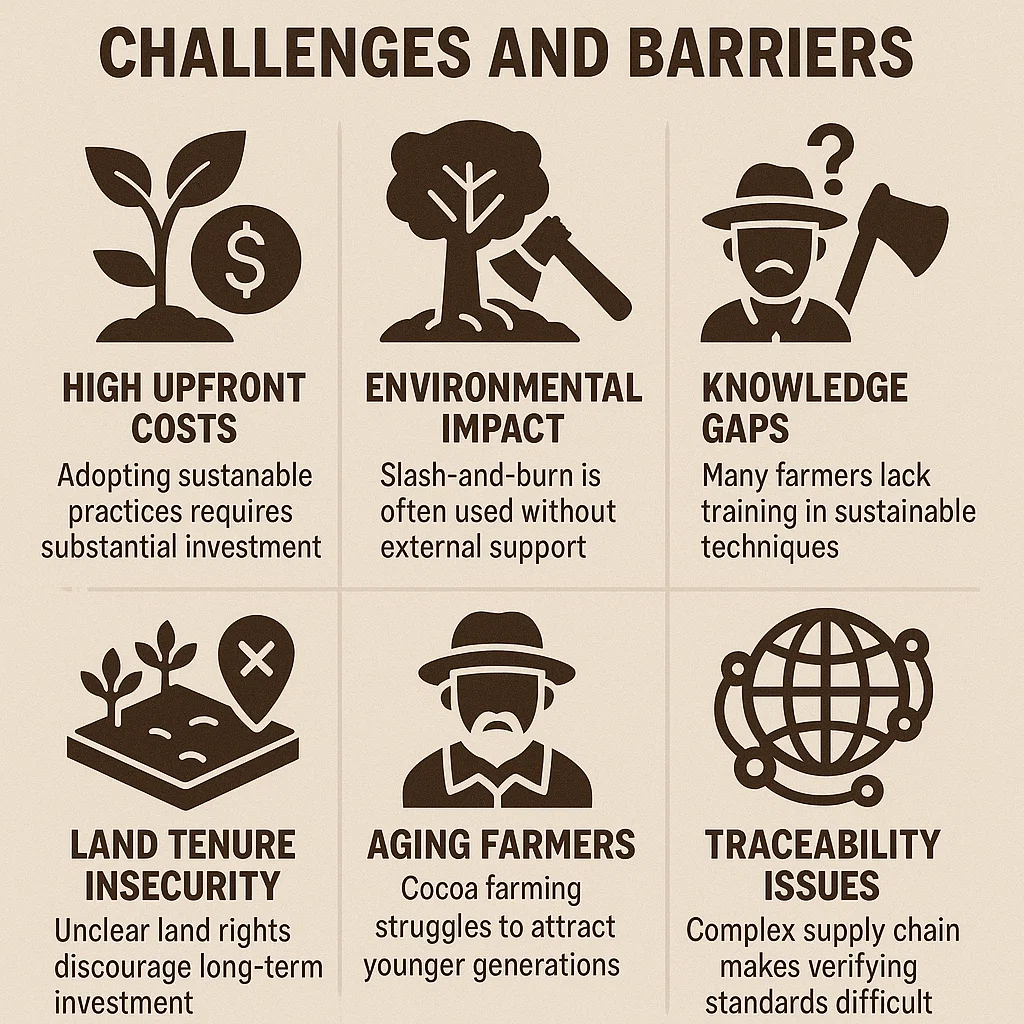
This insecurity discourages long-term investments like tree planting; if a farmer might lose the land, there is less incentive to improve it. Furthermore, the cocoa workforce is aging. In Ghana, for example, the average cocoa farmer is around 55 years old, while many young people leave farming for other jobs. Attracting youth to cocoa is difficult when wages are low and farming is hard work.
Lastly, the complex global supply chain makes it hard to verify that sustainability standards are actually followed. A single kilogram of chocolate may contain beans from hundreds of small farms. Tracing every bean back to its farm and forest condition is a technical challenge.
Blockchain and satellite tracing (as in pilot projects in Colombia and Peru) are promising tools, but they are still being rolled out. Until full traceability is ensured, some unsustainable cocoa may still enter the supply stream, undermining farmers who do the right thing.
Innovations and Future of Sustainable Cocoa
The cocoa industry is rapidly transforming, with technology, genetic innovation, and consumer awareness driving change. New digital platforms, blockchain traceability, and AI-based tools are expected to reshape how cocoa is grown, traded, and certified over the next decade. These innovations give hope that sustainability goals can be met faster and more effectively.
a. New technologies and ideas are helping chart a sustainable future for cocoa. Digital tools are on the rise: farmers can now use mobile apps to log farm data, receive weather forecasts, and learn good practices. For instance, the GIZ “Open Cocoa Chain” project uses a smartphone app and blockchain to certify in real time that cocoa plots are deforestation-free. Transparent traceability systems like this will soon be needed to meet regulations like the EU’s anti-deforestation law.
b. Artificial Intelligence (AI) and data analytics also offer help. Studies show AI can improve smallholders’ incomes by providing real-time information on market prices and weather, and even detect pests or diseases early. Some research tools use machine learning to predict farm yields or optimize input use.
Satellite and drone monitoring, powered by AI, make it easier to spot illegal clearing of forests or to identify stressed trees. Data-driven decision tools are still new to many farmers, but those who use them can adapt faster to climate changes.
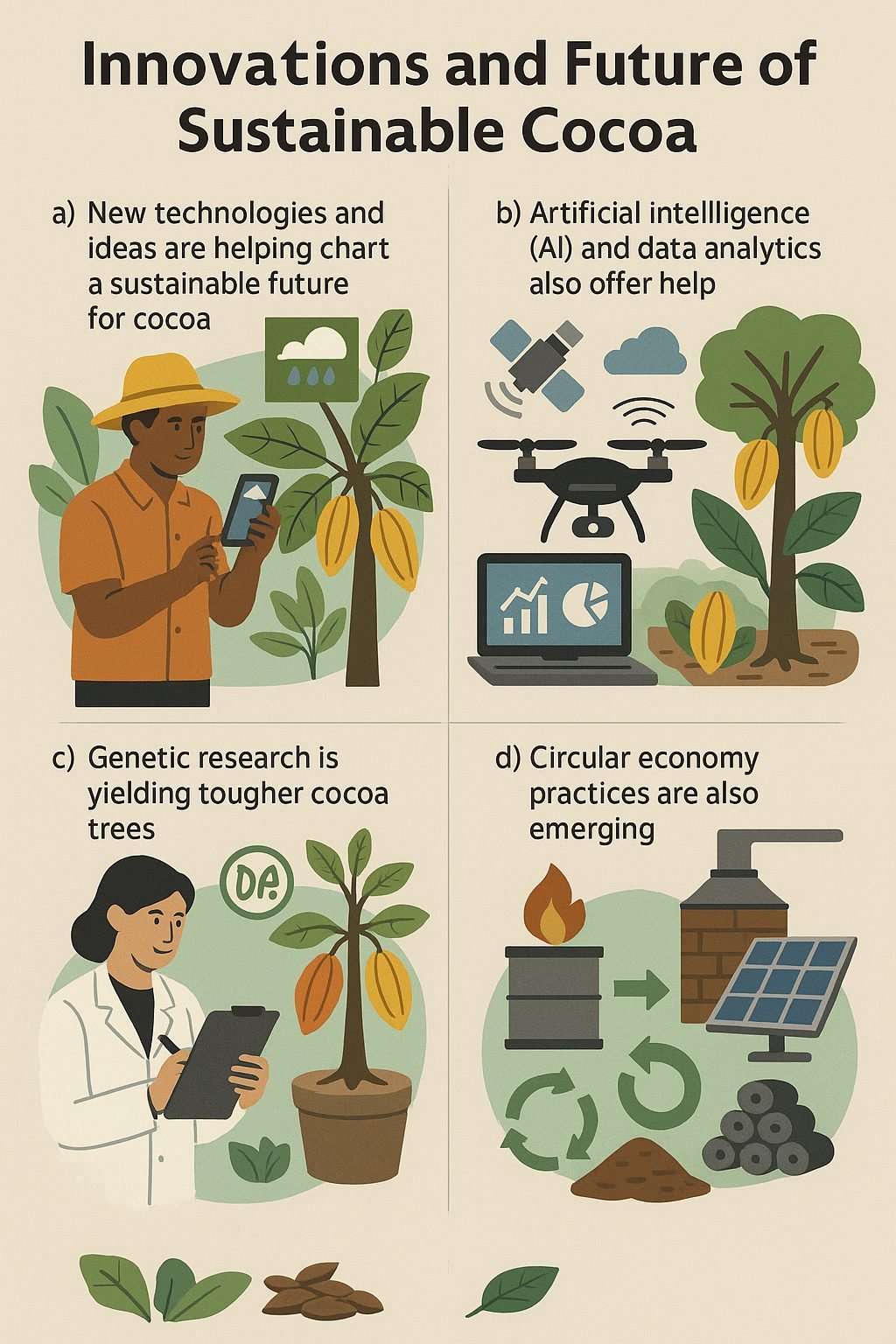
c. Genetic research is yielding tougher cocoa trees. Scientists are breeding varieties that resist diseases like
- Swollen Shoot Virus
- tolerate higher temperatures.
Over the next decade, improved planting materials could significantly boost yields without expanding farmland.
d. Circular economy practices are also emerging. Instead of throwing away cocoa pod husks, some companies are converting them into useful products. For example, efforts with Cargill and others are turning cocoa waste into green charcoal, bio-fertilizers and potash, creating new income streams for farmers. Reducing waste in processing – and even using energy-efficient solar dryers – can cut the sector’s carbon footprint.
Finally, consumer trends are part of the equation. Modern consumers are increasingly aware of sustainability. As demand grows for “bean-to-bar” chocolate and certified products, farmers gain more leverage. Empowered consumers (in Europe, the U.S., and Asia) can influence companies to adopt better practices by choosing brands with transparent sourcing.
Above all, sustainable cocoa farming is about hope: a hope that the next generation of children can enjoy chocolate grown without clearing forests or forcing kids to work. That farmers earn enough to send their children to school rather than fields. And that forests and wildlife in cocoa regions can recover and flourish. The path is complex, but progress is underway on all fronts – from agroforestry nurseries to blockchain apps. By working together, everyone in the chocolate value chain can ensure a future where cocoa farmers and forests thrive side by side.
Call to Action
The journey toward a fully sustainable cocoa sector requires a collective effort. It’s a vision for a future where chocolate is not just a delicious treat, but a product that helps the planet and empowers the people who make it possible.
For Consumers: The power is in your hands. Choose brands that are transparent about their sourcing and actively support sustainable practices. Look for certifications and learn about the direct trade brands that are committed to paying a fair price to farmers. By demanding better, you send a clear signal to the market.
For Companies: The business case for sustainability is clear. A resilient and thriving supply chain is a secure one. Investing in farmer training, fair wages, and environmental conservation is not just an ethical choice; it’s a smart business decision that protects your future.
For Farmers: Embracing new techniques and forming cooperatives can provide the strength and knowledge needed to navigate the changing landscape.
Ultimately, sustainable cocoa farming is a recipe for a better world. It proves that it is possible to create a product that is not only good for us but also good for the planet and its people. By working together, we can ensure that the story of chocolate is a sweet one for everyone, from the farmer to the final consumer.
Conclusion
Sustainability in cocoa farming is no longer optional – it is vital for the future of chocolate. By addressing environmental health, social justice and economic resilience together, we can transform a fragile system into one that thrives. Consumers can play their part by choosing chocolate certified as sustainable or by supporting brands that invest in farmers.
Companies must continue to invest in long-term supply chain improvements, since a healthy rainforest and prosperous farmer family are worth far more than short-term profit. And policymakers in producing countries should enforce land and labor laws and support smallholders with training and credits.


