
The Symphony Nozzle build-on system from Agco’s Precision Planting arm drew significant attention at the Ottawa Valley Farm Show.
The five-nozzle pulse-width modulation (PWM) system provides nozzle-by-nozzle control, independent of rate and pressure, to maintain consistent droplet size.
WHY IT MATTERS: The technology aims to maximize efficiency, reduce input costs, increase yield and expand as Precision Planting develops and releases new accessories.
Jordan Wallace, GPS Ontario’s co-owner, explained there are four system versions, starting with the Symphony Nozzle, which provides row-by-row, or nozzle-by-nozzle, section and pressure control.
“We can baby-step our way into the technology as growers want to evolve into PWM nozzle control with turn compensations right up to green-on-green spray technology — the ability to auto-detect a weed into the actual canopy itself,” said Wallace. “They (farmers) don’t have to change their fleet to be able to take advantage of the technology.”
The total investment is about US$170,000 or C$233,000 (Symphony nozzles: C$68,500, Symphony rate cameras: C$82,200, Symphony Spot: US$82,200, plus taxes), making advanced spray technology more accessible. This compares to around $1 million for a new sprayer boom, offering significant savings while delivering advanced spraying benefits.
“In eastern Ontario, for example, last year we had a devastating crop year, so the cash flow isn’t there to go and buy a new million-dollar machine on a five-year financing,” said Wallace. “A Symphony nozzle at US$170,000 is opening up that technology for that grower to be as profitable as possible, reducing as many input costs as possible and gaining as much yield as possible.”
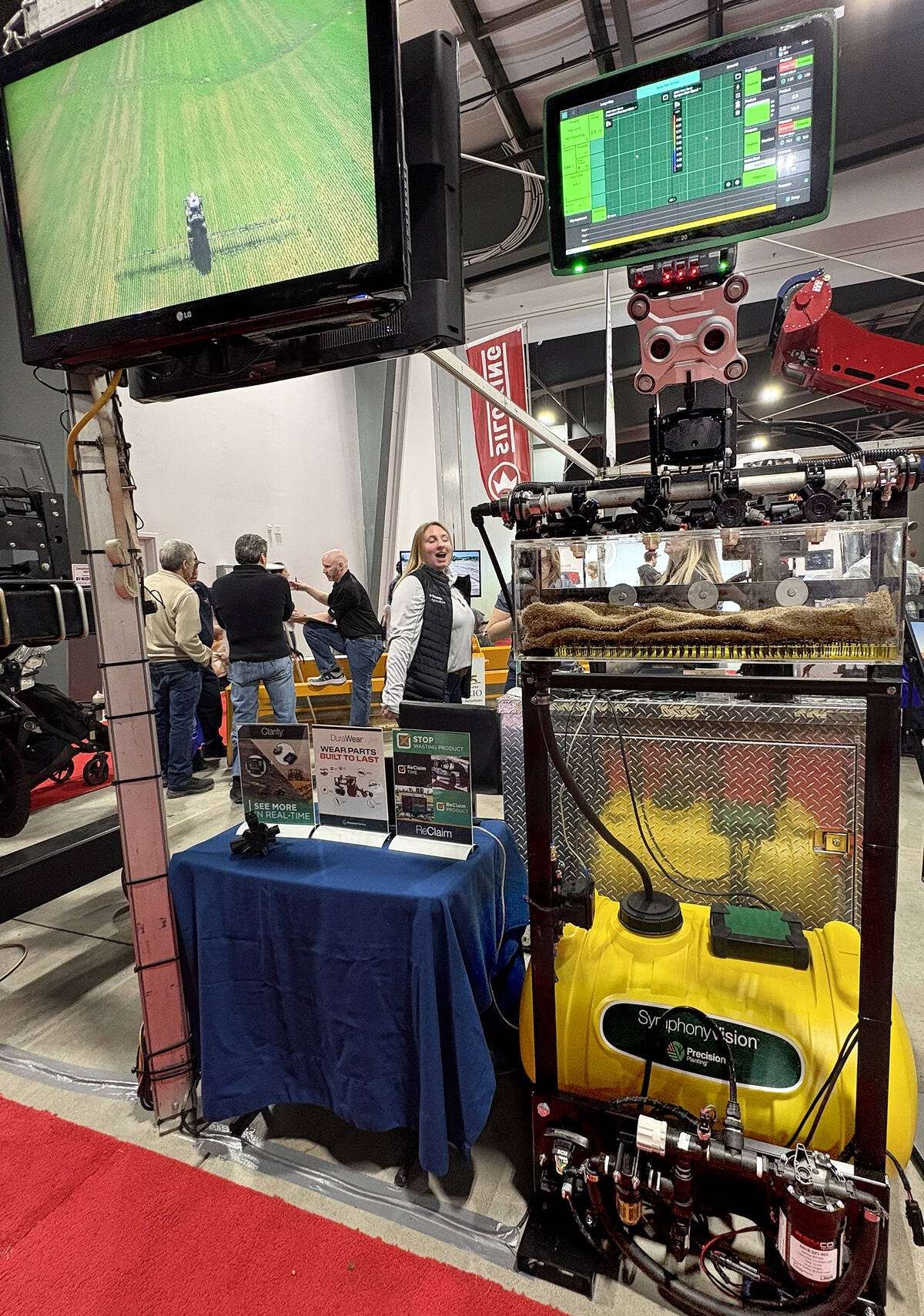
If the nozzles are connected to Precision Planting’s Gen 3 20/20 monitor, operators receive real-time metrics on individual nozzle duty cycles, along with rate and pressure adjustments, to quickly adapt to a field’s needs.
“This is one of the products that we’re really excited about for this year, because we see a huge advancement in some scenarios,” he said. “Some of the data sets we’ve looked at are anywhere between $20 and $25 an acre in chemical savings and application savings.”
Controlled rate and pressure
On the Gen 3 20/20, Wallace ran the display nozzles at 17 gallons per acre at five miles per hour using the red tips. He increased the pressure to 40 psi, and the pump kicked in, creating enough back pressure to maintain the faster pulse control, which also allowed him to manipulate the droplet size.
“I can run at 10 miles an hour and still use the same tips, providing I’m in that range, we just have to adjust what the pressure is that we want to maintain,” he said. “That’s where the pulsing comes in, and as we get to a corner, these nozzles (on the outside) will actually run faster because we’re covering more surface area, and these ones (on the inside) will slow down because we’re covering less area.”
Wallace theorizes, depending on field size, shape, etc., operators could achieve a five to 10 per cent chemical reduction on the headlands.
“It’s not the chemical savings that’s the big part, it’s the yield improvement, because your crop doesn’t have to metabolize two doses of chemical,” he explained. “Now I only have 20 inches of overlap, not 10 to 12 feet of overlap.”
READ MORE: How to choose the right sprayer nozzle
Turning the nozzles is as easy as turning a tap, with some operators choosing a specific nozzle and preloading the Symphony so that if one nozzle plugs, they can simply switch to the next. No mess, no tools.
“The nozzle bodies themselves are very low-cost. This whole nozzle assembly is US$107 (C$146), right? Because there’s no PWM sensor, there’s just a 12-volt solenoid that we’re pulsing,” he explained. “If something breaks, I’m not changing a $1,000 nozzle.”
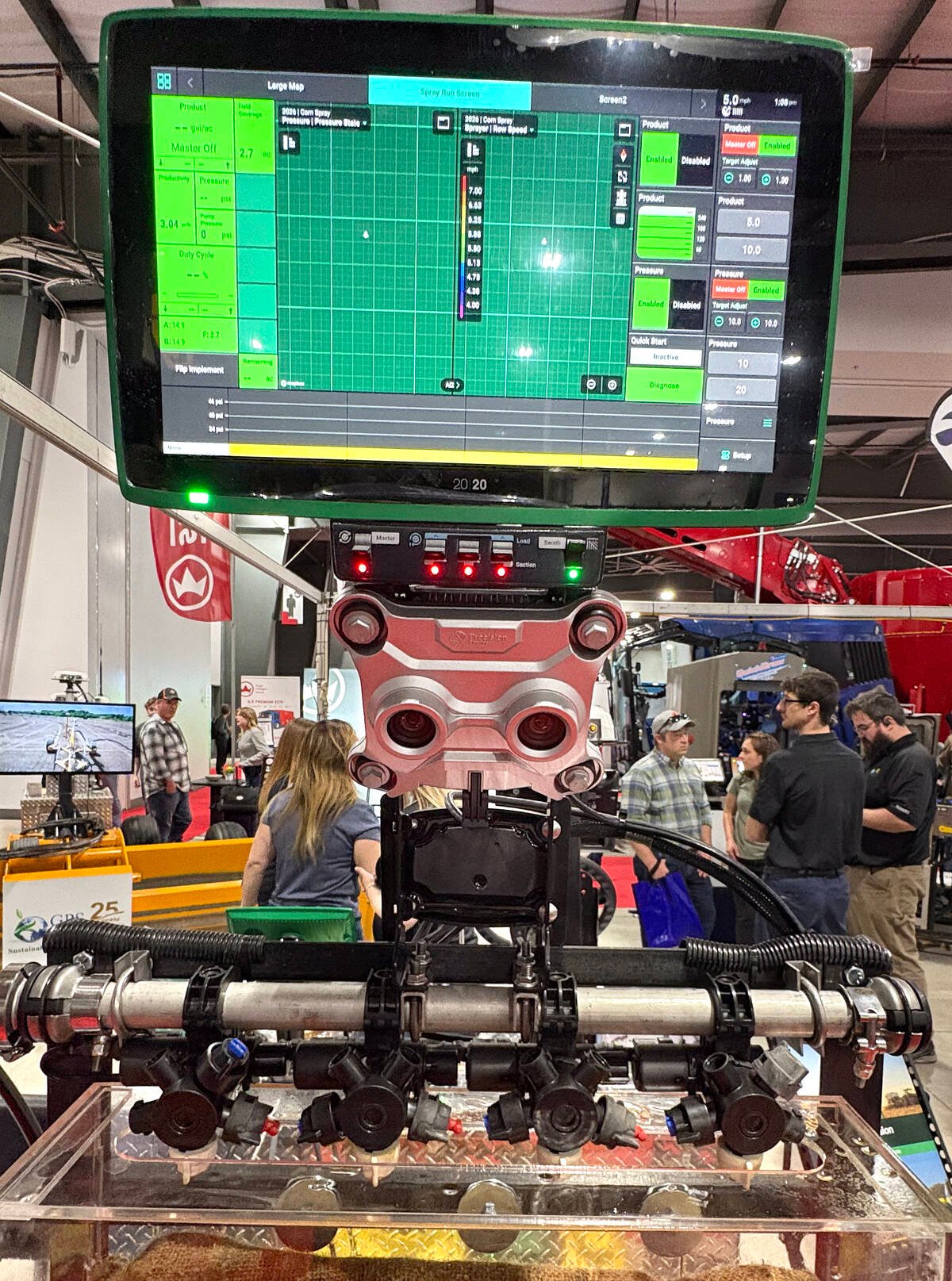
If the nozzle body breaks, an operator can pull two pins, fully service the whole system, and pop it back on for US$27 (C$37), no additional reprogramming required.
“There are technologies coming down the line that are also pairing with it,” he said. “Something like SmokeRow, which is actually Precision Planting’s fence row nozzle.”
Edge-of-field weed control
SmokeRow, an end-of-the-boom nozzle, addresses the edge-of-field weed sink, and rather than allowing that seed bank to blow into the field, it uses an individual chemical tank and pump for control up to 15 feet without cross-contamination concerns.
Symphony Reclaim replaces the end cap deadhead zone with a retainer line back to the tank on a selection valve, which allows chemicals within the boom to flush back to the tank overnight. Wallace said it eliminates potential chemical crossover from granular products that don’t flush easily from the end caps and provides an edge-of-field option to ensure active chemical is across the boom without waste.
“I haven’t killed any crop. I haven’t thrown chemicals into a ditch. I haven’t created a puddle or a pool on the edge of the field,” he said. “We’re actually able to keep everything rolling properly and make sure that we have good, solid weed kill all the time.”
He anticipates the release of Symphony Duo shortly, adding second-boom plumbing for chemical-to-chemical switching between zones without cross-contamination.
This allows real-time dual application at 15 mph and the Symphony system can retrofit any sprayer boom, no matter its age.
Currently, there are five Symphony Spot units in Ontario, according to the winter conference Wallace attended, but interest is increasing, especially amid rising fuel and fertilizer costs in March.
The post Symphony Nozzle system breathes new life into older sprayers appeared first on Farmtario.


