

RiderGuide Brand Guide · Updated September 2026
Talaria Electric Dirt Bikes
The 2026 Lineup, Explained
Talaria’s range runs from a 20 mph starter bike to the Dragon, listed at 70 mph on 28 kW. The catch is that half the numbers you see online are dealer numbers, and the factory quotes something very different.
Talaria lists fourteen electric dirt bikes on its own product pages, and they sort by how much power the factory leaves switched on. The X3 Concept, the MX5, the Sting MX3 and the Sting R MX4 all ship limited to 20 mph, and the road legal X3 L1E is restricted to 28 mph. The XXX Black Edition runs 6,500 W and 50 mph, the Sting MX Expert Edition 6,000 W and 47 plus mph, and both Competizione builds are quoted at about 70 mph. At the top, the Komodo makes 32 kW and is listed at 65 mph, while the Dragon is listed at 70 mph on 28 kW. Prices on Talaria’s shop page run from $2,500 for the X3 to $8,500 for a Competizione 45B. Talaria states on its own product pages that these are sold as off road vehicles and not for street use.
Specs and prices in this guide come from Talaria Power Tech (Chongqing) Co., Ltd, the manufacturer, and from Talaria’s official regional sites. Checked September 11, 2026. RiderGuide has no affiliate relationship with Talaria, so there are no buy links on this page.
How the Talaria Lineup Breaks Down
Talaria’s lineup is wider than most people realize, and the model names do not help. There is an X3 and an XXX, and they are different bikes. There are two of each, which makes it worse. Seven of the fourteen models wear a Sting badge.
The simplest way to read the range is by what the factory lets the bike do out of the crate. The X3 Concept, the X3 L1E, the MX5, the Sting MX3 and the Sting R MX4 all ship with the power and the speed turned down. The XXX Black Edition, the XXX Pro, the Sting MX Expert Edition, the two Competizione builds, the Dragon and the Komodo do not.
That one distinction explains most of the confusion in Talaria search results. It is why a bike listed at 8 kW on one site shows up as a 1,000 W bike on the factory’s own page.
This guide covers the fourteen models Talaria listed on its own product pages on September 11, 2026. The wholesale listing on that page is a trade account rather than a bike, so it is not here.
X3 and XXX: Where Most Riders Start
The X3 is the entry point. Talaria rates it at 3 kW continuous and 5.5 kW peak, on a 60V pack offered in 25Ah or 40Ah, which is 1,500 or 2,400 watt hours. With the smaller pack it weighs 50 kg, about 110 pounds, and the shop page lists it at $2,500 to $3,000.
The limit is what defines the X3. Talaria’s spec sheet gives the top speed as 32 km/h, factory limited, which is roughly 20 mph. That is a deliberate choice, and it is why the X3 gets recommended for younger and newer riders.
The XXX Black Edition is the bike people usually mean when they say a Talaria is quick. Peak power is 6,500 W and the listed top speed is 50 mph. The pack is 38.4Ah nominal, which Talaria puts at 2,400 watt hours, built from 128 LG M-50 21700 cells. The chassis weighs 58 kg, claimed range is up to 80 km, and it is listed at $3,000, down from $3,500.
In practice those two bikes cover most of the Talaria proposition. Same basic architecture, and a very different machine depending on whether the factory left the power on.
Talaria added a second XXX for 2025 and still sells it. The XXX Pro is rated at 2.5 kW with a 6 kW peak, and the listed top speed is 75 km/h, about 47 mph. The pack is 60V 38.4Ah nominal, which Talaria puts at 2,400 watt hours. It weighs 40 kg bare and 53 kg with the 40Ah battery in, claims 100 km at 25 km/h, and the shop page asks $3,200 to $3,500. What you get over the Black Edition is chassis, not power: 160 mm of rear travel on a new linkage, knobby tires on a 19 inch front and a 17 inch rear, a color TFT dash, and the IPM motor out of the Sting R.
The second X3 is the one road legal bike in the family. The X3 L1E Road Legal is $3,500, rated at 3,000 W with a 3,500 W peak, and Talaria lists the top speed as 28 mph, restricted for L1E. It runs a 60V 40Ah LG pack, weighs 58 kg with the battery in, and claims 50 miles at 25 mph. The spec sheet names a CE EEC certificate. L1E is a European class, so read the street legal section before you read that as a US plate.
The Sting Family, and the 1,000 W Catch
The Sting family is where buyers get burned.
Talaria’s own page for the Sting MX3 gives rated power as 1000w (Factory Limited) and maximum speed as 20 mph / 32 km/h (Factory Limited). The Sting R MX4 says the same, 1,000 W and 20 mph, both factory limited. The MX4 page goes further and states, word for word, that this bike is sold as an off road vehicle not for street use. They are $3,000 and $4,500.
Dealers advertise those same bikes at 8 kW and 53 mph. Both things can be true at once. The factory limit is the setting the bike ships in, and the bigger number is what the hardware is thought to manage once that setting is changed. We are only going to print the manufacturer’s figure, because it is the only one with a name attached to it.
Under the limit the hardware is genuinely good. The Sting MX3 runs a 60V 38.4Ah pack, 2,280 watt hours, weighs 63 kg with the battery and claims 100 km at 32 km/h. The Sting R MX4 steps up to 60V 45Ah and 2,700 watt hours, weighs 66 kg and claims 120 km at 25 km/h.
The Sting R SX4 sits alongside the MX4 at $4,500, and it has the thinnest spec sheet Talaria publishes. The page lists a 60V 45Ah LG pack, 81 kg including the battery, and 284 Nm at the rear wheel. No rated power, no peak power and no top speed appear anywhere on it, so we are not printing any.
For a Sting without the restriction, the MX Expert Edition is the one. Talaria lists it at 6,000 W peak on 60V, 47 plus mph with the 44 tooth sprocket, a 60V 38Ah pack, 62 miles of claimed range and 56 kg. It is $3,500.
The MX5 is the odd one. Talaria rates it at 5.5 kW and 13.4 kW peak, both marked unrestricted, then gives the maximum speed as factory limited to 32 km/h. It runs a 72V 40Ah Samsung pack, 2,880 watt hours, and the page prints the weight as 76 kg (159 lbs), which does not convert. Expect $4,600 to $4,800.
Two Competizione builds sit at the top of the Sting range, and both cost more than the Komodo. The MX5 Pro Competizione 45B is $8,500 and the 50s is $8,000. Each runs 22 kW continuous through an EBMX controller on an 81.4V pack of 4,060 watt hours, and Talaria quotes circa 70 mph for both, with the 50s limited to 60 mph in race mode. Neither page publishes a bike weight.
One more Sting matters for a different reason. The Sting 60V Road Legal is $3,500, listed at 45 mph on a 60V 38.4Ah LG pack, 58 kg, with 63 miles of claimed range. It ships with mirrors, indicators, reflectors and a plate holder. That kit does less for a US buyer than the name suggests.
Dragon and Komodo: The Top of the Range
Two bikes sit above the rest, and they are not fast in the same way.
The Komodo is the powerful one. Talaria lists 32 kW peak, 754 Nm of torque, a 105 km/h top speed which is 65 mph, and a 97.2V 45Ah pack. Net weight is 98 kg, about 216 pounds, claimed range is 115 km at 45 km/h, and it is $6,299. That 97.2V pack is the real story, because almost everything else Talaria builds runs 60V.
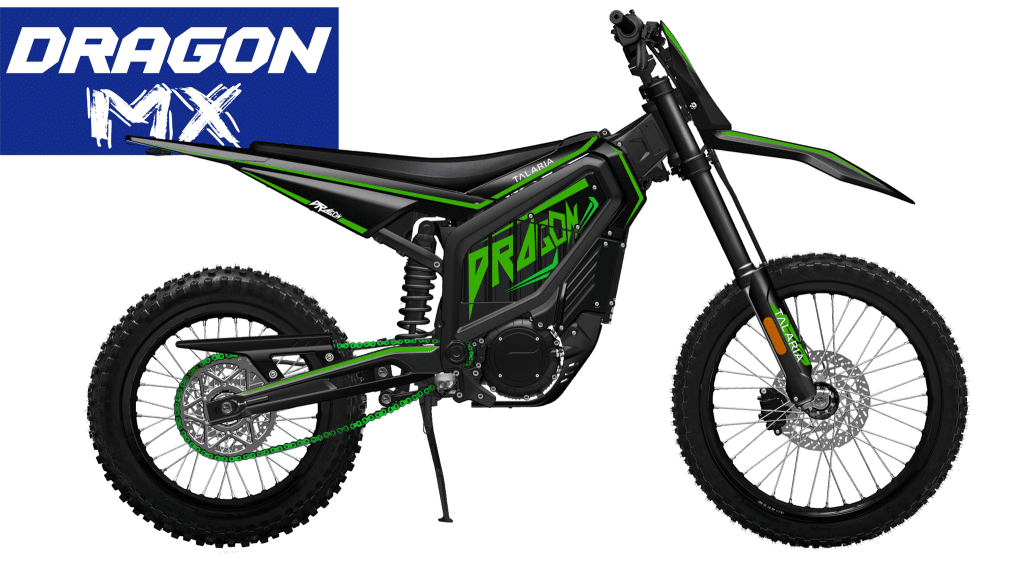
The Dragon is the fast one. Its product page lists 28 kW peak and 10 kW nominal, 630 Nm at the rear wheel with the 48 tooth sprocket, an 88.8V pack at 58.5Ah nominal, and 150 km of range at 25 km/h. It is $5,000, which undercuts the Komodo by $1,299.
On paper the Dragon should be as quick as anything Talaria sells, and the odd part is that the factory page never says so. It publishes no top speed at all. Talaria USA lists the Dragon at 110 km/h, or 70 mph, and Electrek reported the same 70 mph when the bike launched in November 2023. All three sources agree on 28 kW, 630 Nm and the 88V pack, so we are using 70 mph and telling you where it came from.
Weight is published two ways on the same page: 74.4 kg, then 100 kg with the 60Ah battery. Electrek used 220 pounds, which is the 100 kg figure. Either way the Dragon is the heaviest bike here.
Talaria Models Compared
Every figure below comes from Talaria or an official Talaria regional site, and every price comes from Talaria’s own shop page. Where the factory publishes a limited figure, that is what you are seeing, and the cell says so.
| Model | Peak power | Top speed | Battery | Weight | Price |
|---|---|---|---|---|---|
| Talaria X3 Concept | 5.5 kW (3 kW rated) | 32 km/h (factory limited) | 60V 25Ah or 40Ah | 50 kg (about 110 lb) with 25Ah | $2,500 to $3,000 |
| Talaria X3 L1E Road Legal | 3,500 W (3,000 W rated) | 28 mph (L1E restricted) | 60V 40Ah | 58 kg (about 128 lb) | $3,500 |
| Talaria XXX Black Edition | 6,500 W | 50 mph (80 km/h) | 38.4Ah nominal (2,400 Wh) | 58 kg chassis | $3,000 |
| Talaria XXX Pro 2025 | 6 kW (2.5 kW rated) | 75 km/h (about 47 mph) | 60V 38.4Ah (2,400 Wh) | 53 kg with the 40Ah pack | $3,200 to $3,500 |
| Talaria Sting MX3 | 1,000 W rated (factory limited) | 20 mph (factory limited) | 60V 38.4Ah (2,280 Wh) | 63 kg (about 139 lb) | $3,000 |
| Talaria Sting R MX4 | 1,000 W rated (factory limited) | 20 mph (factory limited) | 60V 45Ah (2,700 Wh) | 66 kg (about 146 lb) | $4,500 |
| Talaria Sting R SX4 | Not published | Not published | 60V 45Ah | 81 kg (about 179 lb) | $4,500 |
| Talaria Sting MX Expert Edition | 6,000 W | 47 plus mph (44T sprocket) | 60V 38Ah | 56 kg (about 123 lb) | $3,500 |
| Talaria Sting 60V Road Legal | Not published | 45 mph | 60V 38.4Ah | 58 kg (about 128 lb) | $3,500 |
| Talaria MX5 | 13.4 kW peak, 5.5 kW rated (unrestricted) | 32 km/h (factory limited) | 72V 40Ah (2,880 Wh) | 76 kg (159 lb as published) | $4,600 to $4,800 |
| Talaria Sting MX5 Pro Competizione 45B | 22 kW continuous | About 70 mph | 81.4V (4,060 Wh) | Not published | $8,500 |
| Talaria Sting MX5 Pro Competizione 50s | 22 kW continuous | About 70 mph (60 mph in race mode) | 81.4V (4,060 Wh) | Not published | $8,000 |
| Talaria Dragon | 28 kW (10 kW nominal) | 70 mph (110 km/h), not on the factory page | 88.8V 58.5Ah | 100 kg with the 60Ah pack | $5,000 |
| Talaria Komodo | 32 kW | 65 mph (105 km/h) | 97.2V 45Ah | 98 kg (216 lb) | $6,299 |
There are prices in this guide, and they need one caveat.
Talaria publishes a price for every model on its own shop page, and the XXX carries its own on its product page. Those are the numbers in the table. What Talaria does not publish is a US distributor or a US price list, so treat these as factory list prices rather than an MSRP you can hold a dealer to.
The gap is real. Talaria USA lists the Dragon at $5,099 to $5,499 against the $5,000 on the factory page, and third party sellers go further in both directions. Get the price in writing from whoever you are buying from, and check what the warranty covers.
Are Talarias Street Legal?
Talaria answers this one itself. The Sting R MX4 product page states that this bike is sold as an off road vehicle not for street use. That is the manufacturer talking, not a reviewer.
The legal basis is the same as it is for every bike in this category. Federal law at 15 U.S.C. 2085 defines a low speed electric bicycle as having fully operable pedals, a motor under 750 watts and a motor only top speed under 20 mph. A Talaria has no pedals, so it fails on the first test no matter how the power is set.
That leaves them as off highway vehicles. California’s DMV lists electric motorcycles among the OHVs that carry an ID plate or placard instead of a license plate, valid until June 30 of the second calendar year after it is issued, and meant for use off public roads on land open to the public.
The US Forest Service names Talaria specifically. Electric motorcycles such as those made by Sur-Ron, Talaria, Segway and E Ride Pro count as off highway vehicles rather than electric bikes or mopeds, and they must be registered with a CA Green Sticker through the DMV.
Four models complicate that, and they are all worth knowing about. Talaria sells a Sting 60V Road Legal, listed at 45 mph, with an upgraded low and high beam, rear mirrors, front and rear indicators and reflectors, and an extended rear mudguard with a license plate holder. The page never names a market, a country or a homologation class. Three other listings do. The X3 L1E Road Legal is sold under that name, restricted to 28 mph, with a CE EEC certificate on its spec sheet. The XXX Pro comes in an MX build and an L1E road legal build. The MX5 page describes an L1e version, the Sting PRO, that comes with a homologation kit of rearview mirrors, turn signals and a technical sheet so it can be registered as a 49cc L1e moped, and says that is why it comes limited from the factory. L1e is a European moped category, and Talaria publishes no US equivalent for any of them, so none of them is a shortcut to a US plate. Read our full breakdown of whether electric dirt bikes are street legal before you assume anything, and see where these fit against mopeds, e-bikes and motorcycles.
Talaria FAQ
Is a Talaria street legal?
Not in the form most of them are sold in. Talaria says so on its own Sting R MX4 page, which states that this bike is sold as an off road vehicle not for street use. These bikes fail the federal low speed electric bicycle test in 15 U.S.C. 2085 because they have no functional pedals, which leaves them as off highway vehicles. California treats electric motorcycles as OHVs that need a DMV issued ID plate or placard, and the US Forest Service names Talaria directly as a brand that needs a CA Green Sticker. Four exceptions are worth knowing. Talaria sells a Sting 60V Road Legal with mirrors, indicators, reflectors and a plate holder, and an X3 L1E Road Legal restricted to 28 mph with a CE EEC certificate. It also offers an L1E build of the XXX Pro and an L1e version of the MX5 that can be registered as a 49cc moped. L1e is a European moped class, and none of those pages names a US market or class, so none of them is a route to a US plate on its own.
How fast can a Talaria go?
Three bikes share the top of the range at about 70 mph. The Dragon is listed at 70 mph, or 110 km/h. Talaria’s own Dragon page publishes no top speed, but Talaria USA and Electrek’s launch report both give 70 mph, and all three sources agree on the 28 kW peak. The Komodo makes more power at 32 kW and is listed at 65 mph. Both Competizione builds are quoted at about 70 mph, the XXX Black Edition at 50 mph, the XXX Pro at 75 km/h, about 47 mph, and the Sting MX Expert Edition at 47 plus mph. The X3 Concept, the MX5, the Sting MX3 and the Sting R MX4 all ship factory limited to 20 mph, and the road legal X3 L1E is restricted to 28 mph.
How much is a Talaria
Talaria’s shop page runs from $2,500 to $3,000 for the X3 Concept up to $8,500 for the Sting MX5 Pro Competizione 45B. In between, the Sting MX3 and the XXX Black Edition are $3,000, the XXX Pro is $3,200 to $3,500, the Sting MX Expert Edition, the Sting 60V Road Legal and the X3 L1E Road Legal are $3,500, the Sting R MX4 and the Sting R SX4 are $4,500, the MX5 is $4,600 to $4,800, the Dragon is $5,000 and the Komodo is $6,299. Talaria names no US distributor, so those are factory list prices rather than a US MSRP, and sellers quote differently.
What is the difference between the Talaria X3 and the Sting?
The X3 Concept is the smaller entry bike at 3 kW rated and 5.5 kW peak, factory limited to 32 km/h, on a 60V pack of either 25Ah or 40Ah, weighing about 50 kg with the smaller battery. A road legal X3 L1E sits alongside it at 3,500 W peak and 28 mph. The Sting is the bigger platform, and it runs seven models deep. The MX3 and the Sting R MX4 also ship factory limited, to 1,000 W and 20 mph, but carry more battery at 2,280 and 2,700 watt hours and weigh 63 and 66 kg. The Sting MX Expert Edition is the unrestricted one at 6,000 W and 47 plus mph, and the two Competizione builds sit above it at about 70 mph.
Talaria vs Sur-Ron: which is better?
They are close enough that it comes down to the specific bikes. Talaria’s quickest bikes are the Dragon at a listed 70 mph on 28 kW and the two Competizione builds at about the same speed. Its most powerful is the Komodo at 32 kW and 65 mph. Sur-Ron’s Storm Bee makes 22.5 kW on a 104V pack and is listed at 68.3 mph. Further down the range, Sur-Ron’s Ultra Bee at 24.5 kW and 59 mph has no direct Talaria equivalent. The practical difference is pricing. Talaria publishes a number for every model on its own shop page, and Sur-Ron does not publish US pricing at all.
Bottom Line
Talaria makes good hardware and describes it badly. The model names overlap, and the factory limits are buried in spec tables.
Sort the range by whether the factory left the power on and it gets simple. The X3 Concept, the X3 L1E, the MX5 and the limited Stings are starter bikes. The XXX Black Edition, the XXX Pro and the Sting MX Expert Edition are the real riding bikes. The Dragon and the Komodo are the top of the range, and the two Competizione builds cost more than either.
Go in knowing which version you are being sold, get the price in writing, and plan on riding it somewhere that allows off highway vehicles.
More before you decide: our tested picks for the best electric dirt bikes, our size by size guide to the best electric motorcycles, and how we test.
Ride Safe: Always wear appropriate safety gear and ride within your abilities. Off highway vehicle rules, registration requirements and where you can legally ride vary by location. Check and follow your local laws before riding.
Prices and specs can change without notice. Confirm the details with an authorized dealer before ordering.
{“@context”:”https://schema.org”,”@type”:”ItemList”,”name”:”Talaria Electric Dirt Bikes in 2026″,”itemListElement”:[{“@type”:”ListItem”,”position”:1,”name”:”Talaria X3 Concept”},{“@type”:”ListItem”,”position”:2,”name”:”Talaria X3 L1E Road Legal”},{“@type”:”ListItem”,”position”:3,”name”:”Talaria XXX Black Edition”},{“@type”:”ListItem”,”position”:4,”name”:”Talaria XXX Pro 2025″},{“@type”:”ListItem”,”position”:5,”name”:”Talaria Sting MX3″},{“@type”:”ListItem”,”position”:6,”name”:”Talaria Sting R MX4″},{“@type”:”ListItem”,”position”:7,”name”:”Talaria Sting R SX4″},{“@type”:”ListItem”,”position”:8,”name”:”Talaria Sting MX Expert Edition”},{“@type”:”ListItem”,”position”:9,”name”:”Talaria Sting 60V Road Legal”},{“@type”:”ListItem”,”position”:10,”name”:”Talaria MX5″},{“@type”:”ListItem”,”position”:11,”name”:”Talaria Sting MX5 Pro Competizione 45B”},{“@type”:”ListItem”,”position”:12,”name”:”Talaria Sting MX5 Pro Competizione 50s”},{“@type”:”ListItem”,”position”:13,”name”:”Talaria Dragon”},{“@type”:”ListItem”,”position”:14,”name”:”Talaria Komodo”}]}{“@context”:”https://schema.org”,”@type”:”FAQPage”,”mainEntity”:[{“@type”:”Question”,”name”:”Is a Talaria street legal?”,”acceptedAnswer”:{“@type”:”Answer”,”text”:”Not in the form most of them are sold in. Talaria says so on its own Sting R MX4 page, which states that this bike is sold as an off road vehicle not for street use. These bikes fail the federal low speed electric bicycle test in 15 U.S.C. 2085 because they have no functional pedals, which leaves them as off highway vehicles. California treats electric motorcycles as OHVs that need a DMV issued ID plate or placard, and the US Forest Service names Talaria directly as a brand that needs a CA Green Sticker. Four exceptions are worth knowing. Talaria sells a Sting 60V Road Legal with mirrors, indicators, reflectors and a plate holder, and an X3 L1E Road Legal restricted to 28 mph with a CE EEC certificate. It also offers an L1E build of the XXX Pro and an L1e version of the MX5 that can be registered as a 49cc moped. L1e is a European moped class, and none of those pages names a US market or class, so none of them is a route to a US plate on its own.”}},{“@type”:”Question”,”name”:”How fast can a Talaria go?”,”acceptedAnswer”:{“@type”:”Answer”,”text”:”Three bikes share the top of the range at about 70 mph. The Dragon is listed at 70 mph, or 110 km/h. Talaria’s own Dragon page publishes no top speed, but Talaria USA and Electrek’s launch report both give 70 mph, and all three sources agree on the 28 kW peak. The Komodo makes more power at 32 kW and is listed at 65 mph. Both Competizione builds are quoted at about 70 mph, the XXX Black Edition at 50 mph, the XXX Pro at 75 km/h, about 47 mph, and the Sting MX Expert Edition at 47 plus mph. The X3 Concept, the MX5, the Sting MX3 and the Sting R MX4 all ship factory limited to 20 mph, and the road legal X3 L1E is restricted to 28 mph.”}},{“@type”:”Question”,”name”:”How much is a Talaria”,”acceptedAnswer”:{“@type”:”Answer”,”text”:”Talaria’s shop page runs from $2,500 to $3,000 for the X3 Concept up to $8,500 for the Sting MX5 Pro Competizione 45B. In between, the Sting MX3 and the XXX Black Edition are $3,000, the XXX Pro is $3,200 to $3,500, the Sting MX Expert Edition, the Sting 60V Road Legal and the X3 L1E Road Legal are $3,500, the Sting R MX4 and the Sting R SX4 are $4,500, the MX5 is $4,600 to $4,800, the Dragon is $5,000 and the Komodo is $6,299. Talaria names no US distributor, so those are factory list prices rather than a US MSRP, and sellers quote differently.”}},{“@type”:”Question”,”name”:”What is the difference between the Talaria X3 and the Sting?”,”acceptedAnswer”:{“@type”:”Answer”,”text”:”The X3 Concept is the smaller entry bike at 3 kW rated and 5.5 kW peak, factory limited to 32 km/h, on a 60V pack of either 25Ah or 40Ah, weighing about 50 kg with the smaller battery. A road legal X3 L1E sits alongside it at 3,500 W peak and 28 mph. The Sting is the bigger platform, and it runs seven models deep. The MX3 and the Sting R MX4 also ship factory limited, to 1,000 W and 20 mph, but carry more battery at 2,280 and 2,700 watt hours and weigh 63 and 66 kg. The Sting MX Expert Edition is the unrestricted one at 6,000 W and 47 plus mph, and the two Competizione builds sit above it at about 70 mph.”}},{“@type”:”Question”,”name”:”Talaria vs Sur-Ron: which is better?”,”acceptedAnswer”:{“@type”:”Answer”,”text”:”They are close enough that it comes down to the specific bikes. Talaria’s quickest bikes are the Dragon at a listed 70 mph on 28 kW and the two Competizione builds at about the same speed. Its most powerful is the Komodo at 32 kW and 65 mph. Sur-Ron’s Storm Bee makes 22.5 kW on a 104V pack and is listed at 68.3 mph. Further down the range, Sur-Ron’s Ultra Bee at 24.5 kW and 59 mph has no direct Talaria equivalent. The practical difference is pricing. Talaria publishes a number for every model on its own shop page, and Sur-Ron does not publish US pricing at all.”}}]}
<p>The post Talaria Electric Dirt Bikes in 2026: The Full Lineup Explained first appeared on Rider Guide.</p>


