
The 2026 Forage Expo delivered an impromptu TED-ding talk to accompany its machinery demos on July 9, near Norwood.
Why it matters
Tedding time, technique and technology can all have an impact when making dry hay or silage.
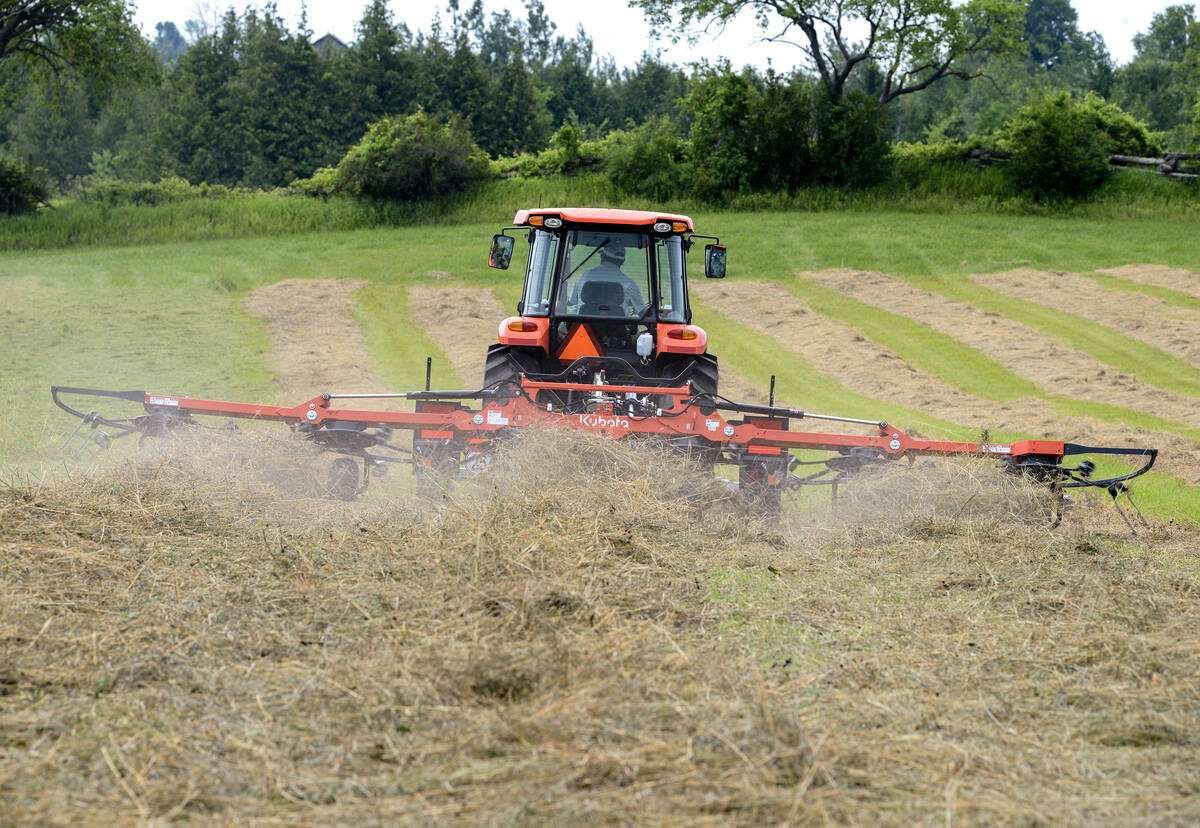
To provide real-time comparisons, Kubota’s TE6576C and Kuhn’s 5203 THA large rotor tedder were put through their paces as part of the event, hosted by the East Central Region Soil and Crop Improvement Association and the Ontario Forage Council.
Kubota’s TE6576C is a high-capacity, low-horsepower, six-rotor trailed tedder, featuring the new TerraFlow flexible frame, with ground-following adaptation for uneven fields, so sod is protected while maximizing hay drying.
Kuhn’s 5203 OptiTedd rotor system promises a steep angle approach for complete crop inversion and uniform, fast drying. The asymmetrical tine length configuration allows longer outer tine fingers to touch the crop earlier than symmetrical tines, for better performance along borders and where the tines overlap.
Travis Grubb, Kubota’s Western Ontario field product specialist, provided a few tedder tips during the demonstration, advising farmers to invest in a tedder that best fits their operation and forage goals.
Farmers should research options through local dealers, online and at events such as the Forage Expo, where they can compare tedders, he said.
“A lot of guys think they have a four-basket and they want to go to a six-basket, but chances are, maybe going to an eight-basket is a better fit for your operation, or going to a bigger one.”
Ten- and 12-rotor machines are gaining popularity because of crop consistency and the ability to cover ground in a shorter time, Grubb added.
If horsepower is a concern, he said, machines on the market today fit a variety of horsepower levels.
“You don’t need a lot of horsepower. We’ve only got 70 horsepower,” Grubb said, waving to the tractor pulling the TE6576C. “It’ll pull a fairly big tedder to begin with, not a lot of PTO draw. We’re just flinging hay across.”
Grubb suggested some simple guidelines to follow to optimize your machine and tedding process for success:
The right machine
Select the right machine for your operation and forage goals, taking cut height and crop type into account.
Large rotor tedders generally have limited tilt and tend to be stronger in grass, whereas the more aggressive tilt of a smaller rotor performs marginally better in alfalfa.
The mower also comes into play.
“Are you cutting with a nine-foot mower or 13-foot mower? Are you leaving it wide?” Grubb asked. “If you’re leaving it narrow, that kind of helps you pick the right tedder for the job.”
For example, he said if you cut with a 10-foot mower making a six-foot swath, you want a tedder that will spread it across the entire mowed space to dry down more efficiently.
Adjust for success
Take the time to adjust the machine for the conditions you’re operating in.
Grubb said a tedder could be the “Cadillac of Cadillacs,” but the tool is only as good as its adjustments.
First, assess the cut height. Does the crop require a more or less aggressive approach to pick it up and throw it, and what PTO speed is ideal?
“A tedder can do a fantastic job at 300 RPM, and a terrible job at 450 or even 500 and 540,” Grubb said. “A lot of guys get stuck on that it says 540 on the PTO shaft, so we just run to 540.”
Within the first 10 to 50 feet, farmers can determine what adjustments will optimize performance, limit machine wear and tear and preserve forage quality.
“These are not tillage tools,” cautioned Grubb. “If you see dust flying, you have got it set way too aggressively. So, please take the time to actually adjust it back a little bit.”
Grubb said the goal is to dry the crop effectively while limiting contamination by foreign material, or “ash,” which can reduce its value.
Tedding timing
Grubb said tedding should not be an afterthought or be prompted by a chance of adverse weather. Instead, it should be integrated into the haymaking process to maximize a farmer’s desired result: silage or dry hay.
“It goes back to making hay properly. If you’re going to make dry hay, make it for dry hay,” said Grubb. “It’s kind of too late to make silage out of dry hay because you’ve already lost the quality of that crop.”
If silage is the primary goal, focus on that, said Grubb, followed by dry hay if the weather supports it. Tedding directly after mowing is ideal for dry hay, even if it requires a subsequent tedding.
“Leaf loss is a little more possible at that point. That’s why we want to ted it as quickly, as close to cutting as possible, for both silage or dry hay,” he explained. “We’re making it fairly dry, so the crop is generally a little more mature at that point and more likely to lose leaves at that point.”
The post Tedding tips for crop and implement optimization appeared first on Farmtario.


