

Tesla has evidently revealed which of its vehicle models will be the first to receive Starlink integration: the Cybercab.
Tesla’s Santana Row showroom now has a full-fledged display of the Cybercab, with an extensive bit of information hung around an exhibit that seems to reveal the vehicle’s newest feature: an integrated Starlink antenna that will enable secure and reliable internet access during trips.
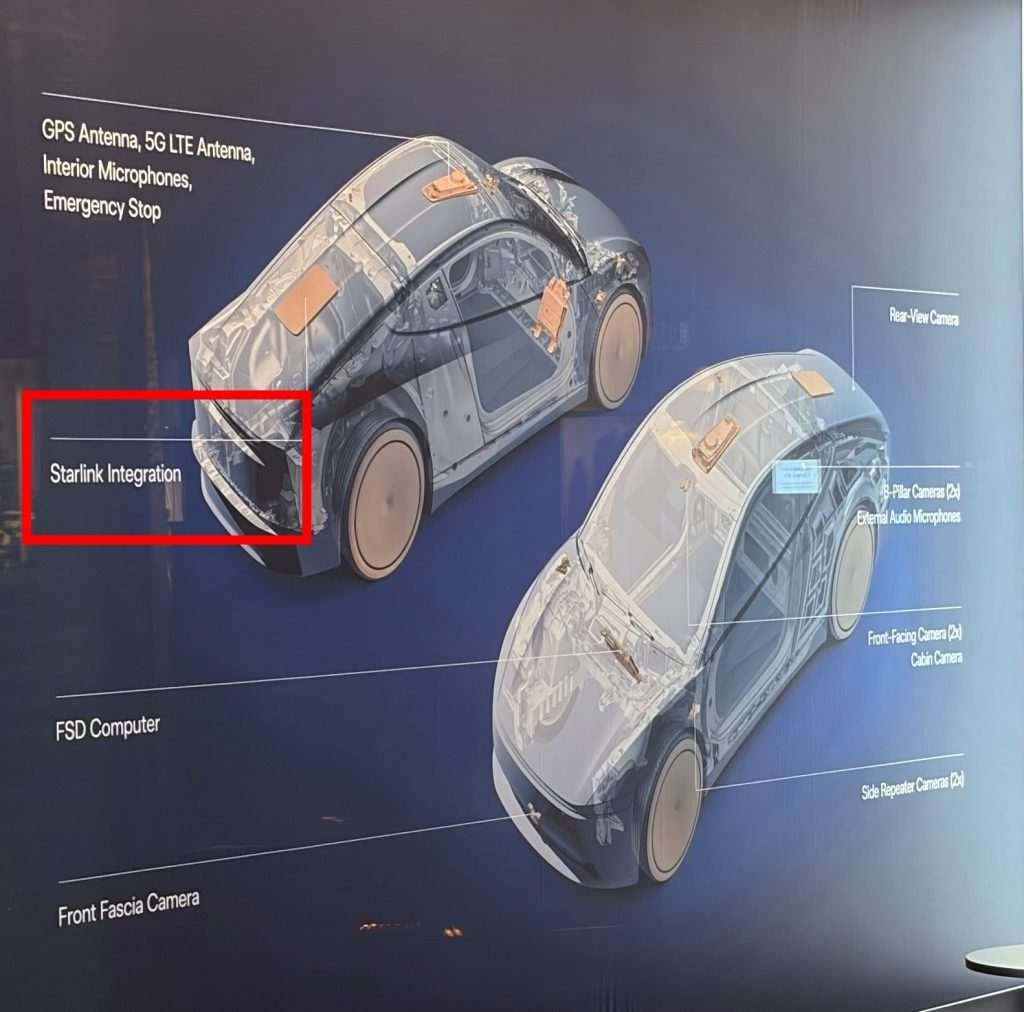
Credit: @Starscream_SJC | X
Cybercab is geared toward autonomous ride-hailing for one or two passengers. The production units rolling off the lines at Gigafactory Texas are built without steering wheels or pedals, meaning when public rides begin, passengers will not need to interact with a human being or control the vehicle in any way outside of what appears on the center screen for their entertainment during the ride.
Tesla Santana Row will be reopening tomorrow with a full focus on self-driving. Everything in the showroom is about Robotaxi and Cybercab with stats and information about the technology. The Cybercab on display is the production model. pic.twitter.com/yIUYdOGFOp
— Shaun Cassidy (@Starscream_SJC) July 20, 2026
Along the display, Tesla wrote this message about Cybercab:
“Cybercab is built for autonomy. It has no steering wheel, no side mirrors, and no pedals. It goes where you tell it to go and how you want it to, so you can relax along the way. It is hyper aware and responsive to your surroundings, monitoring other drivers, responding to emergency vehicles, utilizing its expertise in the rarest scenarios to help keep you safe.”
Tesla has been teasing a potential Starlink integration for quite some time now. In December, the company hinted at potential Starlink internet terminal integration within its vehicles in a patent that described a vehicle roof assembly with integrated radio frequency (RF) transparency.
The company wrote in its patent application that a new roof design built with materials that differ from the standard metallic or glass elements used in today’s cars would allow it to integrate modern vehicular technologies, in particular, ones that require radio frequency transmission and reception.
Tesla suggested high-strength polymer blends, like Polycarbonate, Acrylonitrile Butadiene Styrene, or Acrylonitrile Styrene Acrylate.
This is the first time we’ve seen Tesla officially confirm the Starlink integration into the Cybercab. It’s not much of a surprise considering the company’s intention behind the Cybercab, which is to make travel autonomous.
Productivity will now be at a maximum during a work-related commute, while the center screen could be utilized for Netflix or potentially even live TV for those who are heading to dinner or to a fun activity.
The post Tesla reveals first vehicle model to receive Starlink integration appeared first on TESLARATI.


