
The future of greenhouse strawberries may soon look and taste very different, thanks to an ambitious new breeding collaboration led by Red Sun Farms of Kingsville, Ont.
Why it matters: Most strawberry breeding efforts, which are lengthy and costly, focus on field-grown varieties that do not give indoor growers the yield levels they need.
Working with Italian strawberry breeding consortium CIV (Consorzio Italiano Vivaisti), artificial intelligence powered crop-breeding company Heritable Agriculture, and Vineland Research and Innovation Centre, Red Sun is developing strawberry varieties bred specifically for indoor growing environments.
The project is a first-of-its-kind effort in North America and representatives from eight retail chains, including four from Canada, recently had their first look at the more than 110 breeding lines currently in development.
Paul J. Mastronardi, Red Sun’s business development and account manager, says field strawberries are almost entirely June-bearing, producing fruit in one major flush.
Greenhouse operations, however, need ever-bearing varieties that deliver consistent and regular production.
Flavour is another perennial challenge: consumers want sweet, aromatic berries, not firm-but-bland fruit bred to withstand long-distance trucking.
“We are already working with North America’s largest retailers to bring these innovations to their customers,” says Mastronardi.
“We are looking to increase yield and flavour and no one is working on developing a greenhouse strawberry. Others are trying to put current plant genetic material into a greenhouse, but the yields aren’t there.”
To build those genetics, Red Sun Farms has assembled an unusual partnership.
Mastronardi first connected with Heritable Agriculture, a company born at X, Alphabet’s moonshot factory, and founded by computational and molecular biologists with deep expertise in plant genetics.
Heritable’s platform uses artificial intelligence-driven predictive breeding models to determine exactly which genetic markers deliver key traits, dramatically reducing the time and uncertainty of traditional breeding.
“Breeding is usually a guessing game,” Mastronardi says.
“Heritable has developed an algorithm model to tell you what markers you need for greenhouse performance. It’s faster, more accurate, and it transforms how we think about strawberry improvement.”
Through Heritable, Mastronardi was introduced to Italian strawberry genetics leader CIV, who has brought germplasm and decades of breeding expertise to the project.
Together, the partners are now working on more than 110 breeding lines, all grown under controlled conditions at Vineland. Vineland’s team is responsible for hands-on monitoring — measuring berry size, width, length, plant architecture, and overall performance — providing the data needed to fine-tune the AI models and guide selection.
A unique feature of the initiative is the involvement of North American retail partners, four of them Canadian, representing more than 8,000 stores across the continent.
According to Mastronardi, the conventional approach involves breeders and seed companies developing varieties they think are in demand and then taking those to a grower or distributor for trial.
If they like it, they approach retail partners.
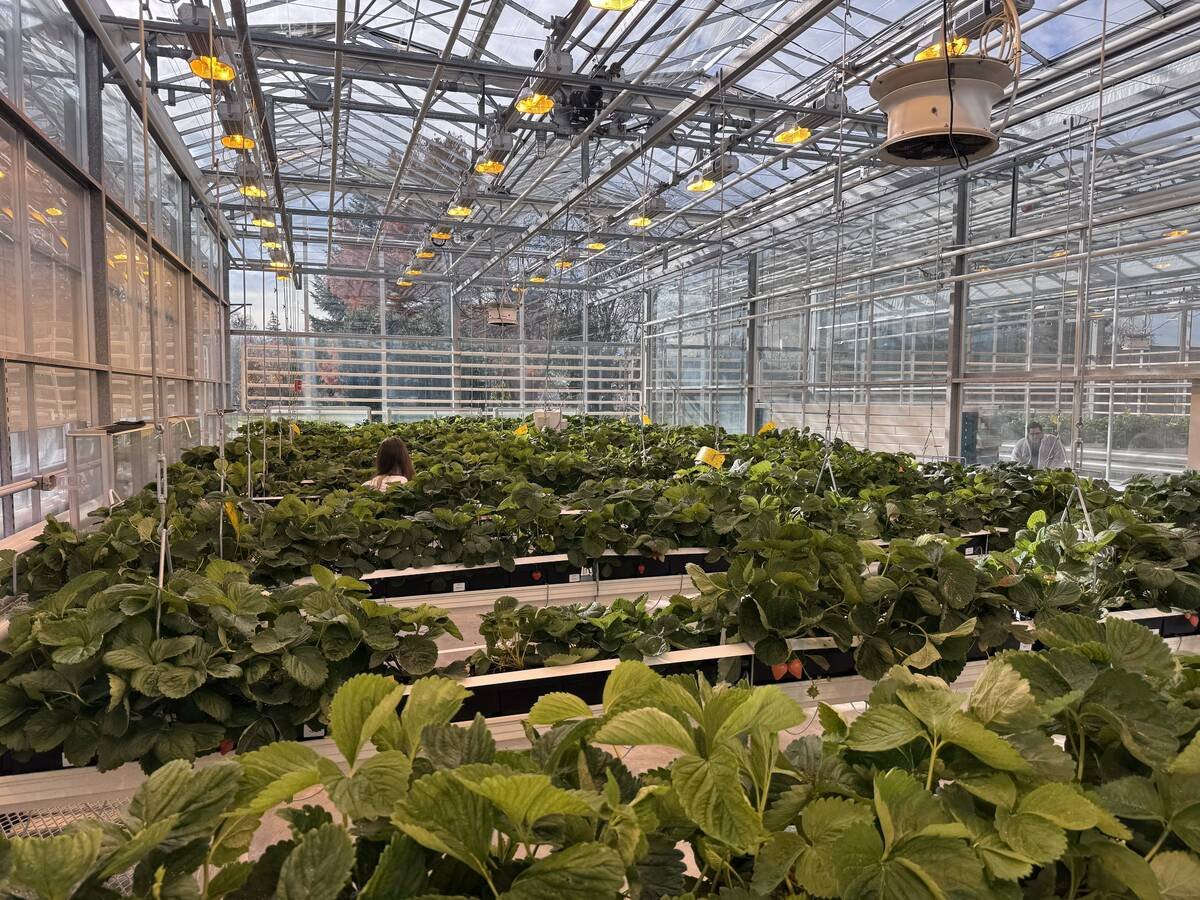
“We’re bringing the retailers in from the beginning. With the time and money that developing new varieties takes, we want them to be part of what we are doing,” he says.
Recently, retailer teams joined the partners at Vineland for an exclusive first look at the early-stage breeding lines. Through guided sensory evaluations, they tasted sample groups of varieties, providing direct feedback on flavour, sweetness, texture, aroma, and visual appeal.
This real-time loop between breeders, growers, AI modellers and retailers is something Mastronardi sees as transformative.
The project represents a new era of produce development that no longer means having to choose between yield and flavour but is rather about developing what the market wants.
“We are effectively reverse engineering the perfect strawberry based on what consumers actually demand, ensuring that when these varieties hit the shelf, they are already proven winners,” he says.
As climate change increases pressure on outdoor production, particularly in California, which is the continent’s largest strawberry supplier, Mastronardi believes indoor-specific breeding will play a growing role in supply stability.
Selection is still underway, but the partners expect the first commercial greenhouse-specific varieties from the project to be in stores by 2029 at the latest.
The post The bid to create the first true greenhouse strawberry appeared first on Farmtario.


