
Organic banana farming is growing in importance as demand for organic produce rises worldwide. Bananas are one of the world’s most important fruit crops (with global production near 135 million tonnes in 2022), so farming them sustainably is vital.
Organic banana cultivation means growing bananas without synthetic fertilizers, pesticides, herbicides or GMOs. Instead, it relies on building healthy soil and diverse ecosystems.
The goal is to enhance soil fertility and plant health through natural methods (compost, cover crops, etc.), while protecting biodiversity. In short, organic banana farming follows a holistic, ecological approach that sustains the health of soil and life on the farm.
Core Principles of Organic Banana Cultivation
Global organic farming continues to grow rapidly, with more than 76 million hectares under organic management worldwide in 2023. Bananas represent one of the fastest-growing organic fruit sectors, with increasing exports from Latin America, India, and the Philippines supplying Europe and North America.
The focus is not only on chemical-free production but also on soil regeneration and fair-trade standards that benefit smallholder farmers.
Organic farming rests on four core principles: health, ecology, fairness, and care. The health principle means farming should “sustain and enhance the health of soil, plant, animal and human as one and indivisible”.
Ecology means working with natural systems (e.g. nutrient cycles, habitats) rather than against them. Fairness means social and economic equity (fair working conditions, fair prices) and sharing the benefits of nature. Care implies a precautionary, responsible approach to land stewardship.
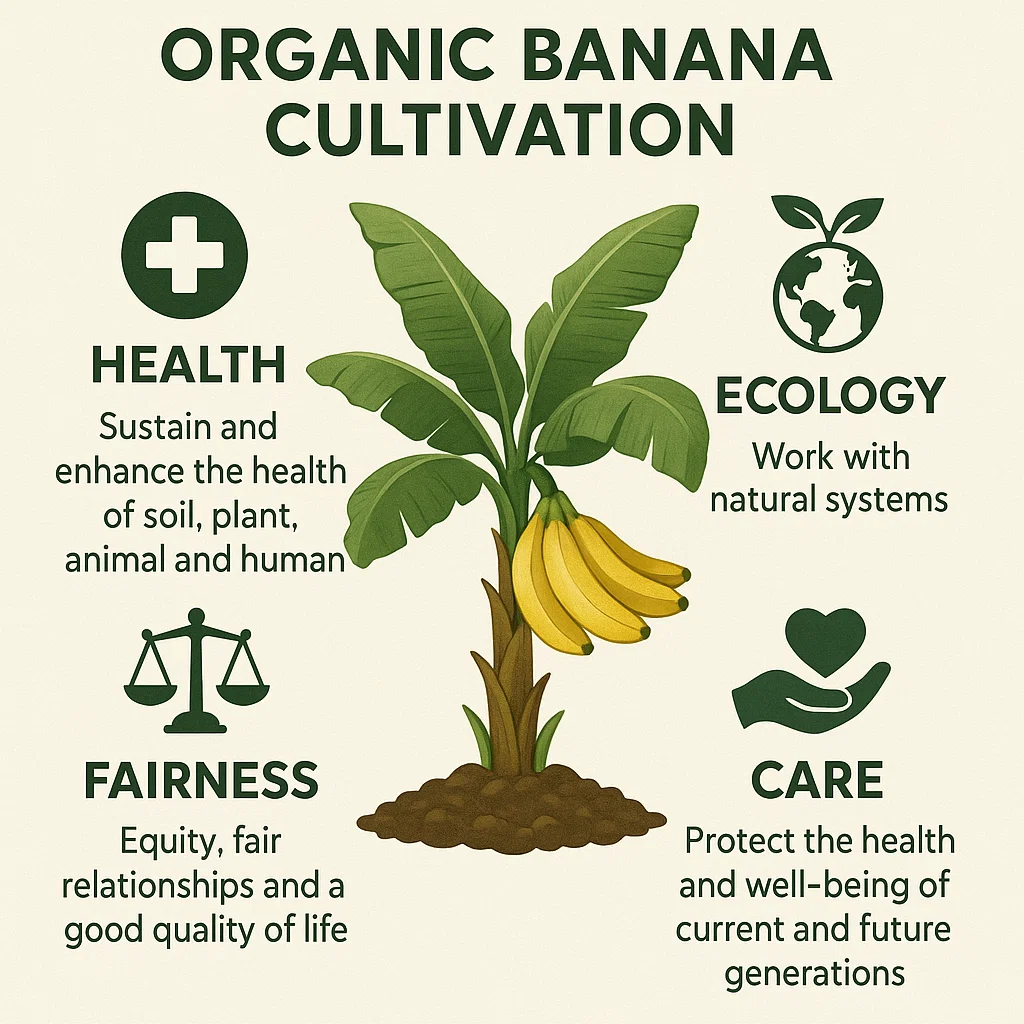
In practice, these principles translate into methods that build soil organic matter (compost, manure), support beneficial microbes and insects, and avoid harmful chemicals. For example, composting banana wastes and planting legumes can improve soil fertility and provide habitat for beneficial organisms. These principles guide every stage of an organic banana farm, from planning to harvest.
Getting Started: Pre-Planting Considerations
The global organic banana market was valued at over USD 2.5 billion in 2024 and is expected to grow steadily at 8–10% annually due to increasing consumer demand for chemical-free fruits.
Countries such as India, Ecuador, and the Dominican Republic have significantly expanded organic banana acreage to meet this demand. This growth means there is a strong opportunity for new farmers to enter organic banana production.
1. Site Selection & Climate
Bananas thrive in tropical to subtropical climates with warm temperatures and high humidity. The optimal temperature is around 27 °C, and minimum night-time temps should stay above about 16 °C. They also need abundant moisture – typically 1,200–2,500 mm of rainfall per year, well-distributed.
Good humidity (60–70% or higher) is helpful, but too much rain or poor drainage can cause root diseases. Thus, bananas must be planted on well-drained fertile soils. Waterlogged conditions can cause diseases such as Panama disease (Fusarium wilt), so soils should not stay soggy. Sandy loams rich in organic matter, with pH 5–7, are ideal.
Wind can also harm banana stands: strong winds tear leaves and topple plants. For this reason, organic farms often establish windbreaks and shade trees (e.g. rows of Acacia or other trees) before planting bananas.
These trees protect bananas from wind and, if leguminous (like Gliricidia or Leucaena), they can also fix nitrogen and add mulch when pruned. Many organic farms use agroforestry designs with multiple canopy layers: tall shade trees, mid-story trees (fruit or legumes), and under-story crops. This creates a stable microclimate and improves soil fertility.
A soil test is important before planting to check nutrient levels and pH. Based on results, organic-approved amendments can be applied (e.g. lime to raise pH, rock phosphate for phosphorus, potassium sulfate for potash).
But overall, the key is healthy, living soil. By choosing a site with the right climate and preparing the land with cover crops and organic matter, an organic banana farm sets a solid foundation for the crop to thrive.
2. Choosing the Right Variety (Cultivar)
Recent research shows that over 47% of global banana exports rely on the Cavendish variety, which is increasingly vulnerable to Fusarium Wilt Tropical Race 4. New disease-resistant varieties developed in recent years offer organic farmers more resilient options, reducing losses and lowering the need for interventions.
Selecting disease-resistant banana varieties is critical in organic farming, where synthetic pesticides cannot be used. While the Cavendish variety dominates global exports, it is highly susceptible to Fusarium wilt (Panama disease) Tropical Race 4.
In organic systems, growers often choose alternatives such as newer hybrids (e.g. “Goldfinger”, FHIA series) or local hardy cultivars with resistance to key diseases. The choice of banana variety is critical in organic farming.
Organic cultivars should be disease-resistant and suited to the local climate and soil. For example, Red bananas or Manzano bananas may perform better than Cavendish in some conditions.
It is also essential to start with clean planting material. Many organic producers use tissue-culture plantlets or carefully treated suckers (baby plants) certified disease-free. Organic standards typically require certified organic planting stock or materials treated with approved methods (e.g. hot-water treatment).
By using pest- and disease-free starters, farmers prevent introducing pathogens like weevils or nematodes into the field. In short, choose the right varieties for your region and ensure planting stock is certified healthy, as disease pressure can otherwise overwhelm an organic plantation.
3. Land Preparation & Design
With climate change causing more intense rains and winds, land preparation has become even more crucial. Studies in 2023 show that farms using contour planting and windbreaks reduced storm-related crop losses by over 30% compared to unprotected plantations.
Proper land preparation sets up the farm for success. In organic banana cultivation, this often involves agroforestry and contouring. On sloping land, bananas should be planted on contours or terraces to reduce erosion. The crop can be interplanted with cover crops or intercrops.
During the first 1–2 years, intercrops like legumes (beans, groundnuts, pigeonpea) or vegetables (cabbage, tomatoes) are grown between banana rows. These protect soil from erosion, improve fertility (through nitrogen fixation), and provide extra harvest.
As bananas grow larger and shade the ground, under-story cover crops (e.g. jack bean, velvet bean) can fix nitrogen and suppress weeds.
Windbreaks and shade trees are established as part of land design. Trees such as Erythrina, Albizia, or Grevillea can form the upper canopy, acting as windbreaks and fixing nitrogen.
These trees should be pruned to the correct height (often to just above banana height) so they do not overly shade young bananas. Good plant spacing also matters: bananas are usually planted 2–4 m apart.
Adequate spacing (for example, about 3 m x 3 m) ensures good air circulation through the canopy and sunlight on leaves. Proper spacing and multistory plantings together reduce disease pressure and improve resource use. In sum, preparing the land with erosion controls, intercrops, and supportive tree species helps create a healthy ecosystem for organic bananas.
Organic Cultivation Practices
According to FAO reports, farms that implement strong organic cultivation practices report up to 15–20% better soil organic carbon levels, which translates into improved yields and higher resilience against droughts. Farmers adopting composting and mulching have seen water use efficiency increase by over 25% in tropical climates.
1. Soil Health Management
Healthy soil is at the heart of organic banana farming. Organic practices build soil organic matter and fertility over time. For example, farmers make and apply compost and vermicompost from crop residues (banana leaves, pseudostems, kitchen waste) and animal manures.
Research shows that adding compost or manure to banana fields significantly improves growth and yield. Organic amendments increase soil organic carbon, improve structure, and boost microbial life. One study found 100% vermicompost led to taller banana plants and much heavier bunches than control.
Organic farms also use green manures and cover crops. Leguminous cover crops (cowpea, sunn hemp, lablab) are grown in fallow rows or intercropped during early growth stages. These crops fix atmospheric nitrogen into the soil and suppress weeds.
After flowering, cover crops are plowed or mulched in, further boosting soil nutrients. Heavy mulching with organic material (banana leaves, straw, grass clippings) is another staple practice.
A thick mulch layer around bananas conserves moisture, moderates soil temperature, and slowly releases nutrients as it decomposes. Over time, mulching can build a very rich, moisture-retaining soil ideal for bananas.
Based on soil tests, organic farmers may also apply mineral amendments that are approved in organic systems. For example, rock phosphate (for phosphorus), agricultural lime (to correct pH), gypsum (for calcium/soil structure) or potassium sulfate can be used as needed.
These ensure that nutrient needs (e.g. bananas require high nitrogen and especially high potassium) are met without synthetic NPK fertilizers. All together, these practices nurture the soil’s biology and fertility.
2. Weed Management
Recent studies show that weed pressure in banana plantations can reduce yields by up to 40% if not controlled properly. Organic farms that combine mulching and cover crops have been able to reduce manual weeding frequency by nearly 50%, saving labor and costs.
Weed control is critical because weeds compete with bananas for water, nutrients, and light. Organic farms rely on preventive, cultural, and mechanical methods rather than synthetic herbicides.
The first step is mulching – covering the soil around banana mats with leaves, straw, or other biomass. Mulching suppresses weed germination and makes pulling weeds easier. Cover crops (like legumes or grasses) also compete with weeds and cover bare soil.
Manual weeding is done regularly, especially in young plantations. Small weeds are hand-pulled or cut with hoes. In larger plantations, mechanical weeders or brush cutters may be used. Sometimes “living mulches” (dense ground covers) are planted to shade out weeds naturally.
The goal is to keep the banana field mostly weed-free, especially during the first 6–8 months when bananas are establishing. As the canopy closes and shades the soil, weed growth slows naturally.
3. Pest Management
Global banana production loses an estimated 15–20% annually to pests like banana weevil and nematodes. Integrated organic pest management can cut these losses significantly — some farms have reported yield improvements of 25% after implementing biological control programs.
Bananas are attacked by several pests: banana weevil borer (Cosmopolites sordidus), aphids, thrips, and nematodes are among the most damaging. In organic farming, Integrated Pest Management (IPM) strategies are used. The first step is monitoring – regularly inspecting pseudostems, corms, and leaves for signs of pests.
| Pest | Estimated Yield Loss (if uncontrolled) | Organic Control Methods | Reported Effectiveness |
|---|---|---|---|
| Banana Weevil Borer (Cosmopolites sordidus) | 10–30% yield loss globally | Pseudostem traps, clean planting material, Beauveria bassiana (fungal biocontrol) | 50–70% reduction in infestation levels |
| Nematodes (Radopholus similis, Meloidogyne spp.) | Up to 20% loss in root health & bunch size | Hot-water treatment of suckers, crop rotation, organic soil amendments | 40–60% improvement in root mass |
| Aphids (Pentalonia nigronervosa) | Vector for Banana Bunchy Top Virus (BBTV) | Neem oil sprays, natural predators (ladybugs, lacewings) | BBTV incidence reduced by 30–50% |
| Thrips | Surface blemishes on fruits (downgrading quality) | Sticky traps, neem-based biopesticides, clean field hygiene | Visible damage reduced by 40% |
| General Pest Management | 15–20% global production losses (all pests combined) | Integrated Pest Management (IPM) combining biological, cultural, and mechanical controls | Yield improvements of 20–25% reported on organic farms |
Cultural controls include removing and destroying infested plant material, using clean planting stock, and maintaining field hygiene (removing weeds, crop residues that harbor pests).
Trapping banana weevils using pseudostem traps is a common practice: pieces of cut pseudostem are placed in the field to attract weevils, which are then collected and destroyed.
Biological control agents like entomopathogenic fungi (Beauveria bassiana, Metarhizium anisopliae) are applied to infected areas to kill weevils or soil pests. Beneficial nematodes may also be introduced to attack pest larvae.
Neem-based sprays and other plant extracts are used against sucking pests like aphids. By combining cultural, mechanical, and biological methods, pest populations can be kept below damaging levels without chemical pesticides.
4. Disease Management
According to FAO, diseases such as Fusarium wilt (Tropical Race 4) are responsible for billions in losses annually, affecting over 20 countries. However, farms implementing resistant varieties and good sanitation have reduced infection rates by up to 60%.
Major banana diseases include Fusarium wilt (Panama disease), Black Sigatoka (leaf spot), and bacterial wilt. Organic control of these diseases focuses on prevention and cultural practices. The most critical step is using disease-free planting material.
Fields must be kept clean: infected plants are promptly removed and destroyed. In Fusarium wilt zones, resistant cultivars should be planted. Soil health management is critical – healthy soils with diverse microbiology suppress pathogens. Mulching and compost applications increase beneficial microbes that compete with disease-causing fungi.
For leaf diseases like Black Sigatoka, organic farms use cultural methods such as de-leafing (removing old, infected leaves), good spacing to improve air circulation, and spraying with approved materials like mineral oils or biofungicides (Trichoderma, Bacillus subtilis). Regular scouting ensures early detection, and localized treatment prevents disease from spreading.
The Harvest and Post-Harvest Process
Organic bananas represent nearly 10% of total banana exports worldwide as of 2024, with Europe being the largest importer. Premium prices — sometimes 20–30% higher than conventional bananas — make post-harvest handling crucial to meet export standards.
Bananas are harvested when they are mature but still green. In most varieties, this is when fingers are plump and angularity is lost. Harvesting is usually done manually with knives, taking care not to damage the bunch. Workers wear padded shoulders to carry bunches carefully to packing stations.

At the packhouse, bananas are washed in clean water to remove latex and dirt. Organic farms use only approved washing agents (no synthetic chemicals). Hands are graded for size and quality, packed into cartons, and labeled with organic certification marks.
For export, bananas are often pre-cooled and shipped under controlled conditions (about 13–14 °C). Good post-harvest handling preserves quality and reduces waste. For local markets, bananas may be ripened naturally in rooms with good ventilation.
Challenges and Solutions in Organic Banana Farming
Despite steady growth, organic banana farming faces challenges such as labor costs, certification expenses, and disease management. Recent data shows that organic production costs can be 15–25% higher than conventional farming, but profitability remains strong due to higher market prices.
Organic banana farming faces several challenges. Labor is one: hand-weeding, composting, and manual pest control require more workers than conventional systems. The solution is to mechanize certain tasks (e.g. using brush cutters) or use mulches and cover crops to reduce labor needs.
Disease pressure is another major challenge. Fusarium wilt and Black Sigatoka can devastate crops. Solutions include resistant cultivars, crop rotation, and strict sanitation measures.
Another issue is obtaining organic certification – it can be costly and bureaucratic, especially for small farmers. Group certification schemes and cooperatives help share costs and make certification accessible.
Finally, organic bananas may yield slightly less than conventional bananas at first. But over time, as soil fertility builds and pest pressures decline, yields stabilize and input costs drop. This makes organic banana farming profitable and sustainable in the long term.
Benefits of Organic Banana Farming
The global organic fruit market is projected to surpass USD 70 billion by 2028, with bananas being a key contributor. Studies show that organic farms can improve soil carbon by 20–30%, enhance biodiversity, and provide safer working conditions for farmers.
Organic banana farming has many benefits: it improves soil health, increases biodiversity (birds, insects), and reduces pollution from pesticides. Workers are not exposed to harmful agrochemicals, making farms safer. For consumers, organic bananas are free from pesticide residues and may have higher antioxidant content.
Economically, organic bananas fetch premium prices on the market, often 20–50% higher than conventional bananas. This boosts farmer income and supports rural livelihoods. Environmentally, organic banana farms act as carbon sinks by building soil organic matter and sequestering carbon.
Socially, many organic banana projects are linked with fair-trade programs, ensuring farmers get fair wages and better working conditions. Together, these benefits make organic banana farming a key part of sustainable food systems.
Conclusion
Organic banana farming is more than just growing bananas without chemicals – it is about building a healthy, resilient farm ecosystem. By focusing on soil health, using biological pest and disease controls, and following fair trade and certification standards, farmers can produce high-quality bananas sustainably.
With growing global demand for organic fruits and increasing awareness of environmental issues, organic banana farming offers farmers a profitable, sustainable path forward. The future of bananas lies in resilient, regenerative systems that care for people and planet alike. Farmers, policymakers, and consumers all have a role to play in supporting this transformation.


