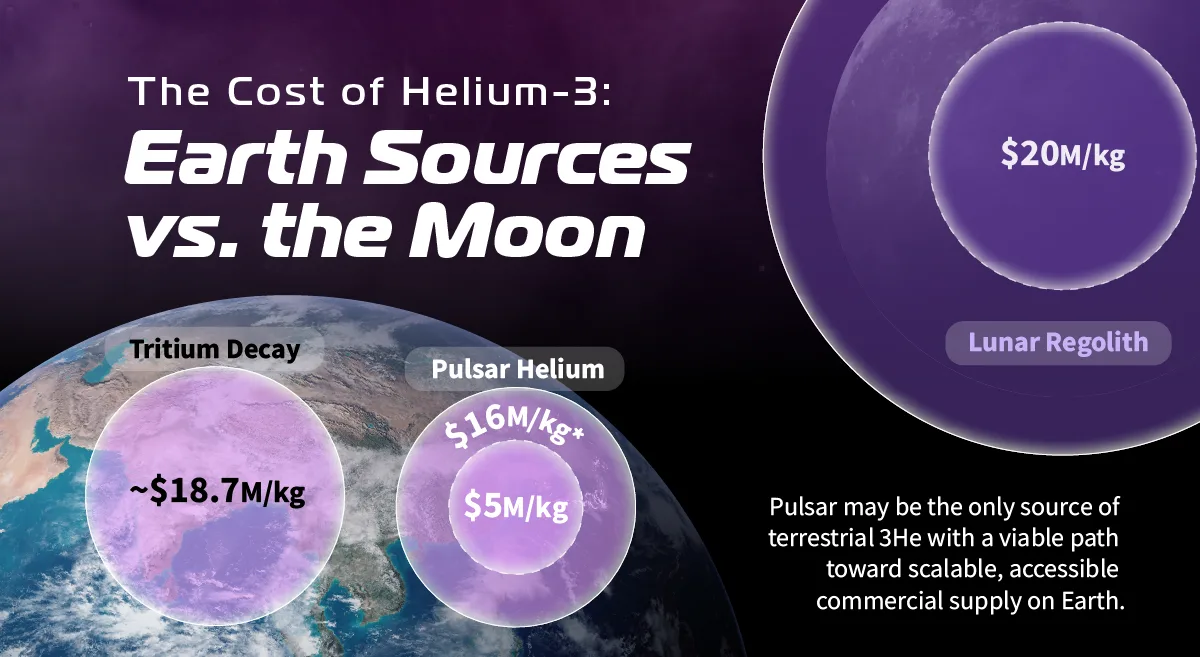




The Cost of Helium-3: Earth Sources vs. the Moon
Key Takeaways
- Earth-based sources of Helium-3 are currently far easier and cheaper to access than surface of the moon and its lunar regolith.
- Lunar He-3 may offer larger theoretical scale, but mining, extraction, and return logistics remain major barriers.
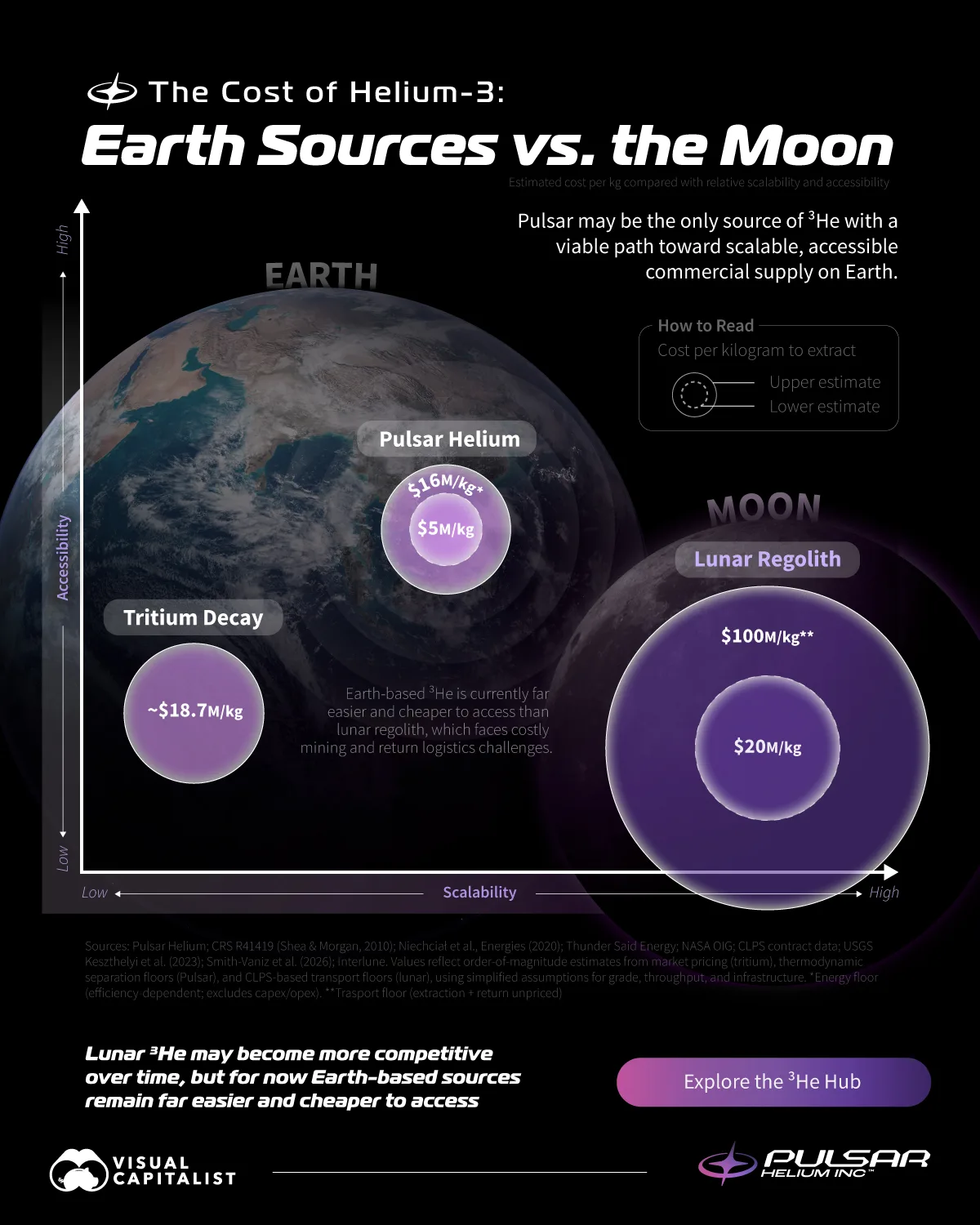
When it comes to Helium-3, the biggest cost divide is between Earth and the Moon. Potential sources range from tritium decay and terrestrial helium wells on Earth to lunar regolith on the Moon. Today, Earth-based sources remain far easier and cheaper to access.
This graphic, created in partnership with Pulsar Helium, compares major potential sources of Helium-3 by cost, scalability, and accessibility. It’s part three of four in the Helium 3: From Theory to Opportunity series, delivering key He-3 insights for investors tracking deep tech, critical minerals, and advanced computing.
The Extraction Cost of Helium-3
Looking at cost alone, Earth-based sources currently have a major advantage over Moon-based He-3.
| He‑3 Source | Cost per kg to Extract | Scalability | Accessibility |
|---|---|---|---|
| Tritium Decay (Earth) – Market | ~$18.7M | Low | Moderate |
| Tritium Decay (Earth) – Unsubsidised | $60–100M | Low | Low |
| Pulsar Helium (Earth) | $5–16M | Moderate | Moderate |
| Lunar Regolith (Moon) | $20–100M | High (theoretical) | Very Low |
Values reflect order‑of‑magnitude estimates from market pricing (tritium), thermodynamic separation floors (Pulsar), and CLPS‑based transport floors (lunar), using simplified assumptions for grade, throughput, and infrastructure.
Tritium decay is an existing Earth-based source, tied to nuclear weapons stockpiles. The tritium used in warheads decays into He-3 and is recovered during processing; however, supply is limited by nuclear stockpiles and government control.
Lunar regolith refers to the Moon’s surface material, where He-3 is believed to have accumulated from solar wind particles over time. Extracting He-3 would involve mining the Moon’s surface material, processing it to release gases, separating the He-3, and then returning it to Earth.
Pulsar sits between these two extremes by accessing Earth-based helium deposits using similar drilling technology as used for natural gas wells. The cost estimate is based only on the theoretical energy needed to separate He-3 from a gas stream, and excludes capex, labour, and other operating costs.
Comparing Source Scalability
Cost is only one part of the He-3 supply story. Each source also has a very different path to scale.
- Tritium Decay: Low scalability, because supply is capped by nuclear stockpiles.
- Pulsar Helium: Moderate scalability, with the potential to scale through terrestrial wells.
- Lunar Regolith: High theoretical scalability, based on a large inferred resource on the Moon.
For tritium, without government subsidies, the price grows significantly further reducing scalability and accessibility.
How Easy is Helium-3 to Access?
Accessibility is the other major difference between Earth and lunar sources.
- Tritium Decay: Moderate accessibility through existing infrastructure, but largely government-controlled.
- Pulsar Helium: Moderate accessibility, with earth-based sourcing.
- Lunar Regolith: Very low accessibility, with no current mining or return logistics.
Lunar He-3 may become more competitive over time, but for now, the only sources available are Earth-based.
Helium 3: From Theory to Opportunity
The rising demand for He-3 is putting new pressure on supply. Though lunar mining may one day become part of the long-term story, the near-term opportunity is much closer to home.
For investors, the key question is not just how much He-3 exists, but how realistically it can be produced and delivered. Scalability and accessibility shape how quickly a resource can move from concept to market.
-

 Energy12 hours ago
The Top 10 Signals Pulsar Is Leading the Helium‑3 Race
See the top signals that Pulsar Helium is leading in the Helium-3 race, from high-grade helium discoveries to an Earth-based supply pathway.
-
 Energy16 hours ago
Helium-3’s Projected Demand Rise Through 2035
See how Helium-3 demand is projected to grow nearly 14x by 2035 for quantum, cryogenics, and fusion research using this rare isotope.
-
 Energy19 hours ago
Helium-3: The Most Powerful Fuel by Energy Density
See how Helium-3 compares to other major fuel sources by energy density, from uranium and hydrogen to gasoline, coal, and wood.