
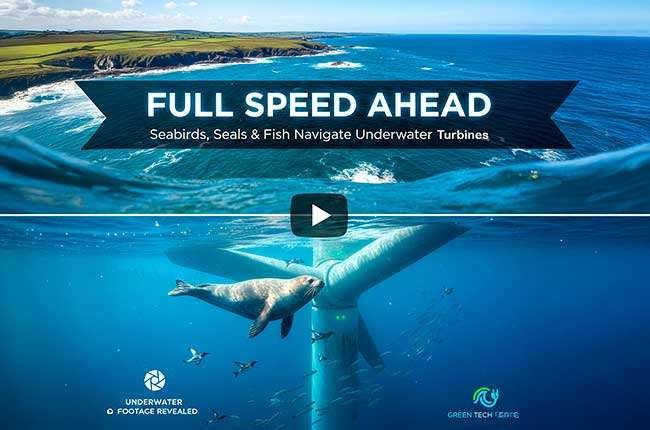
Beneath the churning, slate-grey surface of the Pentland Firth, a narrow channel separating the Orkney Islands from the northern tip of Scotland, a quiet revolution is unfolding. Here, where the North Atlantic meets the North Sea, some of the planet’s most powerful tidal currents race at speeds of up to 11 miles per hour. And in the heart of this aquatic tempest sits the Orbital O2, a 74-meter-long tidal stream turbine, its twin rotors harvesting the moon’s gravitational pull to power 2,000 UK homes with clean, predictable energy.
Yet, the most compelling story isn’t just flowing from its export cable to the grid. It’s captured in a series of underwater photographs and video footage that have sent ripples through both the marine energy and environmental conservation communities. The images show something unexpected, even poetic: seabirds like guillemots diving for fish, Atlantic seals on the prowl, and large pollock navigating the flow—all actively and calmly avoiding the 20-meter rotor blades as they spin. Far from creating a zone of danger, this towering piece of human engineering appears to have become an integrated, and perhaps even beneficial, part of the local ecosystem. For a technology often grappling with the “out of sight, out of mind” challenge, this visual evidence is a game-changer. It suggests we’re not just building machines; we might be learning how to build better neighbours.
A Serendipitous Snapshot
The revelation came not from aggressive marketing, but from rigorous environmental monitoring. Orbital Marine, the turbine’s developer, equipped the O2’s floating superstructure and seabed mounts with a suite of cameras and acoustic sensors. This was a duty of care, a non-negotiable step to fulfil licensing requirements and prove the project’s harmony with its environment. The team expected to see marine life. They expected to document a lack of catastrophic collisions. But the nuance of the behavior they captured was striking.
The footage reveals not panicked evasion, but aware, deliberate maneuvering. A seal approaches, investigates the slowly spinning nacelle with apparent curiosity, and peels away with a powerful stroke of its flippers. Schools of fish adjust their paths upstream, sensing the pressure change created by the turbine’s support structure. Diving birds, expert anglers of the undersea world, give the rotating blades a wide berth, focusing instead on the forage fish gathering in the turbine’s wake. This isn’t a scene of disruption; it’s a display of intelligent co-existence.
Dr. Sue Rodger, a marine ecologist not directly involved with the project, reviewed the footage. “What we’re seeing is profoundly encouraging,” she notes. “Marine animals are highly attuned to their environment. They detect currents, vibrations, and pressure gradients. The turbine presents a large, predictable, and relatively slow-moving object in a dynamic seascape. It seems they are perceiving it as just another geographic feature—a cliff face or a large rock—to navigate around. The alternative, a ship’s propeller or dredging trawl, is fast, unpredictable, and deadly. This is a critical distinction.”
The “Reef Effect” and a New Kind of Predator
The observed behavior aligns with a well-documented ecological phenomenon: the “artificial reef effect.” Any submerged structure, from a sunken ship to an offshore wind turbine foundation, begins to accumulate life. Algae colonize the surfaces, attracting barnacles and mussels. These, in turn, draw in small fish seeking food and shelter, which then attract larger predators. The O2’s massive steel legs and mooring chains are likely already beginning this process, creating a new oasis of biodiversity in a sandy or rocky channel.
But the turbine adds a dynamic element: moving parts. The key to the peaceful co-existence appears to lie in the fundamental physics of tidal stream energy. Unlike the blindingly fast tip-speeds of wind turbine blades or ship propellers, a tidal turbine’s rotors turn with a deliberate, majestic slowness, optimized for torque in dense water. The blades of the O2 spin at a rate of approximately 15 revolutions per minute. For a marine animal, this presents a predictable, visible obstacle, not an invisible blender.
“Think of it as a slowly revolving door in a busy hotel, rather than a food processor,” explains an Orbital Marine engineer. “The marine life has ample time to sense and react. The sound profile is also significant—it’s a low-frequency hum and swoosh, not the chaotic, high-frequency noise associated with fossil fuel extraction or shipping, which is known to disrupt marine mammals.”
Full Speed Ahead: Confidence for a Nascent Industry
The visual evidence from the Pentland Firth arrives at a pivotal moment. The tidal stream industry stands on the brink of commercial scalability, with projects planned from Canada’s Bay of Fundy to Japan’s Naru Strait. Yet, a perennial hurdle has been securing social and regulatory license. Concerns about impacts on marine mammals, fish migration, and seabirds, while always necessary, have often been based on hypothetical models rather than real-world, in-situ data.
“This footage is our most powerful tool,” says a project developer for a planned array in Wales. “It moves the conversation from ‘what if’ to ‘look here.’ We can show communities, regulators, and investors tangible proof that this technology can operate in balance with a healthy marine ecosystem. It de-risks projects emotionally and financially.”
The implications extend beyond single devices to the future of large-scale arrays. Understanding how different species behave around one turbine allows for smarter array design—spacing turbines to create natural corridors, orienting them to align with known migration paths, and using the data to inform placement from the outset. The goal shifts from mere mitigation to proactive ecological design.
A Deeper Lesson in Coexistence
The story of the O2 and its aquatic neighbors offers a broader lesson as we seek to re-power our civilization within planetary boundaries. It demonstrates that low-impact renewable energy is not a vague aspiration but an achievable engineering reality. It shows that with thoughtful, nature-informed design—prioritizing slow movement, minimizing noise pollution, and using non-toxic materials—our infrastructure can become part of the ecological fabric, not a tear in it.
The silent, spinning sentinel in the Pentland Firth is doing more than generating megawatts. It is generating understanding. It is proving that the relentless, clean power of the tides can be harnessed without sacrificing the vibrant, teeming life within them. In an era of climate crisis and biodiversity loss, this harmonious vision is not just promising; it is essential. The path forward is clear, and thanks to a few illuminating underwater images, we can proceed with renewed confidence. For tidal stream technology, and for our relationship with the blue heart of our planet, it is unmistakably full speed ahead.
The post The Silent Guardian: How a Tidal Turbine Became an Unlikely Marine Sanctuary first appeared on Green Tech Gazette.


