
Picture yourself in a wind-swept forest. Leaves are rustling and trunks are creaking as trees sway to and fro. This oscillation might seem precarious, but it’s actually an ancient adaptation: If pines and firs and all the others were perfectly stiff, a gust would snap them. So instead, they flex.
Now teleport yourself to the top floor of a skyscraper during the same windstorm, ever so slightly bending in the same way. A tree’s clever evolutionary trick, you see, has made the modern metropolis possible: As towers reached higher and higher in the early 20th century, architects used not wood but steel to create giants that would similarly flex in hurricane-force winds and as earthquakes rattled their foundations.
But as the world gets hotter and wildfires more intense, architects are turning back to trees for more than inspiration. Engineered materials like cross-laminated and glue-laminated timber, in which layers of wood are glued together, create beams that are tough and somewhat flexible, yet lightweight. They’re so strong, in fact, that designers are crafting wood structures that are 15, 20, even 25 stories high: In 2022, the 284-foot Ascent MKE Building opened in Milwaukee, Wisconsin, becoming the world’s tallest timber building.
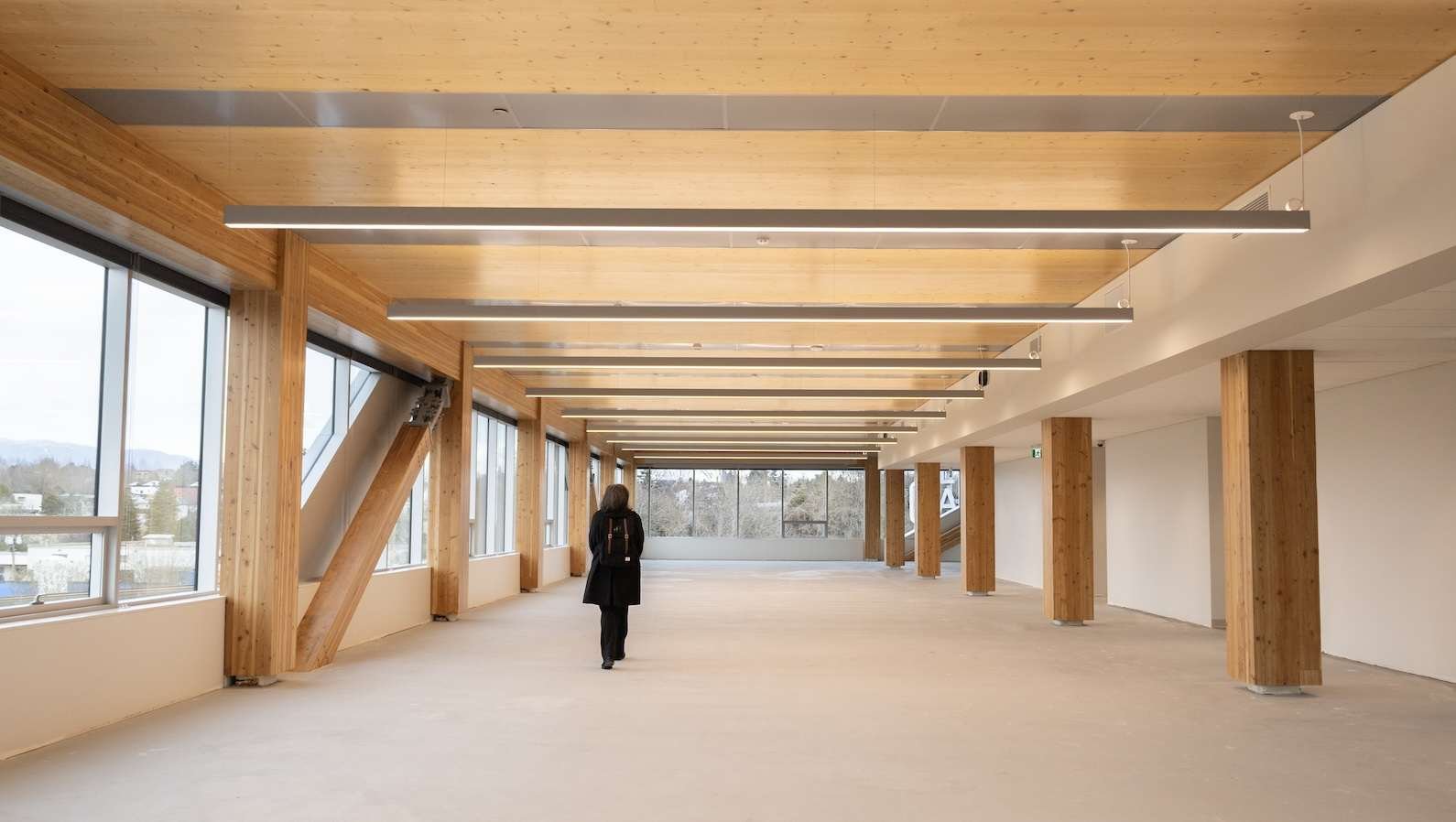
It’s exactly because the world is getting hotter that architects are pushing the limits of how tall they can build with “mass timber,” as it’s known in the field: As trees grow, they capture planet-warming carbon, which is then permanently incorporated into the edifice. To that end, last month crews completed a 10-story building in Vancouver, called the Hive, which is now North America’s tallest brace-framed, seismic-force-resisting (meaning it shrugs off earthquakes) timber structure. “I think we’re going back to how we used to build, which was with more wood,” Lindsay Duthie, an architect at Dialog, the firm that designed the property.
Courtesy Fast + Epp
For thousands of years, humans were stuck with natural building materials: wood, adobe, granite. The industrial revolution unlocked the power of steel, but at an environmental cost, as its production has spewed heaps of carbon. Laminated timber, on the other hand, is not only more environmentally friendly, but also perfectly safe for structures much larger than your house.
Because this resource is engineered, it can come from small- and medium-sized trees. That is, instead of having to form single beams from huge old-growth behemoths, bits can be sliced, layered, and glued together. This harvesting can help improve forest health, as agencies like the U.S. Forest Service remove some stands to prevent overcrowding and reduce the risk of catastrophic wildfires. (A long modern history of suppressing fires has nixed the ecosystem’s natural way of thinning itself. Lightning strikes, for instance, would ignite blazes that cleared out some vegetation while leaving the forest intact. This spurred new growth and attracted grazing animals like deer, boosting biodiversity.) While it takes a lot of work to mine and process the iron needed to make steel — a process that scars the landscape — wood structures use material from ecosystems that, if managed properly, can keep growing more cross-laminated timber for more construction.
The Hive, though, can’t resist seismic forces with wood alone. It’s equipped with Tectonus dampers, which are essentially giant shock absorbers that dissipate energy and recenter the building after an earthquake. Elsewhere, on a large shake table at the University of California, San Diego, researchers deployed a different technique in a 10-story timber structure. At the building’s core sat a large piece of mass timber, called a rocking wall, anchored to the foundation with high-strength steel rods. The researchers simulated 88 earthquakes, and the timber building survived them all with no damage. “It performed phenomenally,” said Shiling Pei, professor of civil and environmental engineering at the Colorado School of Mines.
Courtesy Fast + Epp
That structural integrity is not only important for keeping occupants safe, but for sustaining the sustainability of a mass timber structure. If an earthquake damages a building, repairing it will result in CO2 emissions. Worse, you may have to demolish the structure and start from scratch. A properly designed timber building can capture carbon in its wood — and keep it there for years and years. “You build not only a sustainable structure, but also a resilient structure,” said Alessandro Palermo, a structural engineer at the University of California, San Diego, who studies mass timber.
Which is all not to say that one of these wooden buildings is fully devoid of steel. The timber beams are attached with metal brackets, for instance. And timber buildings still sit on sturdy foundations of concrete, the production of which releases enormous amounts of carbon, though engineers are working to make it more environmentally friendly.
But isn’t building a giant structure out of wood just asking for it to go up in flames? No, because building regulators in British Columbia or anywhere else wouldn’t approve these plans if they were excessively flammable. And laminated timber is designed to form a protective char layer if it catches on fire, insulating the structural integrity of a beam from the flames. “If you have a campfire, you end up at the end of the night with black logs,” Duthie said. “That’s the char layer that actually acts as a protective coating that prevents it from burning further.”
And compared to the sterility of exposed steel and concrete in a building’s interior spaces, wood has a fundamentally different feel for the occupants. “It has a tactile quality about it that people sort of want to interact with,” said Katie Mesia, firmwide design resilience co-leader at the architecture company Gensler. “I think that is just part of who we are as humans. That desire to be close to nature has always been there.”
One day soon, then, you might find yourself safely in a mass timber building — the evolutionary brilliance of a forest repackaged with human ingenuity.
This story was originally published by Grist with the headline The skylines of the future will be made of wood on Apr 10, 2026.


