

A research team from France has studied the wind flow dynamics over PV power plants. Based on their findings, the team also proposed a generalized parameterization of the mean wind velocity profile for PV canopies, enabling the introduction of directional aerodynamic effects of PV parks into land–atmosphere models.
“While the effect of PV parks on local wind flow has been studied through modeling or wind-tunnel experiments, long-term field measurements of turbulence over a full-scale PV park remain scarce,” corresponding author Shunko Bolsée told pv magazine. “Our study is based on nearly three years of continuous wind and turbulence measurements above a 140-hectare PV park in southwestern France, compared directly with a nearby pine forest.”
Bolsée added that the three years’ worth of measurements allowed his team to characterize how wind direction relative to the panel rows controls turbulence and momentum exchange over a PV park. “This research is only the first step,” he added. “We are currently developing a surface model representing the aerodynamic and energy exchanges of PV parks, which will be evaluated against our in-situ measurements.”
The solar park under consideration is located in Salaunes in southwestern France. Its solar panels are installed in east–west-oriented rows, tilted southward by approximately 24◦ and azimuthally oriented by −3◦ toward the south, reaching a maximum height of 1.9 m. The panel width is 3.23 m, and the panel rows are spaced 3.4 m apart. The clearance under the solar panels was about 60 cm, while 20-m-tall maritime pine trees surrounded the park itself.
The wind flow dynamics of this solar park were compared to those of a 10.5 m-tall maritime pine forest, located 47 km away. Both sites were measured between July 2022 and May 2025, using an 8 m meteorological tower carrying a set of sensors, such as 2D anemometers that measure vertical wind profiles and 3D sonic anemometers that record three-dimensional wind velocity and turbulence. After quality filtering, 744 valid 30-minute measurement periods were analyzed.
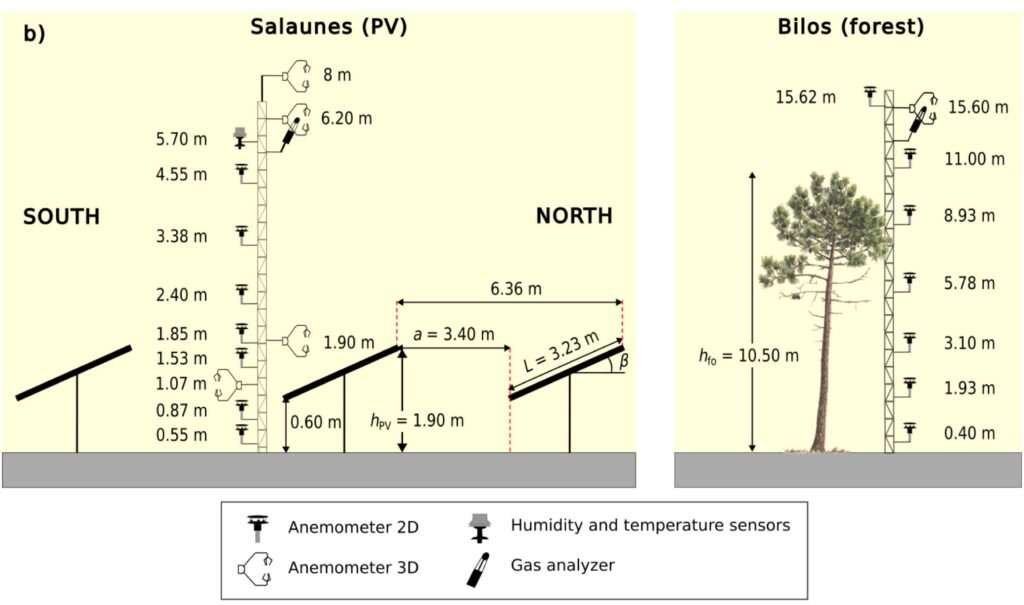
“The most striking finding is how strongly the aerodynamic behavior of the PV park depends on wind direction,” Bolsée said. “When the wind blows perpendicular to the panel rows, the park behaves like a dense vegetation canopy, with an inflection point in the wind profile and turbulence dominated by coherent, sweep-like motions — very similar to what is observed over forests. But when the wind blows parallel to the rows, the same park behaves completely differently, more like a rough boundary-layer flow, with weaker drag and a simple logarithmic wind profile.”
According to the results, when the wind blew perpendicular to the panel rows, the PV array exhibited a shear length scale of 0.8- 1.2 times the height of the PV canopy (hPV), a turbulence intensity of about 0.50, and a momentum transport efficiency of about 0.40, comparable to the values measured over the nearby forest. In contrast, winds parallel to the panel rows produced a much weaker-shear regime, with the shear length scale increasing to about 4 hPV, turbulence intensity decreasing to approximately 0.25, and momentum transport efficiency falling to about 0.25. Turbulence anisotropy increased from around 5–7 under perpendicular winds to about 9 under parallel winds.
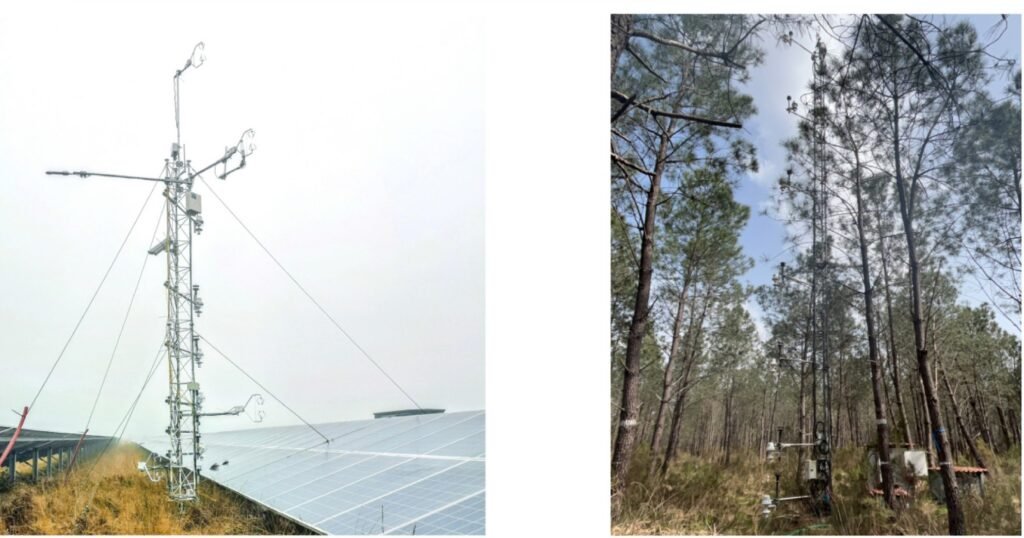
Based on those results, the team developed a simple, physically based parameterization of the wind velocity profile over PV parks, which depends on wind direction and a few key geometric characteristics of the PV array. The model couples a logarithmic law with a roughness-sublayer correction above the PV canopy and an exponential–logarithmic formulation within the canopy.
“The next step will be to couple this surface model with a large-eddy simulation (LES) atmospheric model, to simulate and quantify how PV parks of different sizes and designs affect local and regional weather depending on their structural characteristics such as panel tilt angle, row spacing, array layout, and ground cover/vegetation,” concluded Bolsée.
The findings were presented in “Wind flow dynamics over a photovoltaic power plant: Comparison with a vegetated canopy,” published in Agricultural and Forest Meteorology. Researchers from France’s National Research Institute for Agriculture, Food and the Environment (INRAE) contributed to the study.
The post Three-year testing assesses wind flow dynamics in solar plants appeared first on pv magazine Global.


