

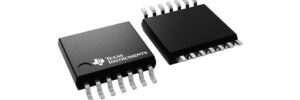
Texas Instruments (TI) has introduced the TMCS2100-Q1, a coreless Hall-effect current sensor for hybrid and electric vehicle traction inverters that measures the magnetic field around a conductor in both the horizontal and vertical directions rather than on a single axis.
The company says displacement error is less than 1% at 0.4 mm of movement and as low as 0.25% at 0.1 mm, and calls the multiaxial approach 20 times more accurate than single-axis coreless alternatives. This precision improves the torque control loop in the EV powertrain, according to TI, maximizing efficiency and power delivery across varying load and thermal conditions.
Hall-effect current sensors detect the magnetic field produced by current flowing through the busbar that typically connects the traction inverter to the motor. Vibration in a running vehicle creates movement between the sensor and the conductor, and single-axis differential coreless sensors lose accuracy as that spacing changes. Measuring both axes at once reduces the vibration-induced error, TI says, which limits magnetic crosstalk and torque ripple, a cause of jerky acceleration, motor noise and inefficient operation that cuts range.
Sensors built around a magnetic core, or C-core implementations, measure accurately but add size and weight, and coreless designs are smaller but give up precision to displacement error and magnetic crosstalk, according to TI. Existing differential coreless parts require busbar modifications such as notches, slices or holes that can complicate thermal management. Positioning multiple sensors relative to the busbar leaves it unmodified, which TI says lets designers adapt more easily to mechanical configurations, optimize board space and reduce overall traction inverter size.
Production quantities of the TMCS2100-Q1 are available on request. An evaluation module, a characterization module and a reference design are also available.
“For the first time, engineers have a Hall-effect current sensor that breaks through the limitations of existing solutions, which is especially critical as 800 V architectures raise the bar for traction inverter accuracy,” said Jason Cole, TI’s Vice President and General Manager of Sensing Products.
Source: Texas Instruments


