
For Kaitlyn Kitzan and her parents, who farm together near Theodore, Sask., farm stress looks different.
Not only do they use different language when talking about stress, they manage it differently, too, Kitzan says.
“When I moved back to the farm, I would ask my dad how his mental health was and he would laugh at me,” she says.
But for Kitzan and her brother, who are both involved in the family’s mixed grain and cattle operation while balancing off-farm jobs, stress management is a top priority.
Kitzan, who has struggled with anxiety issues as an adult, says while her parents’ generation was more inclined to internalize stress and avoid conflict, her and her brother are more prone to talk about these topics.
“I think for my parents it was really about tough it out, just get through it, you figure it out,” says Kitzan, who is also involved in the Do More Agriculture Foundation, which champions mental health in agriculture.
“I think that’s the main difference between the generations, the difference between toughing it out and talking it out. Maybe we don’t have to tough it out.”
Regardless of generation, experts say that regulating stress responses on the farm is increasingly important, as we learn more about the unique challenges farmers face.
In fact, farmers are more at risk of stress-related issues than many other professions, says Dr. Briana Hagen, chief executive officer of the Canadian Centre for Agricultural Wellbeing (CCAW).
“What the data actually shows us, and has been showing us for years now, is that farmers are experiencing things like anxiety, depression, chronic stress, burnout, at higher prevalences compared to other occupations in Canada and compared to the general population,” she says.
“There’s also elevated prevalence of suicidal ideation.”
Recent Canadian research also shows that mental health challenges are widespread in the sector. A national survey of more than 1,100 farmers found that about 76 per cent reported experiencing moderate or high stress, 57 per cent showed symptoms of anxiety and 35 per cent demonstrated symptoms of depression.
What makes farming uniquely stressful?
For younger farmers like Kitzan, one of the biggest challenges is the growing difficulty of making a living from the farm alone. She says her brother and herself balance farming with off-farm jobs.
“Our farm’s just not large enough for both of us to live off farm income, plus give my parents the retirement that they deserve.”
As a result, she is left with little spare time.
The challenges involved with expanding businesses also weigh heavily on young farmers, as farmland prices in Canada have roughly doubled over the past decade, and in many regions are three to four times higher than they were about 20 years ago.
As farms get larger and land is often scarce or unaffordable, young farmers are left trying to figure out how to stay viable, Kitzan says.
Even everyday management decisions have become more complex. While innovation has brought new tools and technologies to the sector, it has also created an overwhelming number of choices.
“My dad says there used to be this chemical and this chemical, and you just chose between two,” Kitzan says. “And now, we have 20 to choose from. There’s so much information overload.”
Farmers must also navigate a growing web of policies, programs and regulations, as well as rising costs, unpredictable weather and complex global, geopolitical events that have an impact on markets.
Kitzan says the role of the farmer has also evolved dramatically over time.
“Lots of farms were just treated as farms,” Kitzan says. “Now they’re treated as multi-million-dollar businesses.”
On top of this, Hagen says another element of stress is that farmers often see their businesses as an extension of their identities.
“When you live and work on a generational farm, your identity is really wrapped up in being a farmer,” she says. “It’s not just a career and a job. It’s your generational livelihood. It is your pride in taking care of the land or creatures.”
She says the uncontrollable factors involved with farming also contribute to the uniquely stressful aspect of the job.
“You can make really good business decisions, or what look like really good business decisions, and then it doesn’t rain all year, and you have absolutely no control over that, but it can destroy your livelihood,” Hagen says.
“You put all your money into the ground in the spring, and then you just wait.”
Finally, Hagen believes that increasingly negative public attitudes towards farming have added another layer of stress to the job in recent years.
“The way people talk about farming has changed. The way people talk about farmers has changed,” she says.
Proven ways to manage stress
While Kitzan believes her generation is getting better at talking about farm stresses to manage them, Hagen says older generations may have relied more heavily on less healthy responses and coping mechanisms.
“There’s a lot of stoicism in farming,” she says. “Not talking about it at all is a coping mechanism — shoving it down and doing nothing.”
Substance use, particularly alcohol, can also be associated with mental health struggles in farming, she says, and coping patterns can differ between men and women.
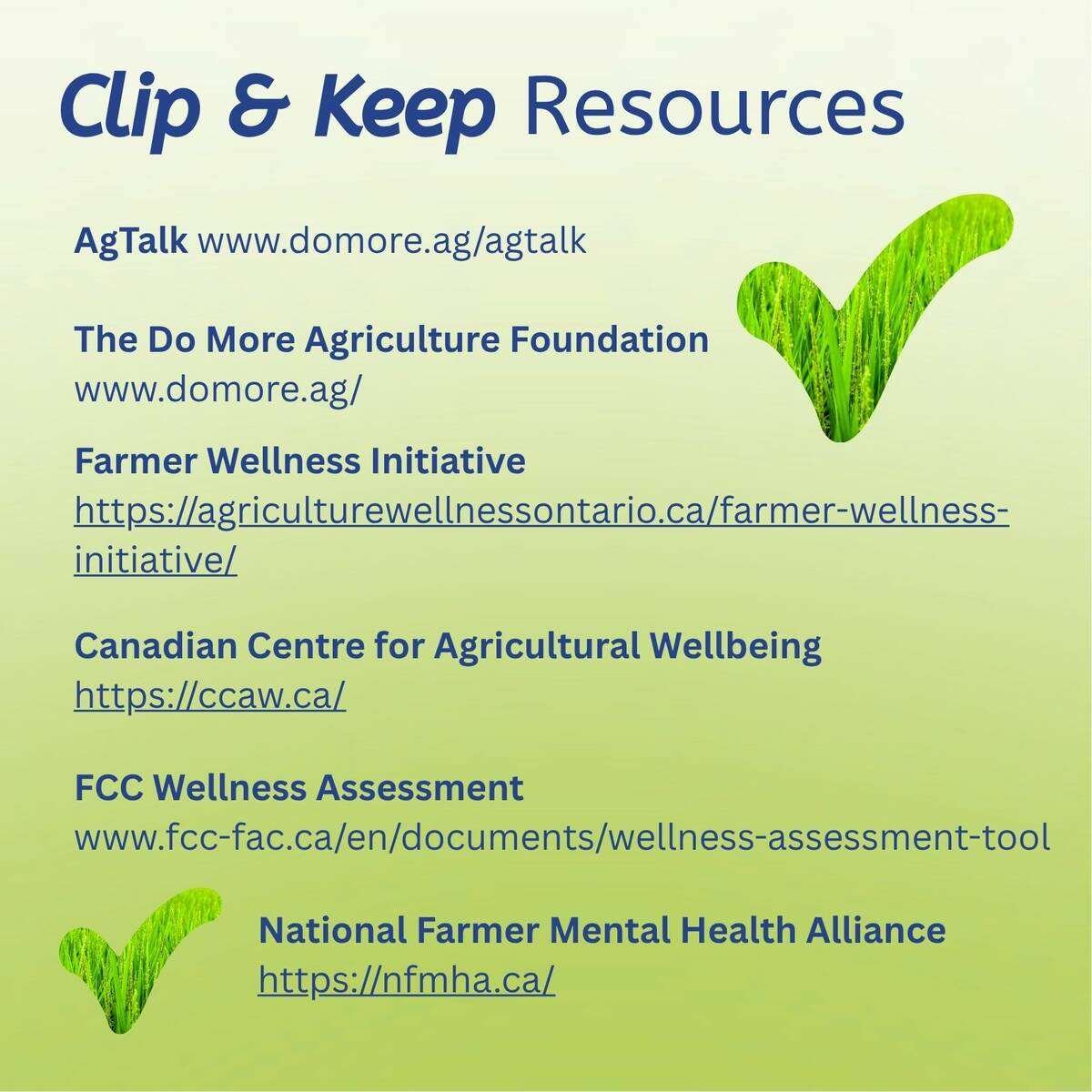
However, she says in recent years we have learned a lot about evidence-based ways farmers can manage stress before it escalates into a crisis and organizations like hers are providing them with the education and resources to do so.
READ MORE: Mental health affects decision-making on the farm
She says the most important first step is simply understanding what mental health struggles look like.
“What we found early on in our research was that farmers didn’t really know what mental health struggle looked like, or how to self-regulate or self-identify when maybe something was going on,” she says.
Because mental health language doesn’t always resonate in farm communities, Hagen says conversations often start with physical symptoms, for example, a racing heart.
She says it’s also important for farmers to recognize that stress response and mental health issues don’t only fall into extreme categories.
“Well-being is not just being ‘OK’ or being suicidal. There’s a huge spectrum there that I think folks still don’t fully understand.”
Building the ability to recognize signs of stress and mental health struggles can make a significant difference, she says, but farmers also need to learn when to start talking about potential issues.
For example, she says in her work farmers have often told her they had recognized a neighbour was struggling but hesitated to speak up because they “didn’t want to make it worse.”
Learning how to talk about mental health can make those conversations easier and more productive, she says.
Another big win for managing farm stress is the fact that access to professional support for farmers across the country has also improved significantly in recent years.
“We now have coast-to-coast national access to evidence-based services,” Hagen says, adding that the CCAW’s National Farmer Crisis Line was launched last year and is specifically tailored to support Canadians working in the agriculture sector.
“The folks on the end of the line are all trained in what it’s like to be a farmer.”
Kitzan says she also believes there are many simple, on-farm tools that can be extremely helpful in monitoring and managing stress levels day to day.
She says she often uses a “battery” analogy when talking about mental health with other farmers.
“Where’s your battery level at?” she asks. “‘I’m 100 per cent, I’m ready to go. Or ‘I’m 80 per cent. I didn’t have the best sleep last night but I’m still feeling pretty good’.”
The idea is to recognize early warning signs before stress becomes overwhelming, she says.
“Thirty and under, you’re kind of in the red zone, just like your phone,” she says. “You’re probably needing professional help.”
Kitzan says everyone recharges differently, but paying attention to basic needs often makes the biggest difference.
“For me it’s sleep and exercise,” she says, adding that she’s found even small actions can help during busy seasons.
“If you’re filling up with fuel, run around the tractor a few times just to get some movement. Don’t overcomplicate it.”
Having a trusted person who can recognize when stress is building is also important, she says.
“I’m the worst at recognizing stress within myself,” Kitzan says, adding that she relies on her mother for help. “She knows where my levels are.”
Maintaining connections outside the farm can also help farmers recharge, she says.
“I know when I’m busy, I sometimes forget about friends and family.”

Finally, Kitzan says planning time away from the farm — even briefly — can help farmers reset before intense seasons of work.
“For my brother and I, we’ve really identified what fills our cup,” she says, adding this is why they both took vacations this spring, to recharge before a busy calving season on the farm.
A shift away from silence
In the end, both research and farmers’ experiences point to the same lesson: recognize stress early, stay connected and ask for help when needed to prevent small struggles from becoming larger crises.
This will be increasingly important going forward as the pressures facing farmers today remain significant.
Despite this, many in the sector say there has also been real progress in how the industry understands and supports mental health in recent years.
In the past five years alone, awareness has grown, conversations have become more open, and new resources have emerged specifically designed for farmers. All these developments are making an impact on the ground, experts say.
While Hagen says she can’t share statistics of usage of the National Farmer Crisis Line due to privacy reasons, she can say that it was much higher in the last year than expected, with calls coming in from across the country, from both men and women.
Kitzan recalls speaking with a farmer who, after much hesitation, called the line during a particularly stressful time last growing season and continued to call it regularly after.
“He said, ‘I literally just felt like I had a friend who I called for an hour every week, and we talked about the farm.’”
Kitzan says the same farmer then told her that was the best growing season he ever had.
And that shift — from silence toward conversation, from managing stress before it becomes an overwhelming problem — may be one of the most important developments for farmers of all generations.
The post Tough it out or talk it out? Ways to manage mental health in agriculture appeared first on Farmtario.


