
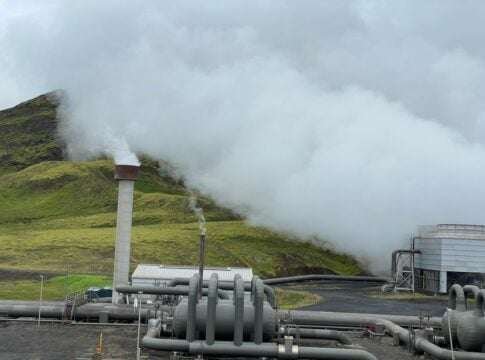
Next-generation geothermal energy is moving from the margins to the center of the clean power conversation. Analysts say technology improvements and rising demand for 24/7 clean electricity are opening the door for geothermal to scale in ways that were not possible before. Annick Adjei, senior research analyst for upstream and subsurface carbon management at Wood Mackenzie, summed it up clearly. She said next-gen geothermal was “fundamentally changing the energy landscape” by making a reliable, around-the-clock clean power source available in far more places than before.
That momentum is already showing up in the money. The geothermal sector attracted US$1.7 billion in funding in Q1 2025 alone, a signal of strong confidence from investors looking for firm clean energy solutions. Against this backdrop, Fervo Energy—the leading name in next-generation geothermal—announced the close of its oversubscribed US$462 million Series E round, led by new investor B Capital. The scale of the raise reflects the growing belief that geothermal could play a crucial role in building a fully decarbonized energy grid.
Fervo Gets Funding Boost to Scale the World’s Largest Next-Gen Geothermal Project
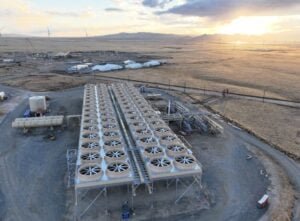
The new capital will speed up Fervo’s development plans, especially the buildout of Cape Station in Beaver County, Utah. Cape Station is on track to become the largest next-generation geothermal development in the world. The facility will start delivering 100 megawatts (MW) of firm clean electricity to the grid in 2026. Fervo plans to add another 400 MW by 2028, bringing total capacity to 500 MW.
Construction has been progressing rapidly, driven by significant operational improvements. Drilling times have fallen with every new well, and overall efficiency has climbed. These improvements help bring costs down and reduce development risk, which is critical as utilities and grid operators look for stable sources of clean power.
At the same time, the United States’ power sector is facing a major turning point. Electricity demand is rising rapidly due to electrification, the growth of data centers, and the expansion in advanced manufacturing. Yet supply has not kept pace. This mismatch is creating a once-in-a-generation chance for new energy resources to break in.
Snapshot of Cape Station in Beaver County, Utah
Investor Confidence Continues to Rise
Fervo continues to attract top-tier investors who view geothermal as the next scalable zero-carbon resource. The Series E round drew a wide mix of new and returning backers. New investors included AllianceBernstein, Atacama Ventures, Carbon Equity, Climate First, Google, Mitsui & Co., Dr. Kris Singh of Holtec International, and JB Straubel. Returning supporters such as Breakthrough Energy Ventures, CalSTRS, Capricorn Investment Group, CPP Investments, DCVC, Devon Energy, and Mitsubishi Heavy Industries also joined.
Centaurus Capital’s participation was notable. The firm recently made a US$75 million preferred equity commitment to support Cape Station Phase I and also joined the latest round. The ongoing interest highlights how geothermal is increasingly appealing to both climate-focused funds and traditional energy investors.
Geothermal: A Clean Energy Source With Minimal Environmental Footprint
Environmental impacts vary depending on how geothermal energy is used. Direct-use systems and geothermal heat pumps have almost no negative environmental effects and often reduce the need for more polluting energy sources. Even geothermal power plants—which do generate some emissions—produce fewer pollutants compared to fossil fuel plants.
Because geothermal plants don’t burn fuel, emissions are low.
- EIA says they release 97% fewer sulfur compounds and around 99% less carbon dioxide than similarly sized coal or gas plants.
Many facilities also use scrubbers to capture hydrogen sulfide from the geothermal reservoir. Most geothermal plants inject used steam and water back underground, which helps renew the resource and keeps surface emissions close to zero.
Fervo Launches a New Standard for Responsible Geothermal Development
As geothermal development accelerates, Fervo is working to ensure that growth happens responsibly. The company introduced the Geothermal Sustainable Development Pact, a new framework outlining best-in-class standards for planning, building, and operating geothermal projects. The Pact includes 37 commitments across six key areas:
- Community engagement
- Workforce development
- Land use
- Water conservation and well integrity
- Induced seismicity
- Emissions
The Pact goes beyond existing regulatory rules and sets a new bar for responsible geothermal scaling. It also builds on the Principles for Responsible Geothermal Development, which Fervo co-developed with the Sierra Club and which has been endorsed by the Sierra Club and the NW Energy Coalition.
Tim Latimer, Fervo’s CEO and Co-Founder, said the Pact came from the belief that the future of energy needs “not just better technology, but better practices.” He emphasized that collaboration with environmental groups will continue as the framework evolves.
Global Capacity and Geothermal’s Path to a Larger U.S. Grid Role
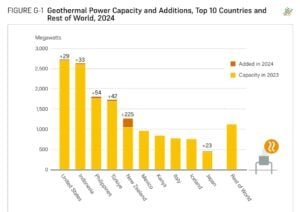
As per REN21’s latest analysis, Global geothermal electricity generation reached 99 terawatt-hours in 2024. During the same year, the world added 400 MW of new capacity, bringing total installed capacity to about 15.1 gigawatts (GW). New Zealand led growth, followed by strong progress in the Philippines, Türkiye, Indonesia, the United States, and Japan.
Next-generation geothermal is attracting attention because it addresses one of the biggest barriers facing conventional geothermal: geography. Traditional geothermal depends on rare underground conditions that exist only in certain regions. But improvements in drilling, well design, and subsurface analytics are allowing developers to tap heat resources in many more places.
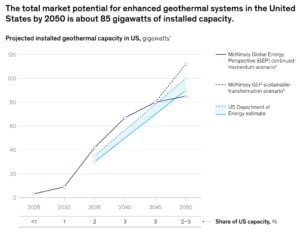
Moving on, according to McKinsey, falling costs, rapid scaling potential, and strong supply chains could help geothermal become a major part of the U.S. energy mix.
- Their analysis suggests next-generation geothermal could supply up to 100 GW of power by 2050, including 40 GW by 2035. That would represent a meaningful share of firm, zero-carbon electricity on the U.S. grid.
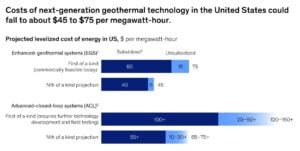
Costs are also expected to drop. Analysts project next-generation geothermal could reach US$45–65 per megawatt-hour for mature, “nth-of-a-kind” facilities within the next decade. While local economic conditions will influence individual project viability, geothermal is expected to outperform other forms of clean, firm power over time.
U.S. Policy, New Wells, and Record Investments Fuel a Geothermal Boom
Under the Trump administration, many renewables face challenges, but geothermal could benefit from a “drill, baby, drill” approach, since it shares techniques with oil and gas. With careful policy support, investment in geothermal could grow significantly.
As of 2025, the U.S. holds 23% of global geothermal capacity, leading the world with 3.7 GW in operation. The latest Global Geothermal Power Tracker shows 223 units in development, adding over 15 GW—almost doubling global capacity if completed.
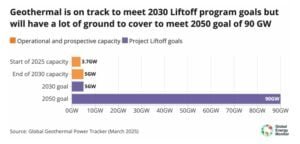
Furthermore, Annick Adjei also highlighted the opportunity: an 80% jump in new wells and nearly US$2 billion in investment show strong confidence in tapping the nation’s vast heat resources. With 500 GW of potential and only 4 GW installed, geothermal could rival traditional oil and gas while delivering always-on, clean power.
To sum up, Fervo Energy, backed by strong investment, is at the forefront of this boom, driving reliable, 24/7 clean energy across the U.S.
The post U.S. Geothermal Boom: Fervo Energy Leads with $462M Funding for Cape Station Project appeared first on Carbon Credits.


