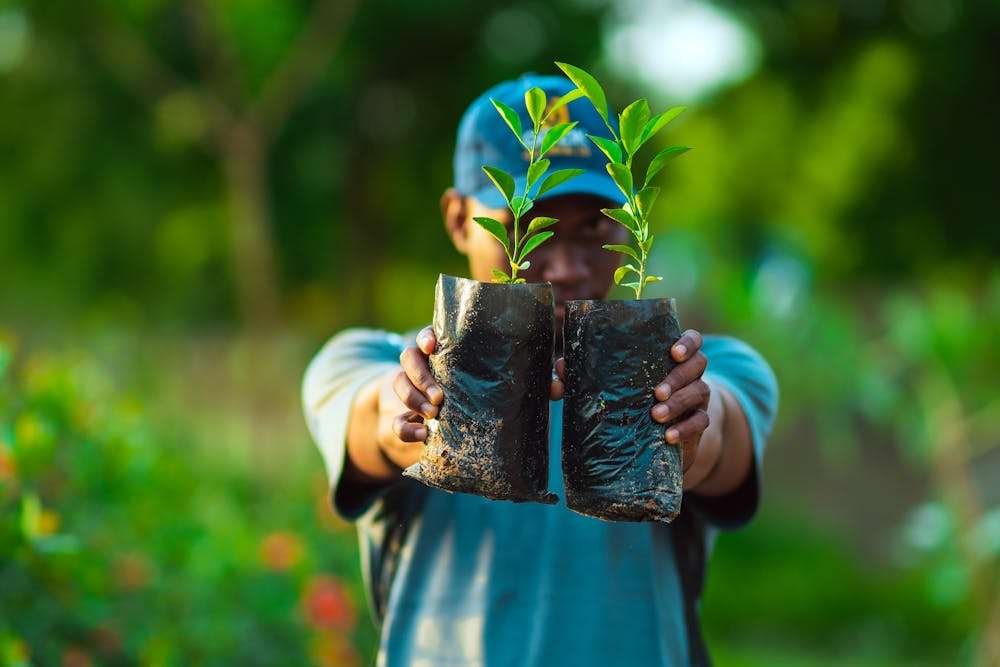
Uganda and Nigeria are developing their bioeconomies to bolster food security, rural resilience, and economic growth.
Agtech and bioenergy are seeing surging policy interest as the countries turn to local biomass for industrialisation and supply stability.
Biochar, plant-based livestock feed, and bioplastics are also drawing private investment, with some startups attracting international attention for innovative methods to valorise agro-waste.
Here is how Nigeria and Uganda are pushing for biobased growth.
Nigeria
Policy shake-up
“This is not just about building factories. It is about building a future where Nigeria becomes a global hub for bio-resources”, announced Nigeria’s Minister of Budget and Economic Planning at a bioethanol workshop in February 2025.
His statement underlined Nigeria’s intensifying commitment to bioeconomy growth.
Already last year, Nigerian experts and officials gathered to update the national biotech policy. Increasing research investments, lab upgrades, and an upgraded regulatory framework were all under discussion.
Motivating the biotech policy shake-up were recent advances in the life sciences and applied fields.
The economic potential of biomanufacturing, synthetic biology, climate-tech and genomic editing is pushing Nigeria to create a policy environment that can nurture these industries domestically.
Bioenergy
Nigeria’s bioeconomy investments have so far concentrated on two main sectors: bioenergy and biobased agtech.
Bioethanol has been the focal point for government efforts so far to scale the bioeconomy. The objective is to boost domestic bioethanol production from cassava.
Nigeria’s Cassava Bioethanol Value Chain Development Project is the fulcrum of this strategy. The scheme, which began implementation this month, will draw cassava feedstock from around 14 million small farmers to manufacture fuel as well as industrial feedstock for diverse chemical industries.
The initiative shows how keen the Nigerian government is to forge stronger links between its agricultural and energy sectors. Geoeconomic factors are a major motive: the government argues that blending bioethanol with petrol could cut dependence on fuel imports and reduce the national energy bill.
Nigeria’s biochar startup
Biobased agtech is another growing sector where private investments are aligning with government priorities in Nigeria.
One of Nigeria’s most internationally renowned biobased startups is Releaf, founded in 2017 by Ikenna Nzewi and Uzo Ayogu, two Nigerian-Americans.
“Using biochar to heal the climate” is their ambitious tagline. Its ultimate goal is to scale-up African production in biochar, a multi-purpose soil conditioner.
Biochar is a dark, crumbly substance made by heating biomass – including waste biomass – in low oxygen environments. It locks up carbon and increases soil fertility.
Releaf’s business model centres around its patented Kraken machine – an oil palm nut de-sheller that processes palm nuts into two sellable products: palm nut oil and biochar made from discarded palm nut shells.
The machine offers farms a way of upcycling waste on-site into a marketable commodity. This lets producers squeeze more revenue and value from the same acreage.
Releaf’s Kraken reportedly operates 25 times faster at shelling palm nuts than local equipment. Its other advantage is quality control: high quality kernels are ready for vegetable oil production rapidly.
An underrated agtech
Releaf’s on-farm system addresses many of the challenges that face Nigerian food security.
In 2025, the nation’s fertiliser imports reached the highest in a decade, 321% higher than in 2020. The country’s dependence on foreign oil-based fertiliser makes its food supply vulnerable to external shocks.
Domestic sources of farming inputs like biochar are crucial if the country is to ease foreign dependence and place its food production on a more secure footing. This is doubly important given that unfavourable growing conditions will become more frequent under climate change.
Biochar can drastically boost crop yields naturally and without expanding tillage. Already, research from South Africa shows biochar application could increase bean yield by 40%, chili peppers by 55% and okra by 10%.
The amendment makes crops so productive because the material retains water and nutrients around the roots. These capabilities make it the perfect organic agricultural aid for arid zones.
Biochar also opens the way towards greater self-sufficiency not only at the country-level but on individual farms. These soil enhancers help food producers restore degraded soils at a lower cost than imported or synthetic soil enhancers, insulating them from volatile international markets for fertiliser.
Uganda
Off-the-grid biogas
Over in East Africa, Uganda is also leveraging local biomass for bioenergy, biomaterials, and bio agtech.
For a country like Uganda where grid power cuts are common, decentralised energy production is key to economic growth.
Reliable energy generation can make or break vital services such as rural healthcare. where grid energy is intermittent or non-existent.
A project run by Biogas Solutions Uganda Limited (BSUL) and the UK’s Inclusive Energy recently set up biogas centres at health sites in remote refugee settlements. The units deliver electricity for medical equipment and refrigeration, with energy generated from waste streams.
Biogas capacity can also have a role in urban environments. This February in Kampala, city authorities and private investors launched a biogas facility that will turn urban organic waste into biogas and liquid biofertiliser.
Biogas technologies in cities offer vital dual functions: both an urban waste management infrastructure and a revenue generator. The biogas plant cleans up dangerous waste from a growing urban population while turning out marketable products that can pay for its own operation.
Africa’s biggest biochar project
Biochar has gained attention in Uganda as a cost-effective way of converting agro-waste to value. For a country where agriculture, forestry and fishing contributed around 24.6% of GDP, it is a value chain that could offer significant value-add.
Uganda’s biochar ambitions hinge on the planned Nile Char Carbon Removal project – a site that would become the African continent’s first large-scale biochar plant. The project cost an estimated $12 million and aims to process over 10 million tonnes of agricultural waste over 20 years.
Foreign partnerships have been integral to the planning. The Ugandan Parliament and Kapala-based climate tech startup Stack Carbon signed a memorandum of understanding last year with Chinese company Jiaxing Tongao Environmental Technology and Norway’s TerraCapX to set the site in motion.
The Elephant Grass value chain
One of Uganda’s most versatile and abundant feedstocks is a plant native to the African grasslands, known as Elephant Grass.
Elephant grass has a long history of economic use in the region. Traditionally, smallholder dairy farmers used it in grazing. With little water and nutrients, it provides precious forage in an arid landscape.
Now, a biorefinery in Fort Portal, Western Uganda, has made Elephant Grass the centre of a new biobased value chain.
Farmers bring grass to be crushed into rich high-protein “cake” for livestock animals. Concentrating the plant’s nutrients in this way allows farmers to maximize the nutrition provided naturally by the landscape.
The biorefinery is firmly embedded into the demands of the local economy, both drawing on local feedstock and supplying local businesses with valuable inputs. Eventually, it plans to expand into other feedstocks like the leaves of beans, alfalfa and other crops.
The project is run under the EU-African Bio4Africa scheme, which develops biobased systems to produce sustainable food in rural Africa. Dutch biotech company Grassa is involved in the elephant grass biorefinery, providing plant equipment and expertise.
Public and private bioplastics innovation
Uganda’s Hya Bioplastics is one of the few private bioplastics firms in Africa. Founded in 2019 by Ugandan engineer Mark Musinguzi, it has developed tech to manufacture biodegradable packaging material from plant fibre and starch.
The raw materials are all plants abundant in the region: cassava, agro-waste, and invasive water hyacinth. Cassava is widely cultivated across East Africa and its starch content makes it useful for bioplastics production.
Ugandan public researchers are also investigating the potential of bioplastics to replace oil-based plastics in agriculture. They are responding to a global problem – the urgent need for alternatives to petroleum plastic in agriculture.
The National Agricultural Research Organisation of Uganda has spent years developing a market-ready biodegradable plastic that horticulturalists can use to plant seedlings.
Their material breaks down safely in soils, releasing nutrients as it does so. The idea is that the material does not turn into harmful microplastics that contaminate soil and enter the human bloodstream.
Building resilience
Across the continent of Africa, governments are pushing to leverage local biomass for economic growth and climate resilience.
Nigeria and Uganda are indicative of this trend. For them, biobased and circular value chains are a route to industrialisation and development.
So far, biobased investments in these countries have focused on circular energy and agtech products. These boost revenues from their agricultural sector while offering supply security in key inputs at the national level.
However, both countries now want to build higher-value sectors centered around synbio and advanced biomanufacturing. To achieve this, upgrades in regulation, infrastructure, and investment are needed.
With globalisation in retreat, climate change worsening, and increasing foreign aid cuts, the question now is how quickly sub-Saharan countries will be able to leverage renewable feedstocks for growth and resilience.
The post Uganda and Nigeria push for bio-based growth appeared first on World Bio Market Insights.