
Upside Robotics is building 80 of its fertilizer micro-dosing robots to dramatically expand its trials this growing season across the province.
The Waterloo, Ont.-based company has also recently raised $7.3 million to continue expanding its unique system.
WHY IT MATTERS: Nitrogen costs are a significant part of farm budgets, so a way to reduce those costs while increasing yields is enticing for farmers.
Upside Robotics turns traditional crop fertilization on its head by microdosing liquid nutrients using a small robot that runs between corn rows and refills and charges on its own at a docking station in the field.
The company has spent two years building the system from scratch, with the assistance of farmer co-operators such as Don Bender, a dairy farmer near Tavistock.
His trial in 2025 started on 80 acres of corn, but some acres were dropped when an oat cover crop complicated nitrogen management. Bender is working with the company again in 2026.
He sees great potential in the technology to meet the goals of 4R nutrient management: the right source, the right rate, the right time and the right place.
“There’s the potential to reduce excess fertilizer in some areas of the field and boost others,” Bender said at the London Farm Show.
“You run your strip-till, and you’re putting 250 pounds of product out. It’s 250 pounds (of nitrogen) too much here, 250 pounds not enough there. To me, it doesn’t make sense,” he said.
The robot applies nitrogen, as it is the corn nutrient with the biggest impact on farm finances. Bender is also excited about the potential of dosing more than nitrogen, applying other fertilizers and micronutrients as the crop shows it needs them, and applying them in other ways, such as on the leaves.
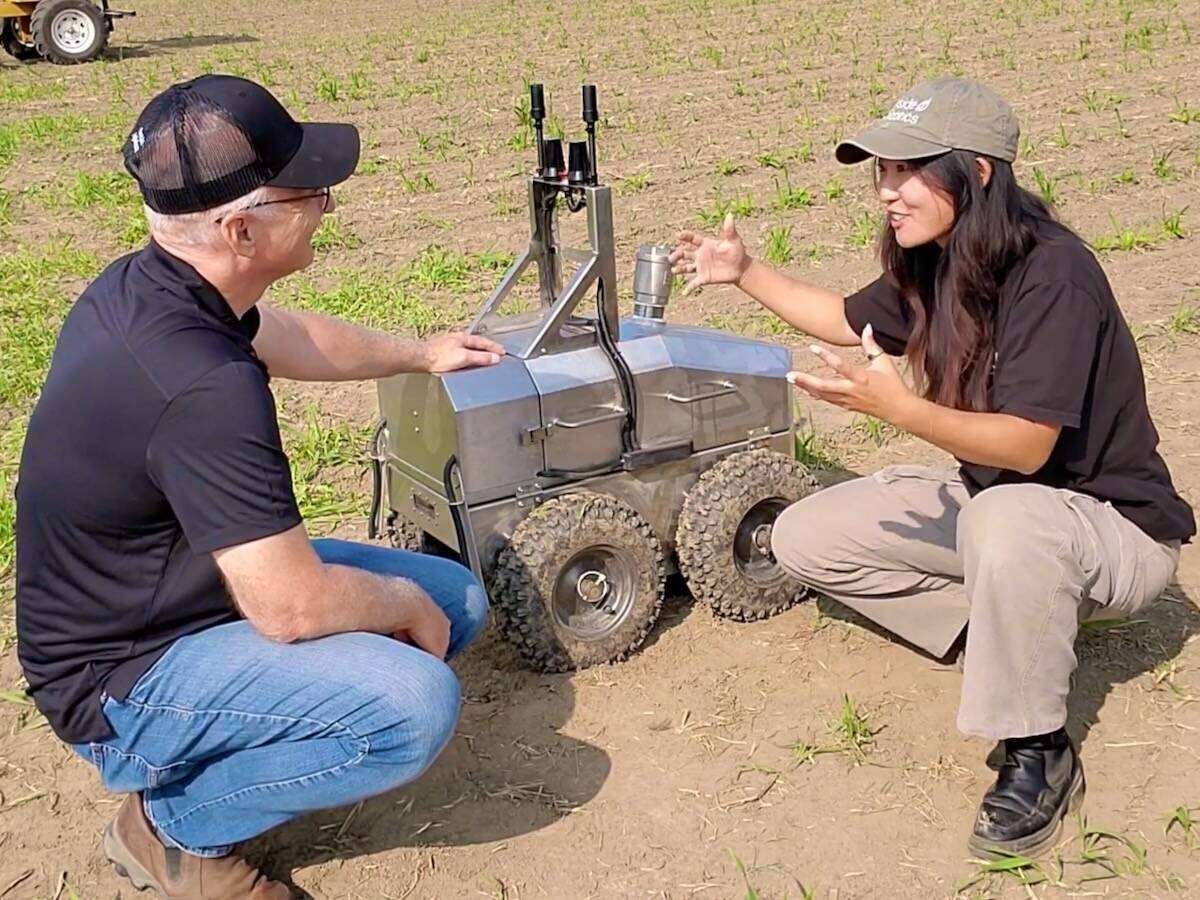
Tanya Franklin, Upside Robotics’ vice-president of agronomy and strategic partnerships, said she can see that in a cold, wet spring, when phosphorus and zinc are tied up in the soil, a foliar application could make sense to deliver those nutrients to the plant and encourage root growth.
“We foliar feed when the time is right, and then we can pound nutrients into the root to take that even further. Think of the potential, 250 bushels is going to turn into 350,” Bender said.
“That’s the part that a lot of the farmers are pushing us on,” said Jana Tian, co-founder and CEO of Upside Robotics. “It’s not all about nitrogen savings. It’s about finding what the other yield-limiting factors are and how we push for that.”
WATCH: Scott Garvey chatted with Jana Tian at Canada’s Outdoor Farm Show in 2024.
Creating more functions for the robots will require experimentation and validation, as well as an increase in the data load, which is already extraordinary.
Upside Robotics uses algorithms to fine-tune nutrient applications based on baseline and real-time data. The robots are now fitted with crop-sensing equipment.
“One robot last year collected 10 terabytes of data, which is insane,” Tian said. “Now we’re analyzing, processing and building models on it, but that’s like hundreds of algorithms we are validating. So it’s going to take some time.”
Reducing equipment
The system also reduces equipment and logistics on the farm, Bender said. The sprayer doesn’t have to stop during fungicide application to add a late-season nitrogen pass. A side-dress pass is eliminated when the corn is young.
He also hopes to limit applications such as fungicides by keeping the corn healthier.
Bender recounted a story that illustrated the Upside Robotics team’s work ethic.
It was 11 p.m. when one of the robots stopped working in his field. Tian showed up and carried a battery and cables to the robot, which needed charging. It had been raining, and the field was wet. They worked until 1 a.m. on the machine.
One of the robots had to go in for repairs.
“I found out she couldn’t get the robot going because the motor had fried, so she pushed the robot out of the field, a quarter- to half-mile, put it in her van and took it home to fix it.”
The post Upside Robotics looks to next steps in crop fertility microdosing appeared first on Farmtario.


