
What we’re watching
Corn: Higher U.S. corn crop estimates pressured prices as Ontario’s harvest began
Soybeans: China’s back, but crush demand has disappointed
Wheat: Down, still highly sensitive to Black Sea shipping disruptions
Hogs: Futures suggest winter weakness followed by spring/summer rebound
The USDA’s larger corn yield forecast accelerated speculative selling of futures. For Ontario farmers, the next test is whether the local bids fall further as harvest deliveries increase.
WHY IT MATTERS:
Corn futures collapsed just as the Ontario harvest was beginning. The main question now is whether local bids remain weak as activity increases. At the same time, soybean demand signals are mixed, and wheat is focused on geopolitics.
Corn: USDA feeds the bears. Funds head for the exits.
The USDA raised its U.S. corn yield forecast Oct. 9 to 181.2 bushels per acre and projected 2026-27 ending stocks at 1.849 billion bushels, as reported on Farmtario.com
In the previous Markets Desk Letter, published before the USDA report came out, I warned that crowded speculative long positions in corn futures could unwind quickly. It happened. Commodity Futures Trading Commission figures show managed-money traders cut their net long corn position by 83,000 contracts in the week ended Oct. 13, to roughly 246,000 contracts. That hints at the risk of further liquidation if harvest results continue to support the USDA’s large crop estimate.
The heaviest harvest pressure is still ahead. The U.S. harvest was 44 per cent complete as of Oct. 18, eight percentage points behind the five-year average. Meanwhile, Ontario’s grain corn harvest is probably less than 10% complete.
Southern Ontario cash bids for corn have fallen sharply, recently dipping under C$6 per bushel.
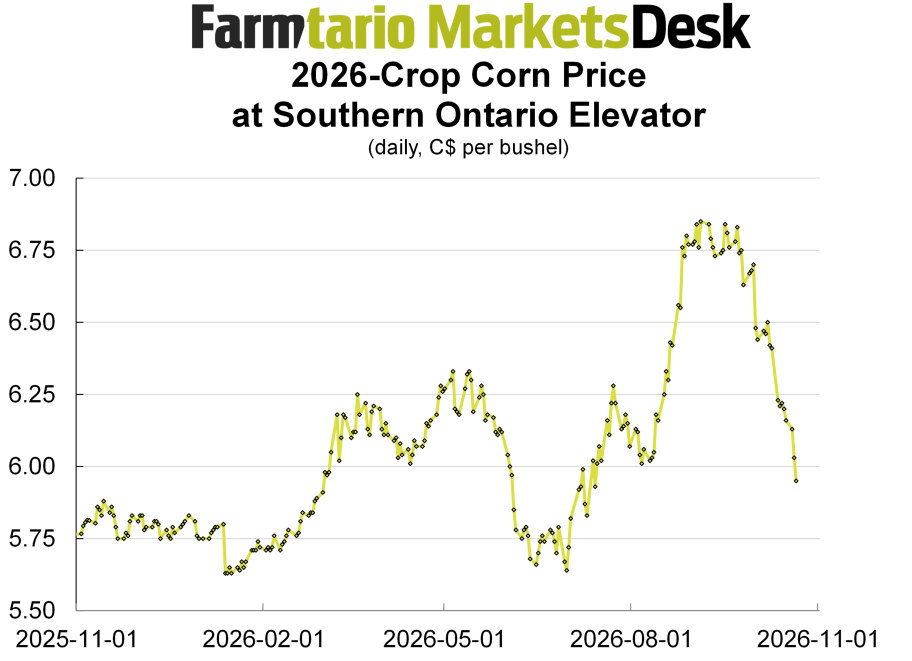
Corn prices have retraced their summer rally.
Soybeans: Chinese buying meets weak crush
China has resumed buying U.S. soybeans, but the demand picture remains mixed. U.S. plants crushed 196.3 million bushels in September. That was a 13-month low, as noted in a recent article on Farmtario.com.
Soybean harvest has seen some interruptions, but overall progress is solid. According to Grain Farmers of Ontario, Ontario’s harvest was 70 per cent complete as of Oct. 14. The U.S. harvest was 64 per cent complete as of Oct. 18, one percentage point behind the five-year average.
Southern Ontario cash soybean bids have slipped but remain around C$16.50 per bushel. The downturn has not been as severe as corn or wheat, due in part to previous basis support from the weak Canadian dollar.
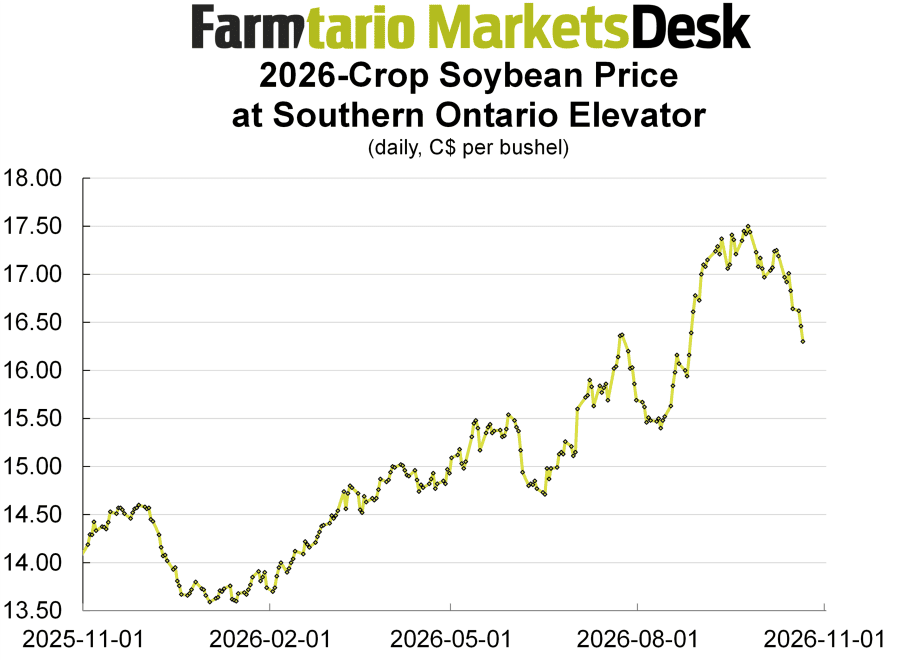
The soybean rally has faded as harvest advances.
Wheat: Still supported by geopolitics and war
Black Sea shipping disruptions continue to constrain wheat exports, supporting global prices. Analysts are debating how long that premium will remain in effect, with renewed rumours of peace talks undermining the market this week.
In the U.S., winter wheat planting was 63 per cent done as of Oct. 18, behind 69 per cent normally. Emergence is also delayed, although not seriously.
Most farmers are too busy finishing seeding winter wheat or harvesting corn and soybeans to think about sales. According to Grain Farmers of Ontario, winter wheat planting was 81 per cent complete by Oct. 14. A recent price drop of C$1.25 per bushel at elevators has also created a psychological barrier to sales.
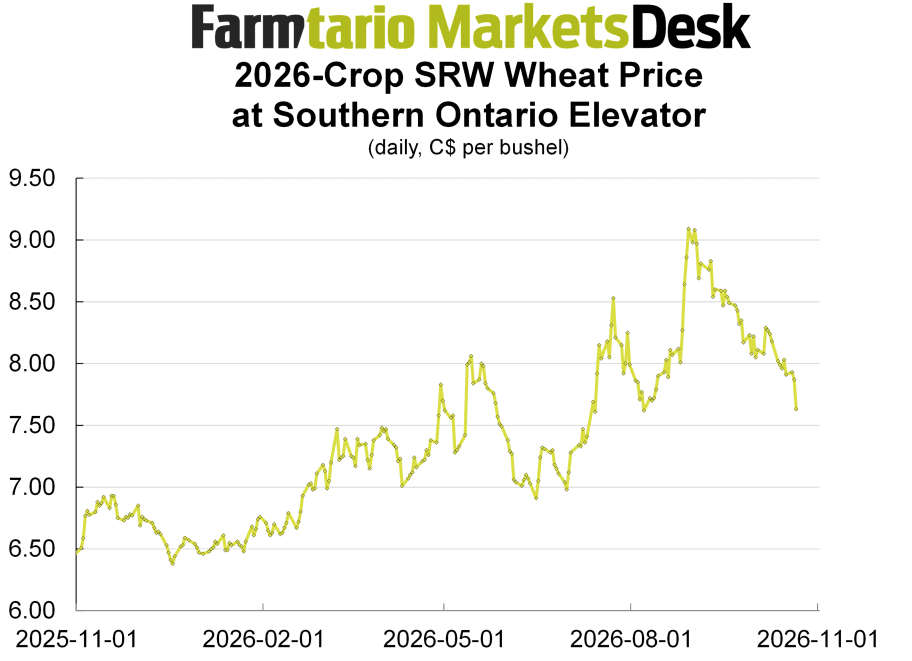
Wheat prices have fallen to their lowest since July.
Canadian dollar and interest rates: No major new signals.
The Canadian dollar has found some support after falling from US$0.73 in early September to about US$0.70 in mid-October. While a larger short-term rebound is possible, gains may be limited as U.S. interest rates are expected to remain higher than Canadian rates.
The Bank of Canada will make an interest rate decision next week. Financial markets expect rates to remain unchanged.
Soybean meal:
December soybean meal futures are US$345 per short ton. That’s in the upper part of its range of the past six months. Harvest will improve physical supplies for crushers and create feed-buying opportunities, although cash price relief may be gradual if futures remain supported.
Cattle: Margins matter
Tight supplies continue to underpin fed cattle prices. At the same time, high feeder cattle costs and elevated financing costs are challenging finishing margins.
In Ontario, the fall harvest offers opportunities to add to feed coverage.
Hogs: Seasonal low ahead
The CME lean hog index is around US$73 per hundredweight. December futures closed at $67, suggesting further weakness for cash over the next two months.
After that, a gradual recovery is expected. The February 2027 futures contract is at US$69, April at US$74 and June at US$88.
Although futures prices will continue to shift, these general expectations can be a useful planning benchmark for hog producers.
==
Kernel of Wisdom:
Good farm marketing is not about finding the perfect strategy. It’s about having a consistent approach that works for you and your farm business.
Markets are full of noise and conflicting forecasts. Often, it’s tempting to chase whatever worked for a friend last season or abandon a plan after a disappointing result. The best marketers don’t react to every headline or price swing, though. They rely on a toolbox of decision-making tools that fit their farm, their goals and their tolerance for risk. No tool works every time, but having a process beats making decisions based on emotion.
In the coming months, a series of articles and related videos on Farmtario.com will explore the concepts that belong in every marketing toolbox. They will dive into how farmers can use them to make more confident, disciplined marketing decisions. I’ll keep you informed of developments through these Markets Desk letters. Stay tuned.
The next Markets Desk Letter will be published Wednesday, Nov. 4.


