
Editor’s Note: This series draws on analysis the National Sustainable Agriculture Coalition (NSAC) conducted in partnership with Bernie Kluger, Managing Partner at Prospect Partners, LLC.
Bernie has led strategic realignments, crisis recoveries, and major capacity-building initiatives in government, higher education, and the private sector. Prior to joining Prospect Partners, Bernie served as enterprise lead for organizational effectiveness and workforce development at the US Department of Agriculture (USDA). At USDA, Bernie tackled complex multi-stakeholder negotiations that delivered results for the public, including a nationwide hiring surge that powered a $40 billion expansion in operational capacity. Bernie holds a B.S. in Political Economy from Williams College and an M.B.A. from Columbia University. He lives in Washington, DC.
This blog post is the third in our series updating analysis on the widespread staffing crisis across the United States Department of Agriculture (USDA). While our previous post showed that all USDA agencies lost staff during 2025, losses of direct farmer-support staff at the Farm Service Agency (FSA) are particularly concerning as farmers face an ongoing crisis and struggle to stay on the land. In this post, we examine previously unpublished data on FSA County employees to show a troubling loss of local staff.
Through a Freedom of Information Act (FOIA) request, NSAC and our colleagues at Prospect Partners have confirmed that over one-third of FSA local offices experienced a net loss of staff by the end of 2025, with 42 offices ending the year with no FSA County employees. These losses compound cuts previously reported on other locally stationed staff in the Natural Resources Conservation Service (NRCS) and Farm Service Agency (FSA) who provide direct support to America’s farmers and ranchers. NSAC urges Congress to prioritize reversing FSA staffing losses, ensuring that the local staff who administer programs passed by Congress to help farmers access the credit and other resources they need to build and grow viable operations are present in every community that needs them.
Farm Service Agency: Freedom of Information Act (FOIA) Data Reveals Majority of Counties Lost Staff
USDA reduced the number of front-line staff at the US Farm Service Agency (FSA) by 8% in 2025, according to data recently obtained through a Freedom of Information Act request. Over one-third of FSA local offices lost FSA County employees by year’s end, with 42 offices ending 2025 with no FSA County staff. Cuts to FSA County staff were USDA’s largest termination of community presence in over a decade. These findings build on federal data released in March 2026 showing widespread loss of FSA Federal personnel in 2025.
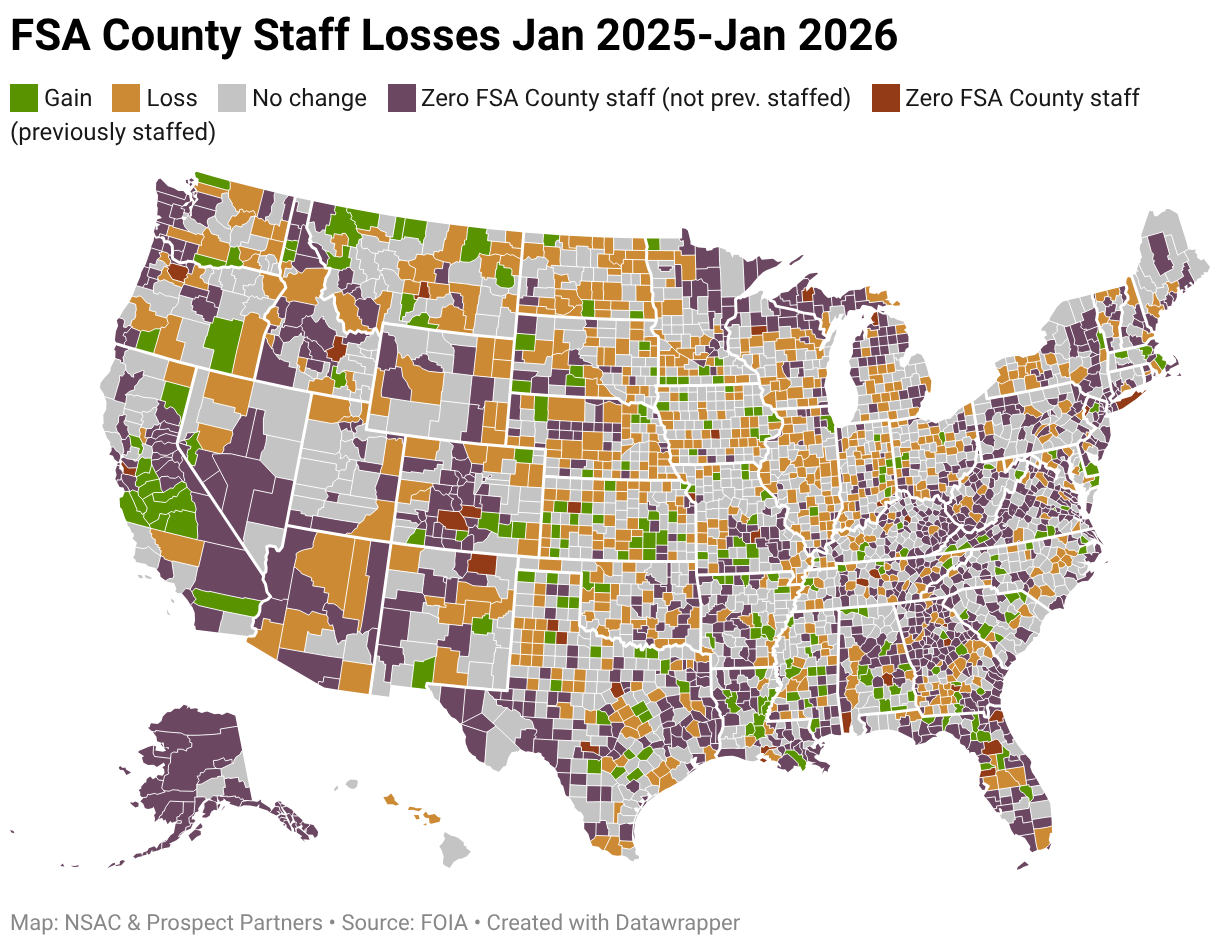
Figure 1: FSA County Staffing Losses (Jan 2025-Jan 2026)
FSA’s Heritage of Local Presence and Control
Many federal agencies, including the US Postal Service and US Small Business Administration, maintain local presence in the communities they serve. Among such agencies, the Farm Service Agency has a unique heritage of local presence, with over 2,000 reported offices nationwide in 2025 and a commitment to local input regarding who staffs those offices in each county.
Every FSA office in the country is required by law to have an advisory board, called a County Committee, made up of local elected farmers and ranchers. Since the 1930’s, County Committees have provided grassroots input on FSA programs and hiring. Historically, approximately two-thirds of the FSA workforce have actually served as employees of these local committees, not the federal government. FSA’s locally employed staff are commonly referred to as FSA County Office (FSACO) employees.
This analysis focuses on changes in headcount among FSACO employees, who have primary responsibility for FSA front-line services and are relied upon by local farmers and ranchers to navigate an array of federal agricultural programs.
Top Findings
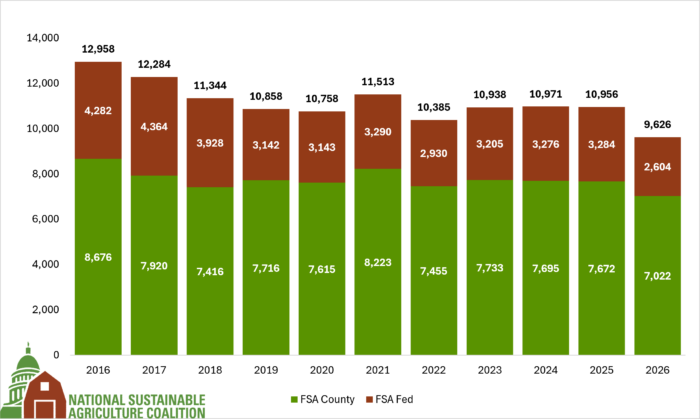
US farmers and ranchers ended January 2025 with access to 7,672 FSACO staff stationed across 2,037 offices in 2,012 counties. By the end of January 2026, staffing dropped to 7,022 FSACO staff, an 8% decline, across 2,018 offices in 1,992 counties.
- 89% of the FSA County staff lost between January 2025 and December 2025 were full-time, permanent employees.
- The positions with the steepest losses are County Program Analysts, a direct farmer-facing role where staff helps with “interpreting and explaining procedures, program regulations and forms to producers.” FSA lost 614 County Program Analysts between January 2025 and December 2025, the staff farmers and ranchers rely on most to navigate programs and paperwork.
- Leadership took a significant hit, as well, with 122 positions lost among County Executive Directors and 47 County Executive Directors in Training between January 2025 and December 2025. These experienced leaders manage county office service centers and provide essential outreach to producers, “working closely with farmers and ranchers to promote environmental and economic growth and sustainability.” Major losses in farmer-facing and leadership positions remove a vital conduit between local communities and federal staff, leaving county offices less equipped to deliver the programs and support that American farmers depend on.
FSA County Employees: Local Impact of Staffing Reductions
Net staffing reductions among FSACO employees were widely distributed across rural America. Among counties that started the year with FSA County staff, federal data shows a net reduction of FSA County employees in 704 (34%) counties in the United States and territories. Staffing was flat in 1,122 (54%) counties, with only 232 (11%) showing a net increase. Among counties that started the year with FSA County staff, 38 (2%) counties ended 2025 with no FSA County staff, including three counties unstaffed in Florida and four in Texas.
FSA County Employees: Regional Highlights
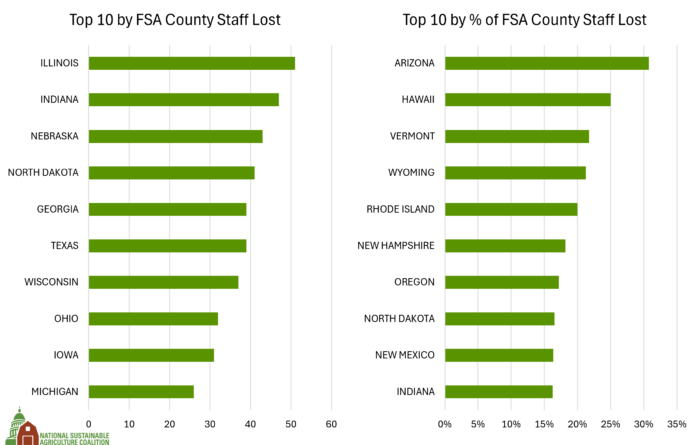
Major agricultural states in the Midwest and Southeast lost the most FSA County staff during 2025. The largest staffing losses were in Illinois (51), Indiana (48), Nebraska (43), North Dakota (41) and Georgia and Texas (39 each). Smaller states saw steeper percentage declines, with the largest in Arizona (31%), Hawaii (25%), Vermont (22%), Wyoming (21%), and Rhode Island (20%). Minnesota lost 7% of its FSA County staff. Two states–Indiana and North Dakota–appear on both lists, meaning they lost both large numbers of staff and a substantial share of their total FSA County workforce.
Figure 2: Top 10 States with FSA County Staff Losses (Jan 2025-Jan 2026)
The formerly staffed county offices that ended 2025 with zero FSA County staff are spread widely across the West, Midwest, and Southeast, as seen in the map above.
FSA Federal Employees: Adding to the Impact of County Staffing Reductions
USDA has historically staffed local FSA offices with a combination of FSA Federal and FSA County employees, the former being locally stationed staff who are employed directly by the Farm Service Agency. FSA Federal employee data, which the federal government published at data.opm.gov on March 4, 2026, shows that headcount declined among FSA Federal employees at more than double the rate of FSA County employees. Headcount among FSA Federal employees fell by 21% in 2025, compared to 8% for FSA County employees.
Figure 3: Count of FSA County and FSA Federal Employees (Feb 2016- Jan 2026)
FSA Federal employee staffing levels declined in 45% of counties and were flat in 44% of counties. In that same period, 11% of counties experienced a net increase in FSA Federal staff. Nationwide, 127 counties lost all of their FSA Federal employees in 2025, reducing the number of counties with FSA Federal staff from 932 to 805.
Figure 4: Net Staffing Change Among FSA Federal Employees in US Counties (Jan 2025-Jan 2026)
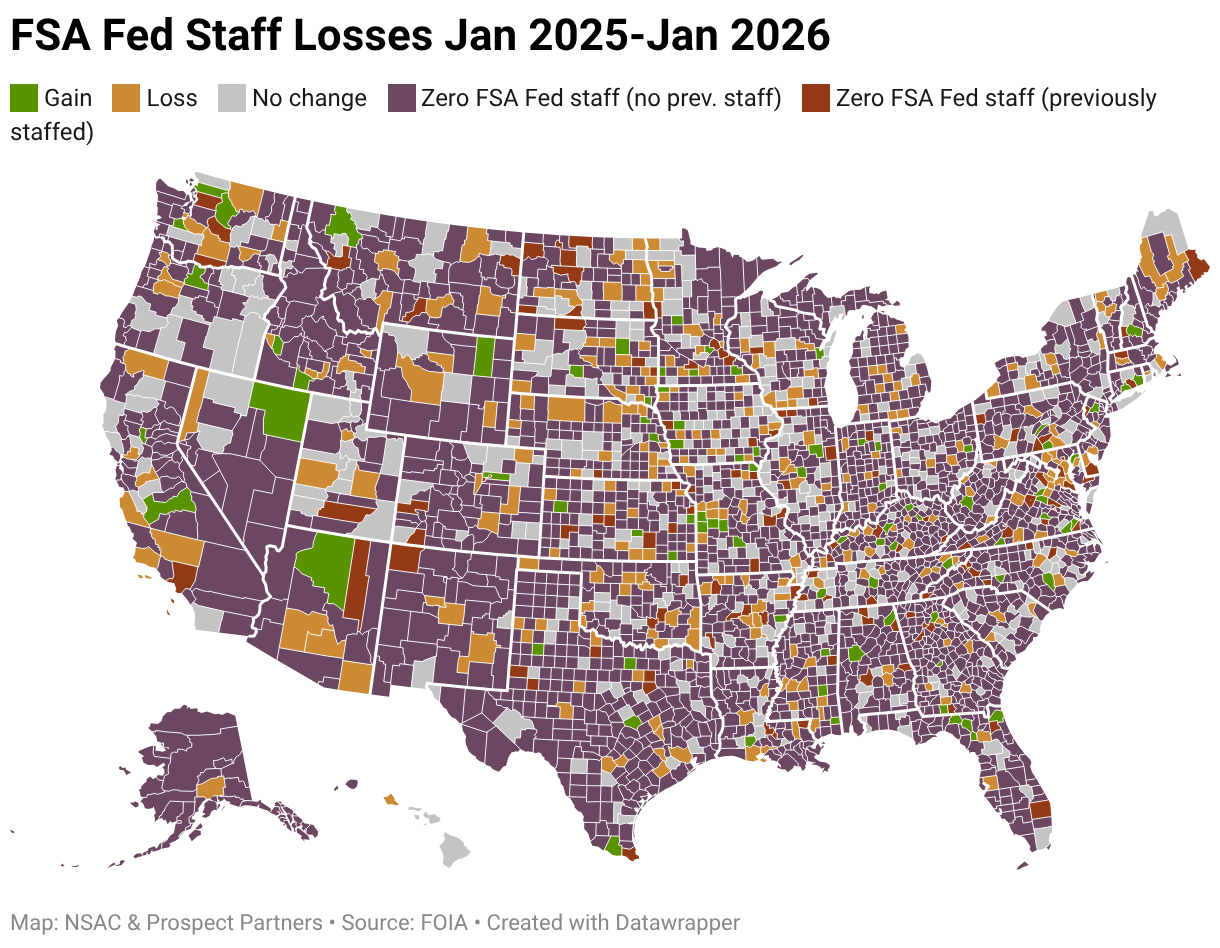
The FOIA data obtained for this analysis make visible what farmers and ranchers across the country have been experiencing firsthand: the front-line staff who help them navigate federal programs, manage paperwork, and access a safety net built over decades are disappearing from their communities. With 42 county offices ending 2025 with no FSA County staff, and FSA Federal staff declining at more than double the rate of county staff, the cumulative impact on local agricultural communities is severe. FSA’s heritage of local presence and community accountability — embodied in the County Committee system — was built precisely because federal agricultural programs work best when administered by people who know the land and the farmers they serve. That heritage is now at risk.
Congress must act urgently to reverse FSA staffing losses at both the county and federal level. America’s farmers are in crisis: trade disruption, volatile markets, and a string of natural disasters have put enormous pressure on farm operations of every kind. FSA County staff are the people farmers call when they need to access the programs designed to help them weather exactly these kinds of challenges — including the Emergency Loan program, Emergency Conservation Program, Farmer Bridge Assistance, and the Supplemental Disaster Relief Program. Every one of these programs requires local FSA staff to administer them. NSAC urges Congress to use the appropriations process and the Farm Bill to mandate and fund the restoration of FSA staffing to levels adequate to deliver these essential programs, and to ensure that no county is left without local FSA presence.
The post USDA Staffing Crisis: Losses Reduce Local Presence in Communities Nationwide appeared first on National Sustainable Agriculture Coalition.


