

Verra has officially issued the first carbon credits carrying the Core Carbon Principles (CCP) label under its Improved Forest Management (IFM) methodology, VM0045. This milestone comes after the Integrity Council for the Voluntary Carbon Market (ICVCM) approved the latest version of the methodology, marking a major step forward for transparent and reliable forest carbon accounting.
VM0045—formally known as Improved Forest Management Using Dynamic Matched Baselines from National Forest Inventories—introduces a new way of evaluating forest carbon. Instead of relying on long-term growth models or outdated assumptions, it uses real, continuously updated forest inventory data to set dynamic baselines. This design helps project developers track real-world carbon changes with a higher level of precision and integrity.
Mandy Rambharos, CEO, Verra, noted:
Verra’s VM0045: A New Approach to Forest Carbon Accounting
VM0045 stands out because it supports many IFM practices and uses dynamic performance benchmarks. Instead of relying on modeled projections, it directly compares project plots with matched baseline plots taken from national forest inventory data. These baseline plots come from outside the project area but share the same starting conditions.
Because the baseline plots are monitored over time, the method captures real changes in forests, including impacts from climate, pests, markets, and natural disturbances. This real-time comparison creates a quasi-experimental setup, making carbon accounting more accurate and harder to manipulate.
The methodology focuses on measuring actual changes in carbon, not estimating total carbon stocks. Tracking increases or decreases within permanent sample plots improves the precision of reported emission reductions and carbon removals.
How it Works in Practice
The methodology allows projects to adopt one or more specific IFM practices that deliver measurable climate benefits. To qualify, these practices must be new, additional, and not pre-existing on the land.
Examples of eligible IFM activities include:
- Enrichment planting
- Managing vegetation to support natural regeneration
- Irrigation or fertilization to improve tree growth
- Lowering harvest levels
- Delaying or extending harvest cycles
- Setting up forest reserves
- Reducing fire risk through fuel management
For all these activities, VM0045 uses a large-scale monitoring and accounting system that tracks how each practice affects greenhouse gas (GHG) emissions or carbon sequestration.
Unlike traditional IFM methodologies, VM0045 does not require developers to run growth-and-yield forest models. Instead, it uses actual field measurements from both the project area and matched baseline plots. As these plots are monitored year after year, the methodology updates baseline expectations dynamically.
This approach ensures that project results reflect the real world—not hypothetical scenarios—making the credits more credible to buyers and regulators.
Key Deadlines and Versions
Several important deadlines apply to VM0045 users:
- VM0045 v1.2 became active on July 10, 2025.
- Projects using v1.1 must complete validation and submit registration by April 30, 2026.
- Verra released Corrections and Clarifications for v1.1 on December 13, 2024, and all projects using that version must apply them.
- Projects using v1.0 must have been listed before March 12, 2024, and validated by March 12, 2025.
These updates ensure that projects operate under the most rigorous version of the methodology.
KNOW MORE:
- ICVCM Backs Verra’s Biochar and IFM Methods as High-Integrity Climate Solutions
- Verra’s Cookstove Credits Get ICVCM Green Light – Boosting Carbon Market Trust
First Credits Issued: Family Forest Carbon Program
The Family Forest Carbon Program – Central Appalachia, developed by the American Forest Foundation (AFF) with support from The Nature Conservancy, became the first project to receive credits under VM0045 v1.2. The project earned 18,326 Verified Carbon Units (VCUs).
Although the project originally began under version 1.1, AFF voluntarily transitioned to v1.2 after it received ICVCM approval. This move demonstrates a strong commitment to environmental integrity and the highest standards of carbon crediting.
This issuance also highlights how VM0045 can open the voluntary carbon market to small landowners. These landowners often struggle with high participation costs and complex requirements. The simpler, more standardized design of VM0045 helps reduce those barriers.
Carbon Sequestration Potential of Forests
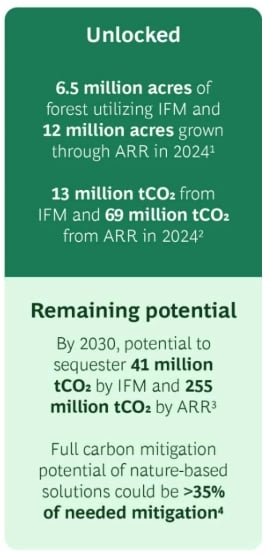
Using National Forest Inventories—In the U.S. and Beyond
Currently, VM0045 uses data from the U.S. Forest Service’s Forest Inventory and Analysis (FIA) database, which tracks forest conditions across the country. However, the methodology was designed to be globally adaptable. Many countries have national forest inventory programs with comparable datasets.
Work is underway to expand VM0045 so developers in more regions can use their national inventories to build dynamic baselines and project comparisons. This will make the methodology a powerful tool for forest conservation worldwide.
Global Impact of IFM on Carbon Markets
Improved Forest Management, or IFM, refers to a set of sustainable practices that help existing forests store more carbon or avoid emissions. Unlike plantiFng new forests, IFM focuses on managing current forestlands in ways that increase carbon storage while supporting ecosystem health.
These practices help forests grow older, become more diverse, and build resilience against disturbances like fire, drought, and pests. At the same time, IFM supports continued timber production by optimizing harvest cycles instead of eliminating them.
Because IFM projects often run for 100 years or more, they ensure long-term carbon benefits and create healthier forests that can withstand climate stress.
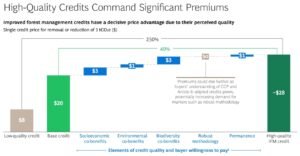
IFM plays a major role in voluntary carbon markets.
- Studies have shown that, globally, 293 IFM projects have produced about 11% of all offset credits issued by registries. These projects direct substantial climate finance into forest conservation.
- IFM practices could increase global carbon stocks by 0.2 to 2.1 gigatonnes of CO₂e per year without reducing wood supply or other ecosystem services.
- Practices like longer rotations, reduced-impact logging, soil protection, and habitat conservation all help build more stable and productive forest ecosystems.
In tropical regions, for example, reduced-impact logging preserves soil carbon and limits forest degradation. In temperate forests, extending harvest cycles helps trees store more carbon while maintaining timber revenues.
IFM can also boost resilience, reducing the risk of carbon loss from wildfire, insects, and extreme weather—threats that are becoming more intense due to climate change.
Thus, with strong support and a robust regulatory environment, IFM projects—especially those under VM0045—can play a crucial role in creating a more sustainable and climate-resilient future.
READ MORE:
- Carbon Credits Supply to Skyrocket 35x by 2050 – But at What Price?
- The Power of Plastic Credits: How Verra’s Waste Reduction Program Can End Global Plastic Pollution
The post Verra Issues First CCP-Labeled IFM Credits Under VM0045: A New Era for Forest Carbon Accounting appeared first on Carbon Credits.


