Arctic Ice Loss Since 1980, Compared to Countries
See visuals like this from many other data creators on our Voronoi app. Download it for free on iOS or Android and discover incredible data-driven charts from a variety of trusted sources.
Key Takeaways
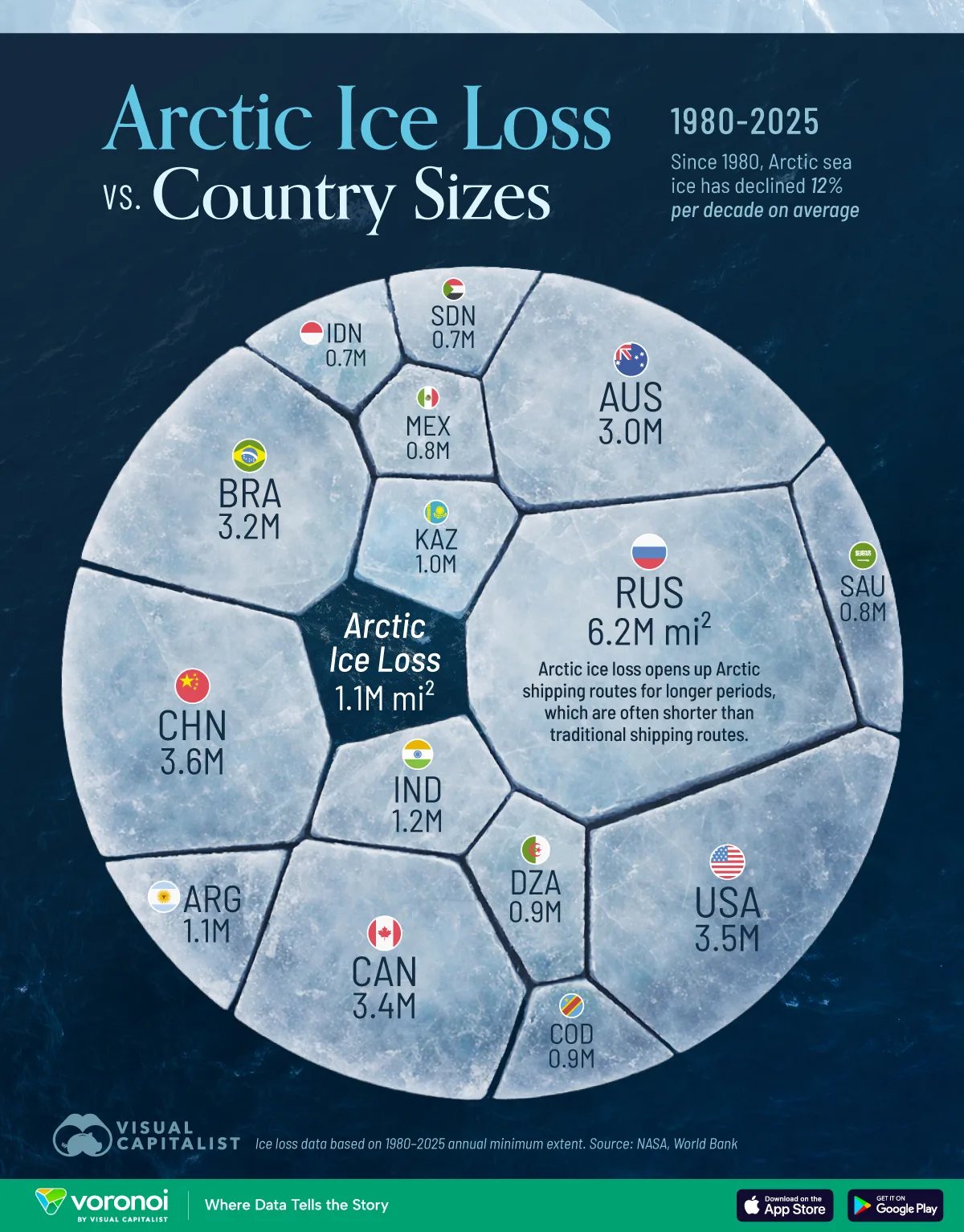
- The Arctic has lost 1.1 million square miles of sea ice since 1980, roughly the size of Argentina.
- At current trends, it could see nearly ice-free summers by 2050.
Since 1980, the Arctic’s summer sea ice has shrunk at a rate of 12.2% per decade, dramatically reshaping the polar region and opening new geopolitical and shipping dynamics.
This graphic shows the size of Arctic ice loss since 1980 compared to country land masses, based on data from NASA and the World Bank Group.
With such significant amounts of ice loss, these changes to the Arctic are opening up global shipping routes, which can be half as long as traditional routes.
How Much Arctic Ice Has Melted?
Arctic sea ice fluctuates over the course of the year, with the most shipping activity occurring when it is at its smallest point, known as its annual minimum ice extent.
This annual minimum ice extent has shrunk the equivalent of tens of thousands of square miles each year. Below, we compare the change in minimum ice extent from 1980 to 2025 to the world’s largest countries by land area:
| Country | Land Area (Millions of Square Miles) |
|---|---|
 Russia Russia |
6.2 |
 China China |
3.6 |
 U.S. U.S. |
3.5 |
 Canada Canada |
3.4 |
 Brazil Brazil |
3.2 |
 Australia Australia |
3.0 |
 India India |
1.2 |
 Arctic Ice Loss (1980-2025) Arctic Ice Loss (1980-2025) |
1.1 |
 Argentina Argentina |
1.1 |
 Kazakhstan Kazakhstan |
1.0 |
 Algeria Algeria |
0.9 |
 DRC DRC |
0.9 |
 Saudi Arabia Saudi Arabia |
0.8 |
 Mexico Mexico |
0.8 |
 Indonesia Indonesia |
0.7 |
 Sudan Sudan |
0.7 |
In 1980, the Arctic’s minimum ice extent was 1.1 million square miles (2.8 million km²) larger than it was in 2025.
Given this rapid ice melt, the Arctic region is projected to be “ice-free” in the summer as soon as 2050. Not only has Greenland been under intense focus, but the Arctic region will become increasingly important for shipping, security, and economic reasons.
How Global Powers are Preparing for an Ice-Free Arctic
Today, multiple countries including China, Russia, Europe, and the U.S. have developed national strategies for the Arctic region given its growing geopolitical importance.
In 2018, China introduced the idea of a “Polar Silk Road,” centered on the Northern Sea Route. This Arctic passage could reduce travel time by nearly 20 days compared to the Suez Canal and is about 40% shorter for ships traveling between China and Northern Europe.
Moreover, the Arctic holds an estimated 412 billion barrels of undiscovered oil. Greenland’s rare earth reserves alone are estimated to be 1.5 million metric tons, the eighth-highest in the world. While there has been no rare earth production, melting ice could present huge opportunities should local regulations ease.
Learn More on the Voronoi App 
To learn more about this topic, check out this map explainer on the territory of Greenland.