
We Can Protect the Air in Our Homes & Decrease Energy Use. I’ve Seen How.
By: Tara Randall
Driving through Michigan is very different than driving through California. Instead of gently rolling mountains, pristine strawberry fields, and the sparkling Pacific Ocean, it was boggy. One large, swampy forest that seemed to cover the entire state. Hours went by without feeling like I had moved at all, the scenery was the same. Trees surrounded everything, with the occasional lake to break up the view.
I had woken up at 4AM to drive the five hours it would take to get from Dayton to Grand Rapids where David Gater, our Residential New Construction sales manager for Michigan, had scheduled a demo seal with a local builder. It would be my first time seeing a real AeroBarrier seal. I didn’t mind waking up early though. Morning had always been a peaceful time to me. The whole world asleep with a new day’s promise on the horizon.
I thought about how different things were here as the miles rolled by. Here, in the Midwest, there seems to be an abundance of everything: rain, heat, cold, humidity, snow, ice, wind, thunderstorms. After six years on the coast, where the temperature stayed between 60 and 80 degrees year-round, it was almost overwhelming.
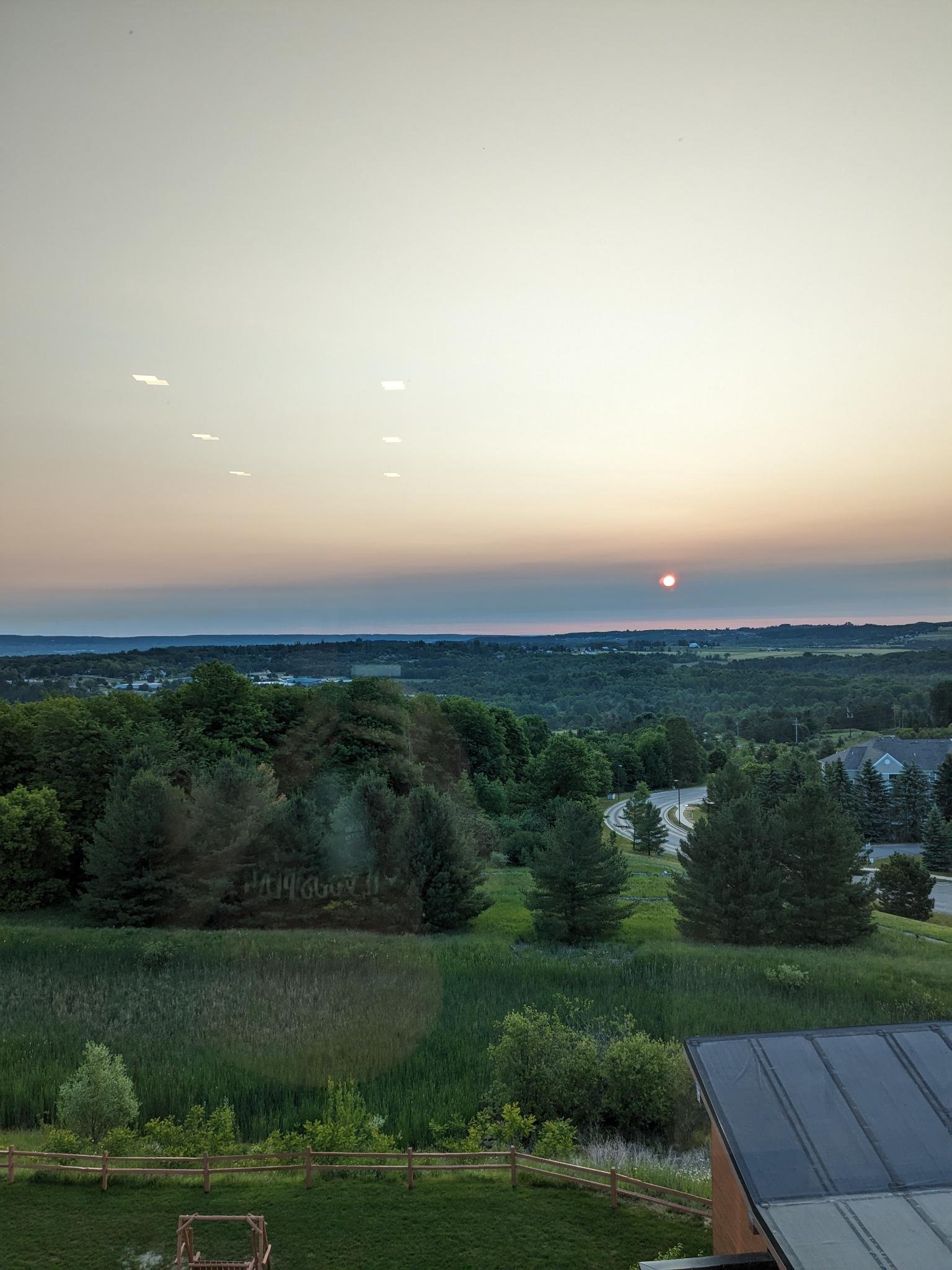
A snapshot from my early-morning travels through Michigan

Soberanes Wildfire, California 2016
You learn a different kind of appreciation for water when you live through multiple years of drought and wildfires. The rain comes in the winter for a few months, then simply stops for the rest of the year. Month after month of no rain at all. As summer approaches, the heat ramps up, and drought and fire warnings become more frequent. You watch the weather forecast, but it’s the same day after day. If a wildfire starts, firefighters have only a few hours to put it out or it will spread – like the Soberanes Wildfire did through Big Sur, burning 130,000 acres of forest – and won’t stop until the rains return.
Driving through Michigan, it was hard to imagine a wildfire catching in this wetland. As the sun rose, mist rose off all the dense, lush plant life and through the tree canopy. It was beautiful, in the land of a thousand lakes. But this abundance of water, wind, and cold posed a different kind of problem out here. Here, you don’t worry so much about wildfires, but instead, cold, heat, and humidity getting in.
Soberanes Wildfire, California 2016
That’s what today was all about: how to keep the elements out and the good air in. AeroBarrier is a new climate change technology that seals homes from the inside out. By making it easy to build tight homes, it’s easier for homes to stay warm in the winter, cool in the summer, and keep humidity out of the wall cavity. It keeps energy costs low and reduces strain on the grid – a key point in a state that is already struggling to keep up.
By the time I got to the job site, David had set out sandwiches, drinks, and cookies for our guests. Jonathan and Frank, our sealing team, had already finished prep work and were nearly done setting up David walked me through the house, showing me all the gaps in the drywall, around the lighting fixtures, and the outlets.
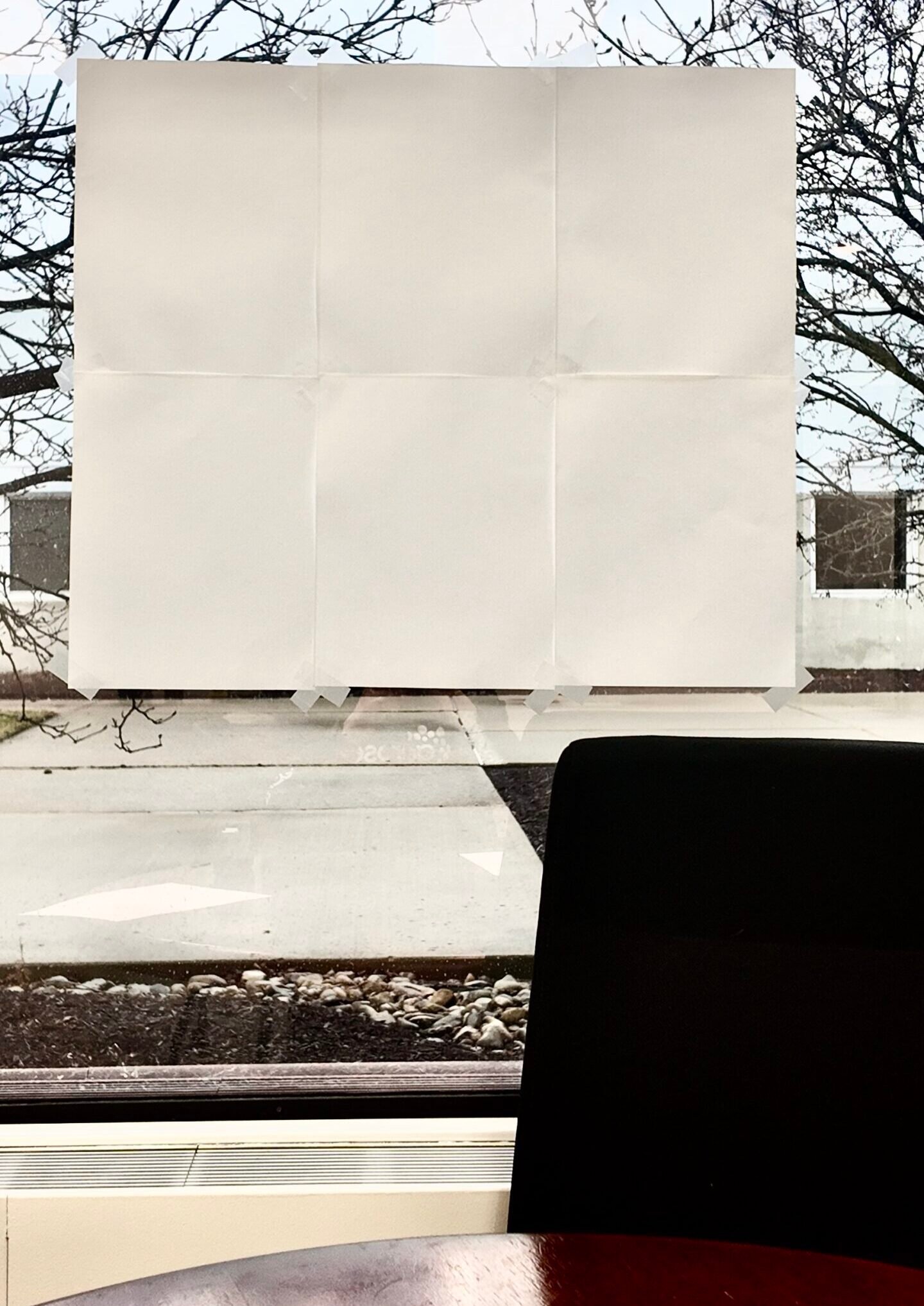
Six pieces of 8.5′ x 11″ paper representing the total sq inches of air leakage from the building
Six pieces of 8.5′ x 11″ paper representing the total sq inches of air leakage from the building
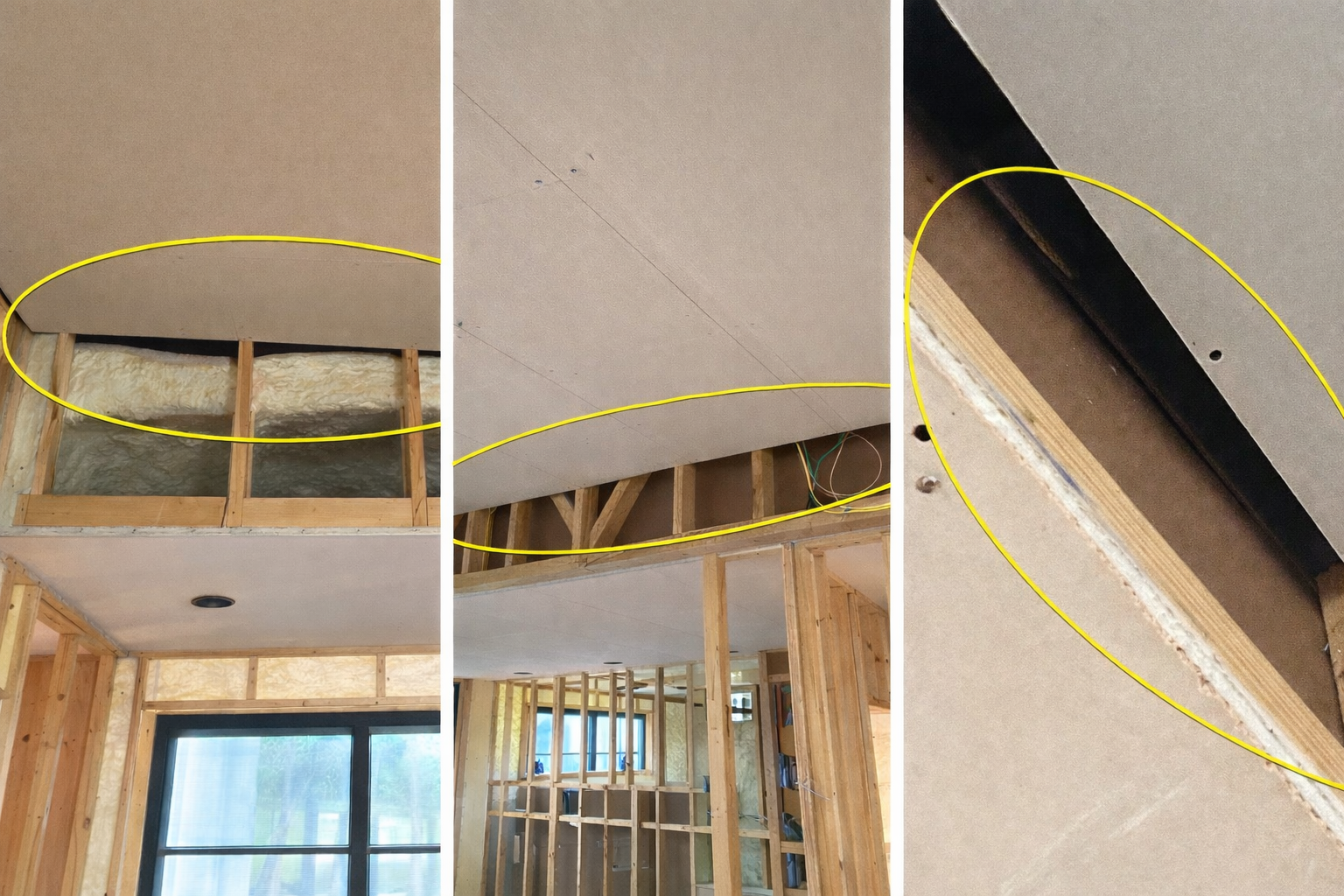
When our team first tested the house with a blower door, they weren’t even able to pressurize it. Incomplete ceiling elevation changes prevented them from even getting a reading. After they closed up the larger gaps with foam, they were able to pressurize to 10ACH50 – the equivalent of 558 sq in of leakage. Imagine 6 pieces of 8.5” x 11” paper laid out in a square. Now imagine a window of that size being left open to the elements…..all of the time. That’s how much leakage the house had when we started.
AeroBarrier is an ingenious approach to air sealing homes. Instead of walking around with a caulk gun guessing where the leaks are only to find out months later at the final blower door test that the house isn’t as tight as you thought, the AeroBarrier system uses air pressure to find the leaks. Wherever air is moving from high to low pressure, that’s where the sealant sticks. It builds on itself until the leaks are sealed without sticking to other surfaces. The tightness of the building is measured in real time, so you can stop the sealing process when you need to.
Ceiling Before Foam
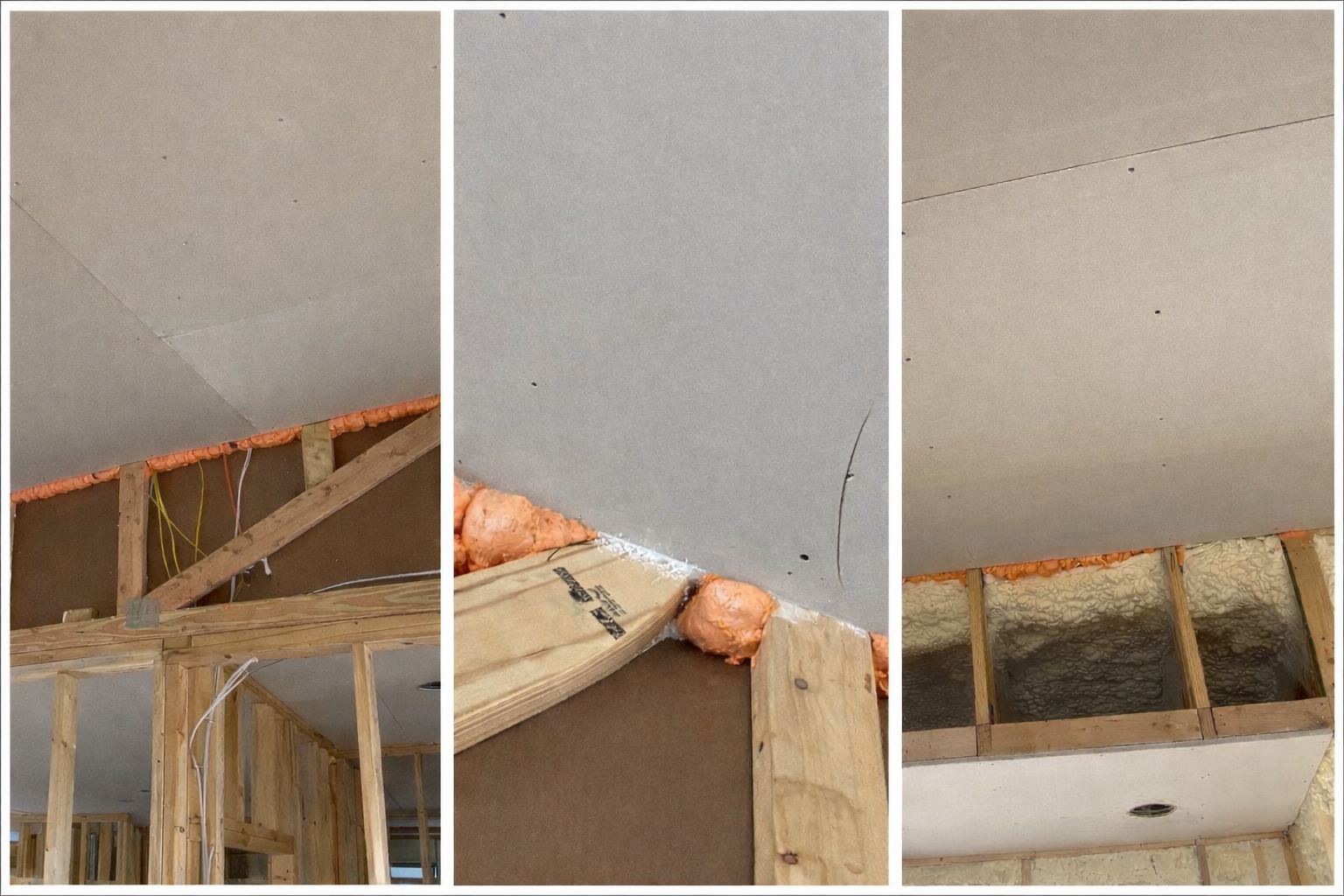
Ceiling After Foam
Ceiling Before Foam
Ceiling After Foam
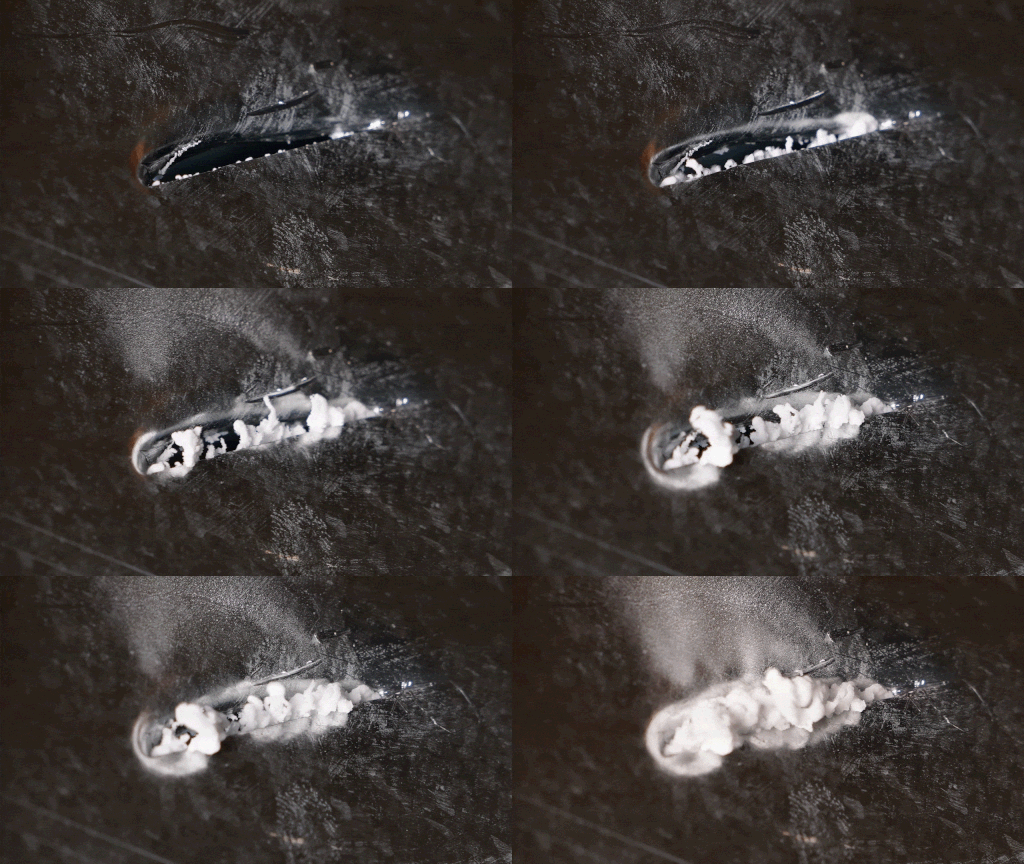
AeroBarrier Sealant Time Lapse
After prep and initial blower door test, it was time to start the seal. Everyone gathered around the monitor to watch as the seal began. The machine spun up, the lay flat inflated, and the stations started to seal. The sealing stations atomize the sealant, filling the home with a fog of sealant. Because the area is pressurized the sealant particles rush to escape through the leaks, finding any existing holes and cracks in the envelope and gradually accumulating to form a strong but pliable air-tight seal.
AeroBarrier Sealant Time Lapse
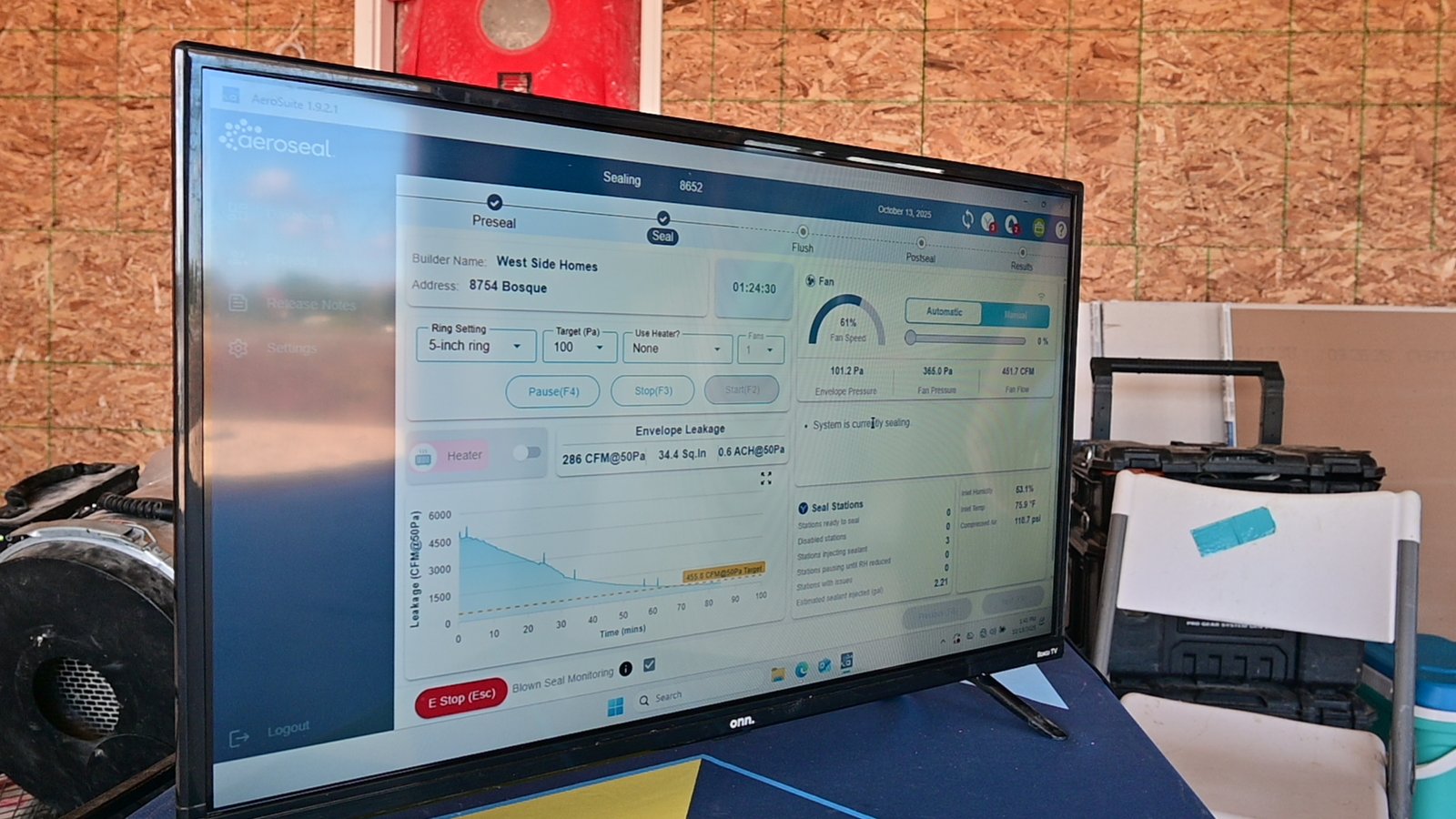
Grand Rapids Seal Screen
Because the pressure is continuously monitored, we know exactly how long to seal and what the air tightness is at any given moment. At this demo, we went from 10ACH50 to 0.53ACH50 in only 1.5 hours. That took the beginning leakage rate of 24% down to only 2%. What normally would have been an incredibly frustrating game of whack-a-mole trying to find every little leak, was a smooth, straightforward, and – most importantly – measurable process.
Once the seal was complete, the team powered down the machine and opened up the windows to let the sealant disperse, and after 30 minutes, we were clear to enter. At this point, the subsequent trade could come in and begin work. For our group, we examined all the gaps where the sealant had sealed off leaks. It was impressive to see such an elegant solution for something that traditionally has to be done by hand, with uncertain results.
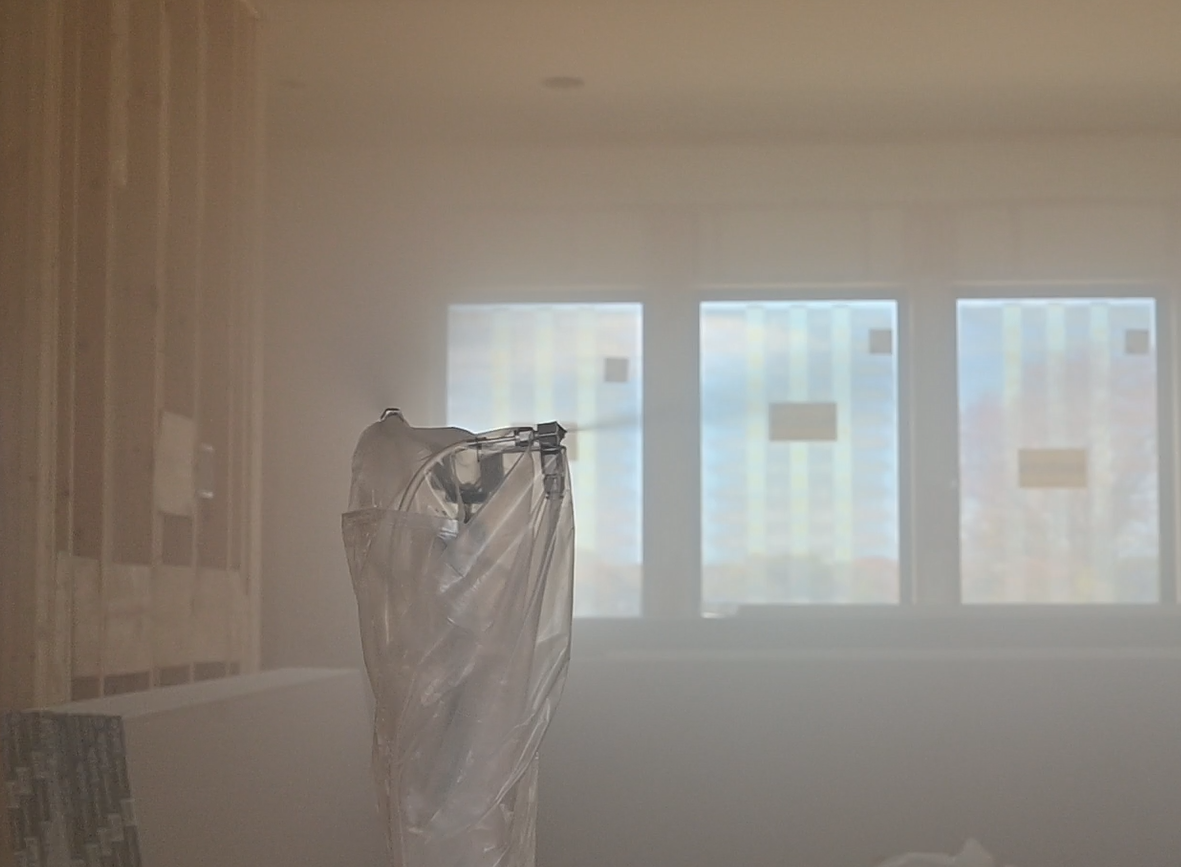
AeroBarrier Sealing Station
Among the guests at this demonstration was a local energy rater who attended the demonstration. He was so pleased to see such a straight-forward and measurable process that he was ready to certify the house on the spot once we ran a final blower door test. Getting sign off from the energy rater can be a difficult process for builders – often the house is nearly complete when the raters come to do the final code tests. At this point, if you don’t have a tight home, you may have to rip out cabinetry, light fixtures, duct work, and drywalling. Suddenly, you’re looking at a chain reaction that delays closing and cuts into your schedule and, of course, the bottom line. That’s the nightmare scenario to a builder.
Tight homes not only keep conditioned air inside, lowering the load on the heating and cooling system and energy usage by up to 30%, but a tight home also keeps out unwanted pollutants: pollen, pollution, and wildfire smoke.
I moved from California to Ohio in the spring of 2022. I thought I had left wildfire smoke behind but in Summer 2022, the Midwest experienced their first major wildfire smoke event as Canadian forests burned. Months of haze and orange skies and air quality warnings. My father-in-law, who has lived in rural Ohio for his entire 74 years of life, had never seen such a thing. It’s inescapable – and for those with asthma or other breathing conditions: dangerous. We also don’t know the long-term effects of breathing fine particulate matter, like the kind that travels hundreds of miles through the atmosphere, does to your lungs over time. No one wants their children exposed to this.

A dog trots around on our foggy Michigan morning
Building codes are getting tighter all over the country. Austin, TX and Las Vegas, NV are moving to residential code that could require air tightness as low as 3ACH50. The original air tightness goals were implemented to keep humidity from getting from the outside into the house and causing mold, but is now recognized as key for insulation, air quality, and energy savings. Nearly 40% of the world’s energy is used to heat and cool buildings. At the same time, building code has only recently incorporated air tightness as a measured requirement. Imagine how much energy we could save if buildings were tight and not losing conditioned air through huge holes. We could live more comfortably, breathe better air, save energy, and protect our families. Maybe we could even change the course of climate change for the better in the process.
A dog trots around on our foggy Michigan morning
The post We Can Protect the Air in Our Homes & Decrease Energy Use. I’ve Seen How. appeared first on Aeroseal.


