
Beef cattle are at record-high prices, which means shipping overweight or underweight cattle carries an even higher profitability penalty than ever before.
Ken Schaus, of Schaus Land and Cattle, says he can’t afford to miss those weights and that he has an extensive weighing system, so cattle are tracked through their backgrounding and finishing periods.
Beef prices are high, so profitably marketing them can bring higher returns.
Beef prices are high, so profitably marketing cattle can bring higher returns.
Schaus finishes cattle, but he also buys many cattle for other feedlots.
“What we’re doing is trying to maximize the value of those cattle,” he said.
At the recent Brussels Agri Services Pasture Walk and Talk event, Schaus said cattle with similar genetics and from the same farm can have 300 lbs. of difference in weight at maturity.
Schaus knows that because of his extensive weighing program.
Weighed at every stage
- ~550 lbs. — weighed off the farm of origin, usually in western Canada
- Arrival in Ontario — weighed off the truck
- ~700 lbs. — end of backgrounding; whole truck weight plus individual weights through the chute
- ~1,050 lbs. — weighed at first terminal implant
- 90 days on feed — performance check on the way to 1,350 lbs., gaining about four lbs. per day
- ~1,350 lbs. — predictive marketing; within a 100-head pen, cattle ship anywhere from 35 to 75 days apart
The cattle are weighed off the farm where they are born, usually in western Canada, at about 550 lbs. They are weighed off the truck when they arrive in Ontario and again when they are finished being backgrounded at about 700 lbs., both as a whole truck weight and individually going through a processing chute.
They are weighed at about 1,050 lbs. when they get their first terminal implant and again at 90 days in the feedlot, so that performance is measured as they make their way to 1,350 lbs. They are gaining about four lbs. per day at that point, and then Schaus said they will do predictive marketing. In a pen of 100 cattle, some might be shipped in 35 days and some in 75 days.
Overweight cattle can mean a $385 discount, he said, which is the profit. “So then you get to do the whole deal for nothing.”
In-pen scales made in Ontario
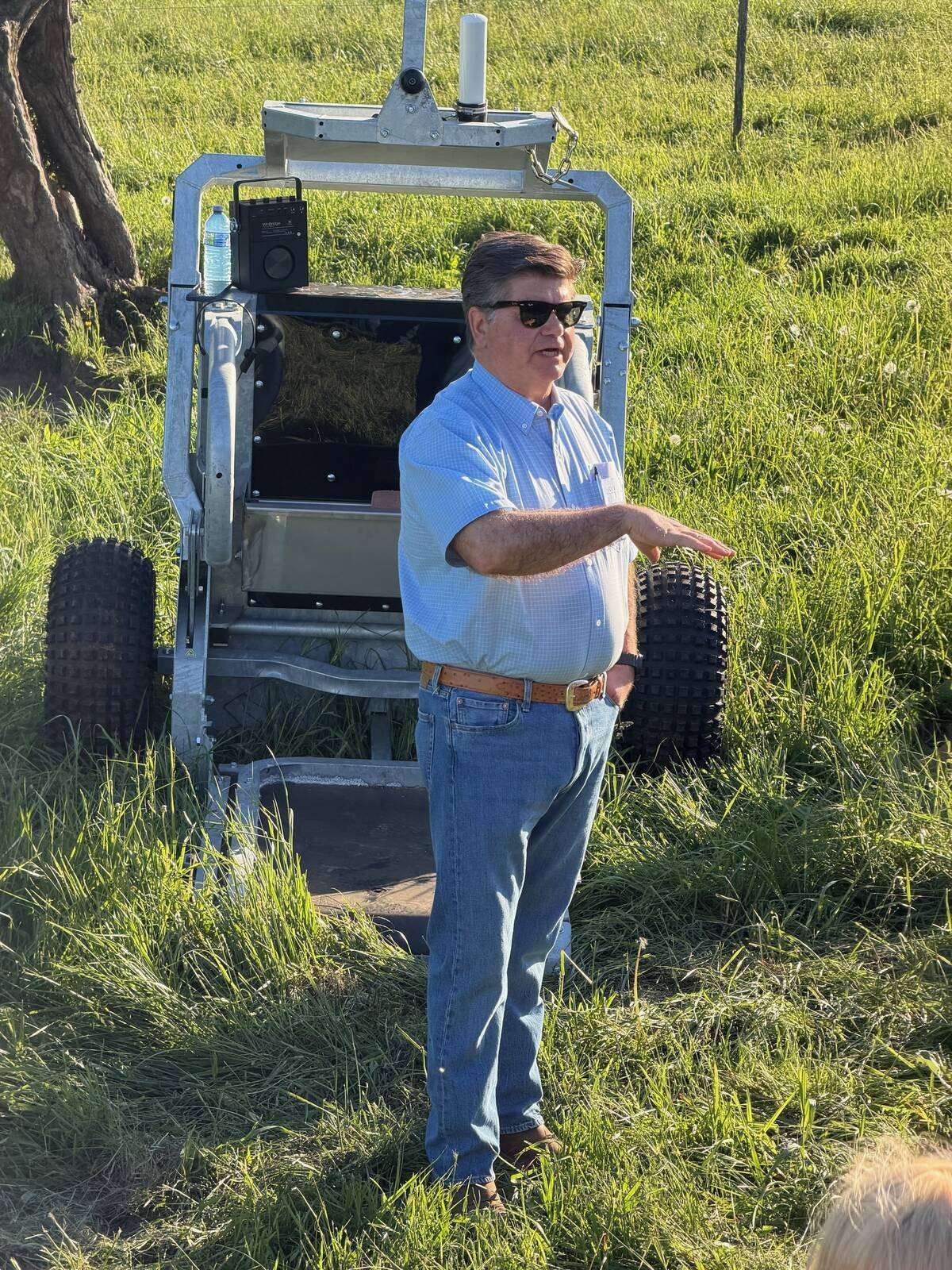
Schaus uses innovative technology, manufactured in Canada, to weigh cattle in the final stage, in the pen.
The StrongBó automatic cattle weighing systems are available as portable units and fixed units. Schaus is putting six fixed units in the six pens in a new barn he’s building near Walkerton. He has four of the units placed with custom feeders.
The cattle are enticed to the weigh scale by a salt block, and they only need to have their front feet on the scale to be weighed accurately. Some cattle will visit the autoweigher six times per day.
StrongBó was founded in Ireland by Michael McInerney and Ivan Wahlrab. McInerney moved to Canada and partnered with Marty Metzger, a cattle veterinarian, to further develop the technology. The units are made in Ontario and now have worldwide distribution through a partnership with Gallagher.
McInerney said the main demand for the units is in Australia. That country’s beef production system has become more competitive over the past 10 years, with better attention to production management and the arrival of feedlots in that marketplace.
The unit can also be put into a pasture and can deliver data to a cloud server. Cattle on pasture can be monitored for growth or weights, whether that’s heifers, cows, backgrounded animals or grass-finished cattle.
A tool to hit important weight goals
It pays to be good at measuring cattle growth, said Schaus.
“We got good at it because I can’t afford to ship the steer 100 lbs. underweight, and I can’t afford to ship the steer 100 lbs. over, and that’s where the numbers are astonishing, how many dollars can be left over.”
He started using the StrongBó scales about a year and a half ago.
When the scales are put into pens at about day 135 of the finishing period, he said he can have weights on 80 per cent of the cattle in three or four days.
When cattle were $4.75 per lb. on the rail a year ago, he said they soon found hitting the right weights could mean a difference of $15,000 on a group of 100 cattle.
“That’s huge. There’s nothing else you can do on performance, there’s nothing you can buy, put in them, pour on them, inject into them that can make you as much money as weighing cattle.”
At today’s price of $5.50 per lb. on the rail, the effect is even larger, up to $20,000 to $25,000 extra value in a group of 100 cattle, when all the costs, down to interest, are considered.
“I can sort cattle all day for $20,000 to $25,000 on 100 head.”
The post Weighing cattle ‘can make you as much money’ as anything in the feedlot appeared first on Farmtario.


