

Record-breaking June heat coincided with a sharp regional split in European solar resource, according to analysis using the Solcast API. Persistent high pressure over France, Iberia and the western Mediterranean limited cloud formation and lifted irradiance across western and southern Europe, while repeated Atlantic weather systems brought cloud and rainfall to Scandinavia, the UK and Ireland, reducing irradiance further north. These patterns broadly aligned with expectations from earlier seasonal outlooks, although the contrast between regions was more pronounced than anticipated. The spatial pattern shows a clear split between above-average irradiance in western and southern Europe and below-average irradiance across parts of northern Europe.
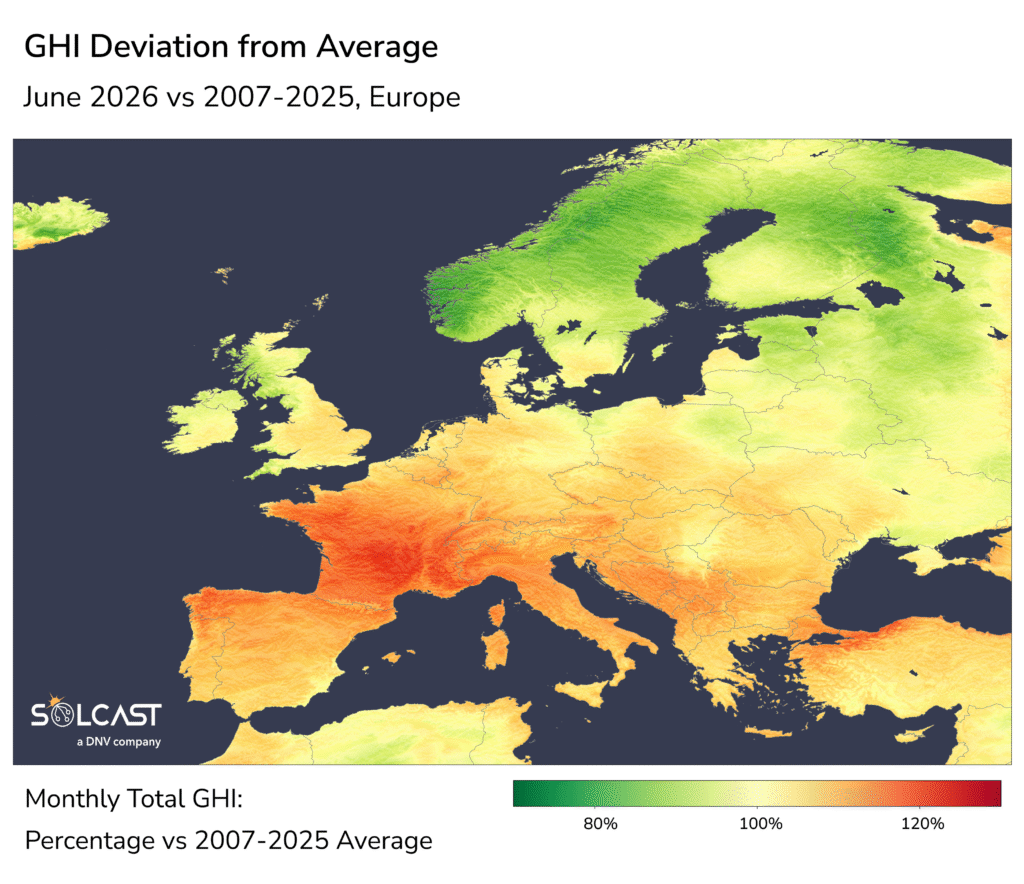
The ‘Azores high’ extended well into central Europe bringing persistent clear-sky periods across western and southern Europe. With limited cloud formation, solar producers benefited from increased irradiance. Further drying of soils already affected by drought intensified the heat. Across
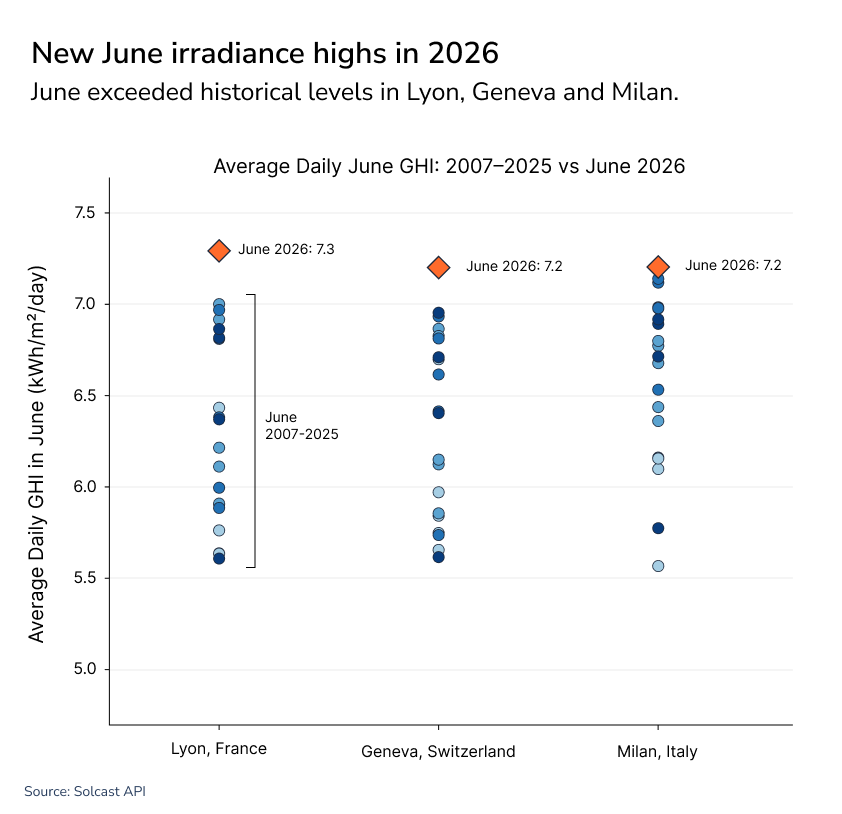
western France, northern Spain and nearby parts of western Europe, irradiance was around 25% above average, with cities such as Lyon, Geneva, and Milan recording their highest June values in the available record.
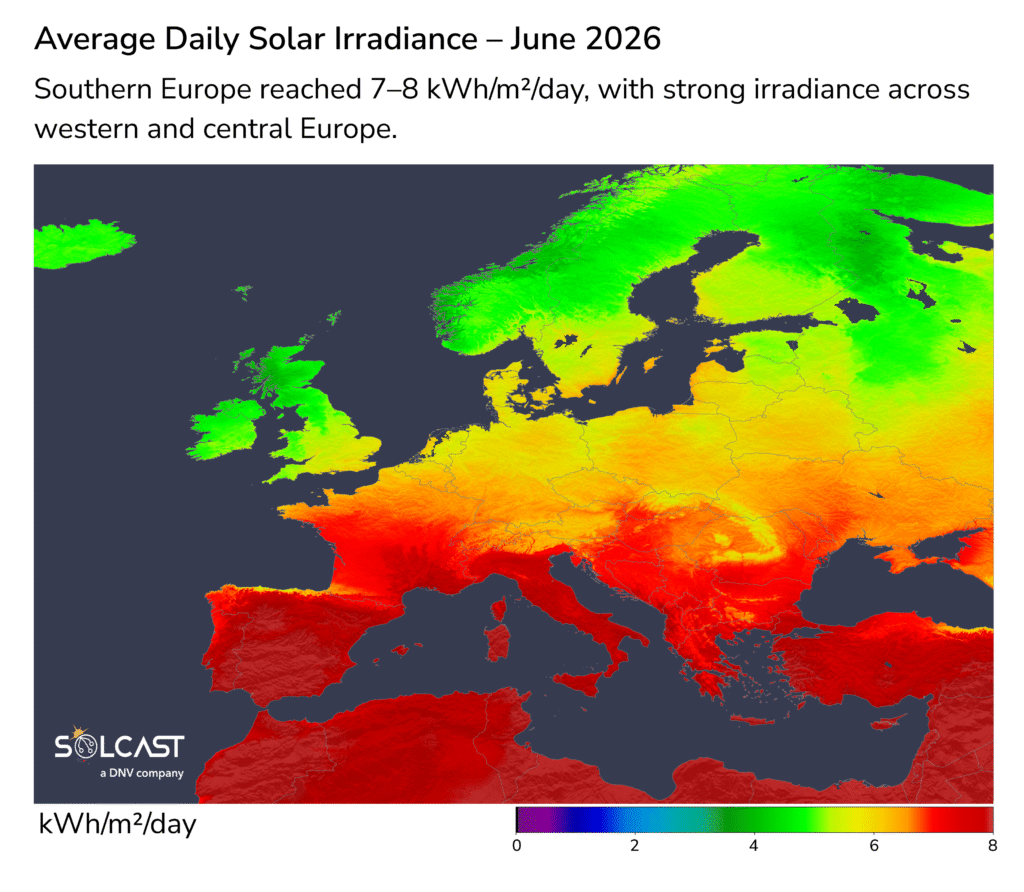
These positive anomalies occurred on top of already strong summer irradiance levels across southern Europe.
Daily conditions frequently showed widespread clear skies across western and southern Europe during the latter half of the month.
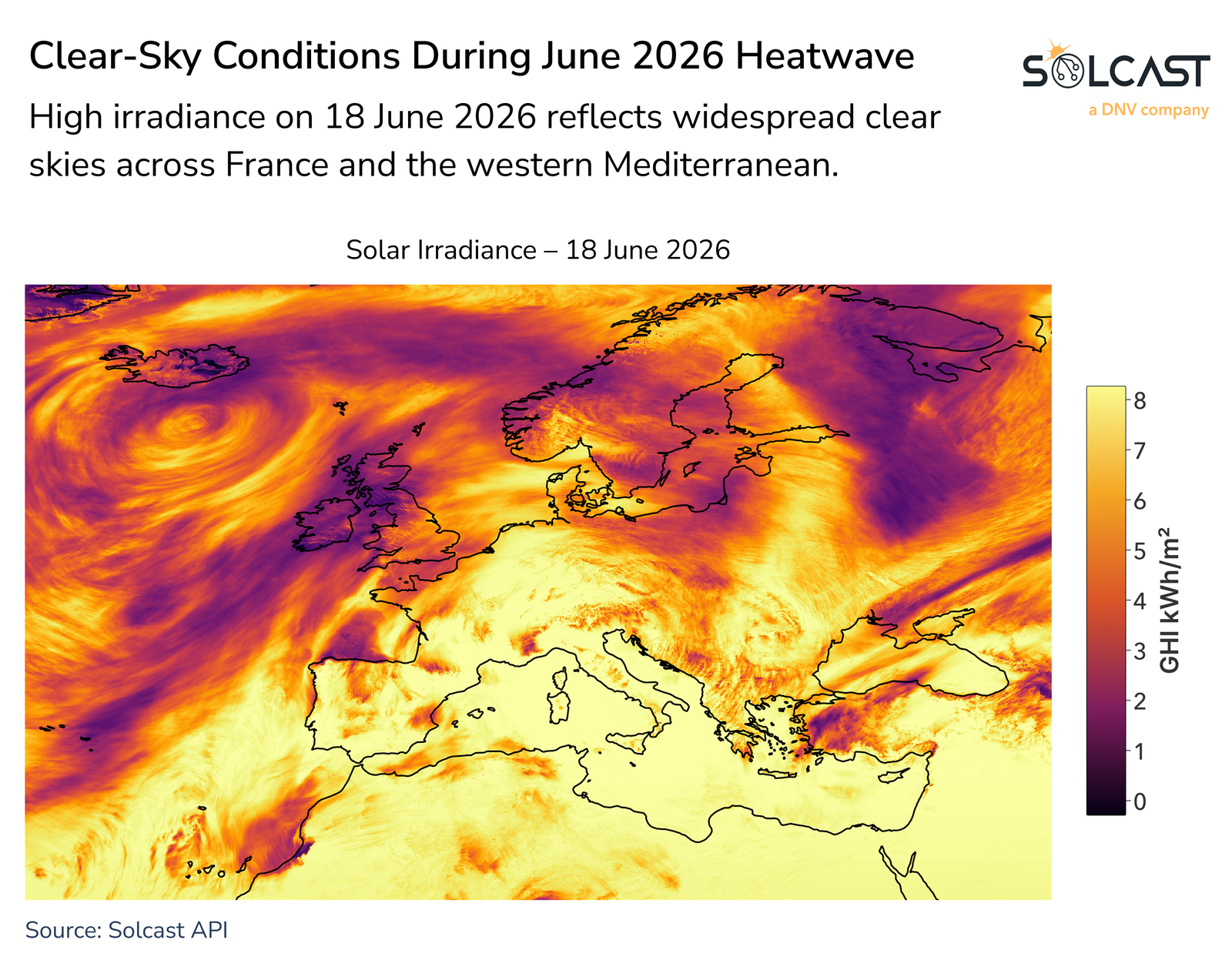
The same clear, stable conditions also drove extreme temperatures. For PV operators, this means the solar benefits of higher irradiance will have been dulled, as elevated module temperatures reduce conversion efficiency.
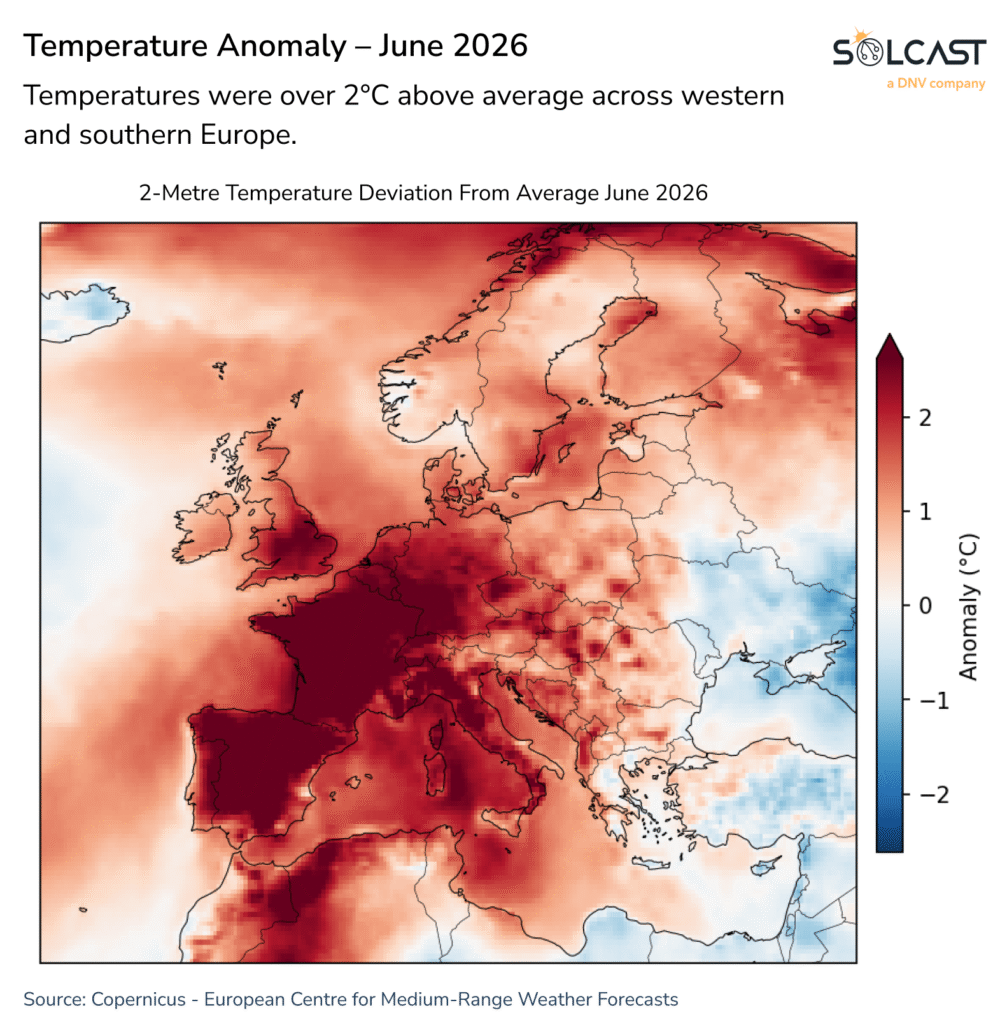
Further north, a stronger Atlantic storm track, associated with a positive phase of the North Atlantic Oscillation, brought repeated weather systems across Scandinavia, the UK and Ireland, leading to more frequent cloud, rainfall and wind. These conditions reduced irradiance, even as temperatures remained above average. Scandinavia saw the largest reductions, with irradiance up to 25% below average in parts of Norway. Ireland, Scotland and southwest England also recorded negative anomalies of around 5%.
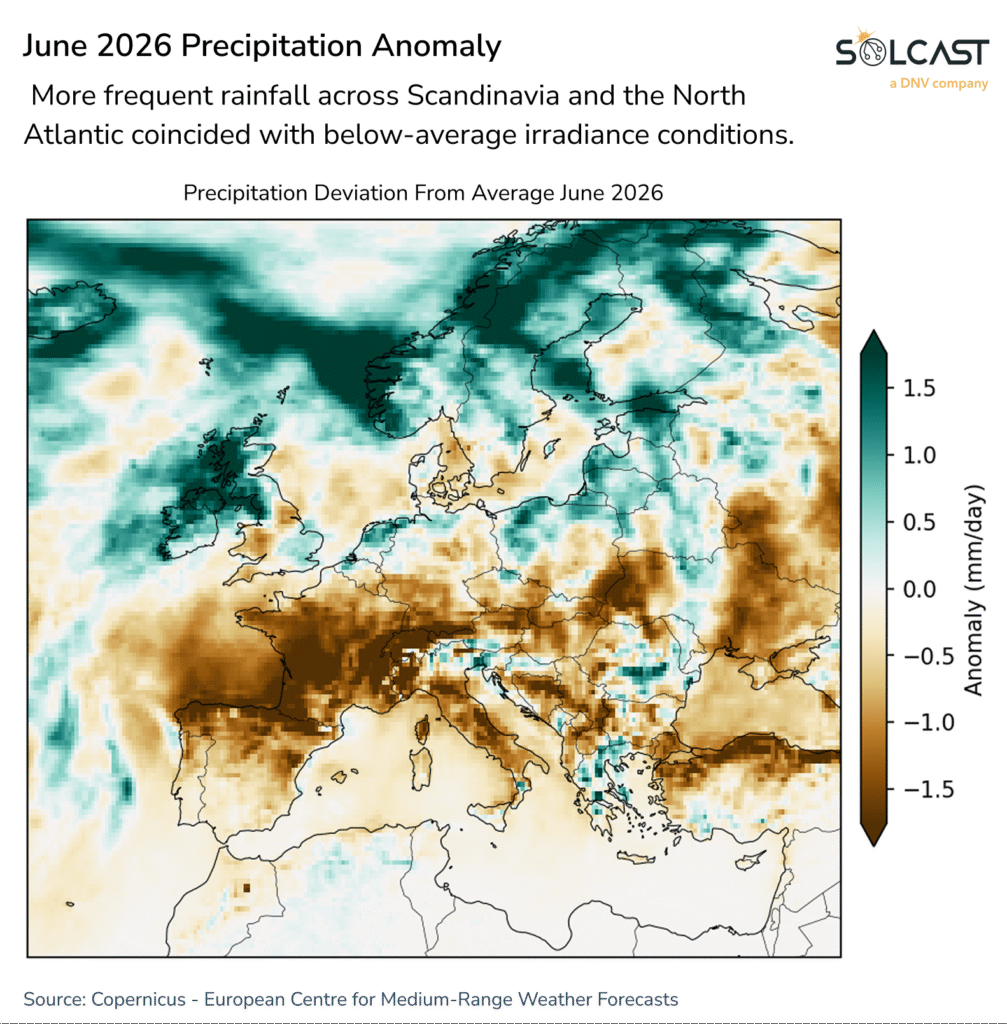
Seasonal forecasts issued in December 2025 indicated likely broadly higher irradiance across most of Europe, with weaker conditions expected in northern regions. Observations from June were largely consistent with this outlook, although contrasts were stronger than anticipated, with gains
concentrated in France, northern Spain and northern Italy, and reductions across Scandinavia, the UK and parts of eastern Europe.
Solcast produces these figures by tracking clouds and aerosols at 1-2km resolution globally, using satellite data and proprietary AI/ML algorithms. This data is used to drive irradiance models, enabling Solcast to calculate irradiance at high resolution, with typical bias of less than 2%, and also cloud-tracking forecasts. This data is used by more than 350 companies managing over 300 GW of solar assets globally.
The post Western Europe sees strong irradiance gains during record June heat appeared first on pv magazine Global.


