
What is Regenerative Agriculture?
Regenerative agriculture is a farming and ranching approach focused on improving soil health, restoring ecosystem function, increasing biodiversity, and strengthening the natural cycles that support life. Rather than simply sustaining current conditions, regenerative agriculture seeks to improve the land over time, making farms and ranches more resilient, productive, and profitable for future generations.
As interest in regenerative agriculture continues to grow, so does the debate surrounding its definition. Farmers, ranchers, researchers, consumers, and agricultural organizations often emphasize different practices and priorities. As a result, regenerative agriculture has become one of the most discussed, and sometimes misunderstood, concepts in modern agriculture.
How Do You Define Regenerative?
If you ask 10 different people to define regenerative agriculture, you’ll probably get 12 different answers.
In many ways, regenerative agriculture is a lot like human health. What would you consider to be a “regenerative lifestyle” to optimize human health? Go online for five seconds and you’ll see there are infinite diet and exercise gurus and communities quick to explain why their definition is the one to follow and why other definitions are flawed.
However, if the diet and exercise plan you’ve personally landed on is safe, legal, improves your health, leaves you feeling better and is enjoyable, then that is the right definition for you no matter what any of the “experts” say. Every body is different and the definition of “regenerative lifestyle” should reflect this fact.
The Confusion Around Regenerative Agriculture
As you likely already know, the same definition battles rage on when it comes to “regenerative agriculture”, and there are positive and negative aspects to this. It’s positive because regenerative agriculture isn’t supposed to be a rigid, one-size-fits-all recipe. Different farms, climates, soils and communities require different approaches. The movement still has room for creativity, adaptation and innovation.
On the flip side, it can be frustrating because the term regenerative agriculture gets stretched in so many directions that people start wondering whether it means anything at all. To some, regenerative agriculture is mainly about not using pesticides. To others, it’s about not tilling the soil and destroying soil structure. Others still demand animals be reintegrated on every acre of cropland to be regenerative.
While each of these camps have their legitimate points, declaring a hard stance on these hot-button topics, as well as many others, ends up leaving everyone collectively more confused with each attempt at a definition.
So, let’s simplify it and find some common ground that we can all agree on.
What is Being Regenerated?
The definition of regenerative agriculture starts with that simple question above. Something needs to be regenerated in a regenerative system. “Regenerate” is the root of the word, after all! To us, regenerative agriculture needs to focus on outcomes, not necessarily practices.
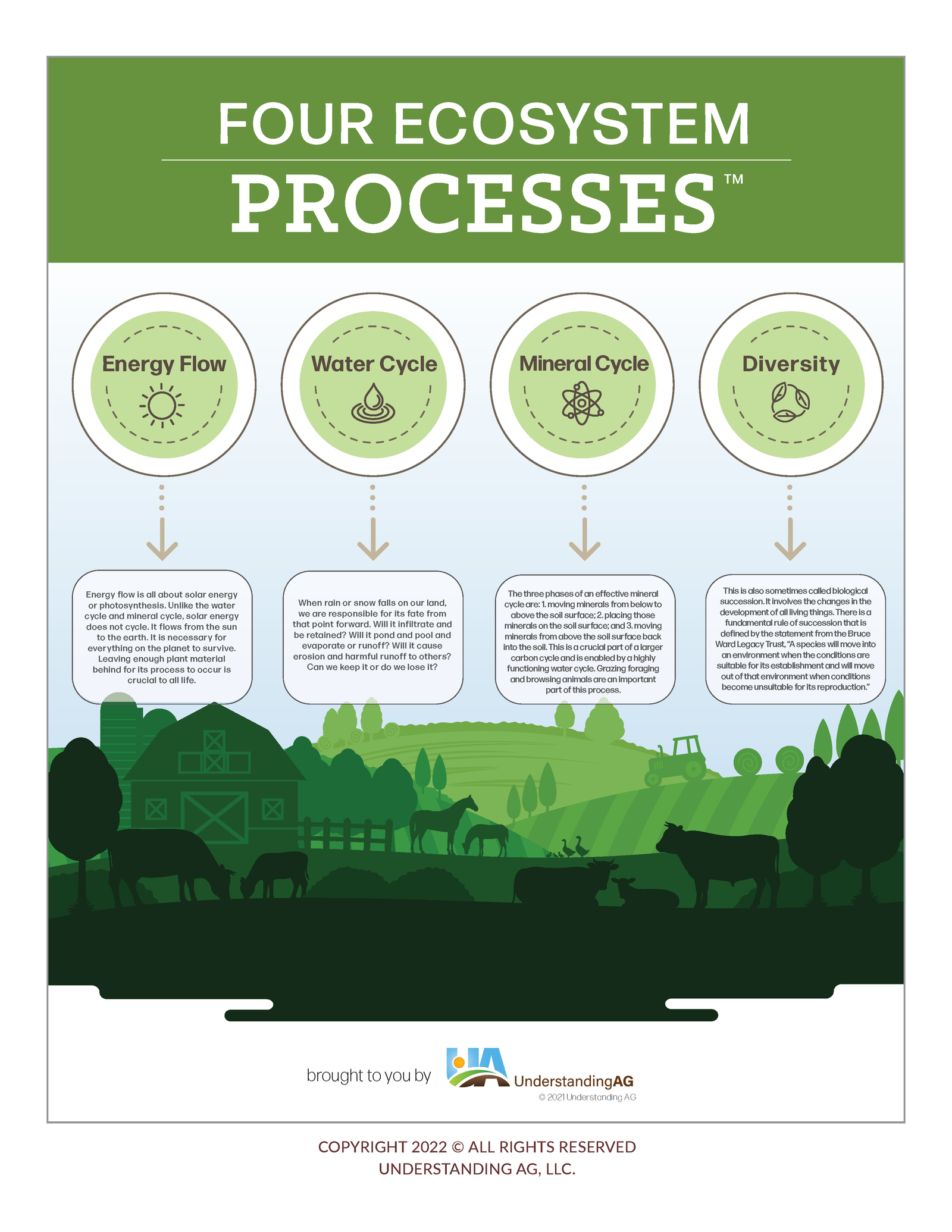
The simplest answer to “what is being regenerated?” is the four ecosystem processes on which every landscape and living creature on earth depends:
- The Energy Cycle
- The Water Cycle
- The Nutrient Cycle
- The Cycle of Life (also called Community Dynamics)
The Energy Cyle
Every farm, ranch and ecosystem ultimately runs on energy from the sun, whether ancient (fossil fuels) or modern (today’s sunlight). Through photosynthesis, plants capture solar energy and convert it into biological molecules that feed livestock, soil microbes, wildlife and people alike. A healthy energy cycle means maximizing living plant coverage and photosynthesis for as much of the year as possible. When soil sits bare or plants are unhealthy, less solar energy is captured and more potential productivity is lost. Regenerative agriculture seeks to improve the efficiency of this cycle by capturing and utilizing more modern solar energy, which allows the operation to use less ancient solar energy.

The Water Cycle
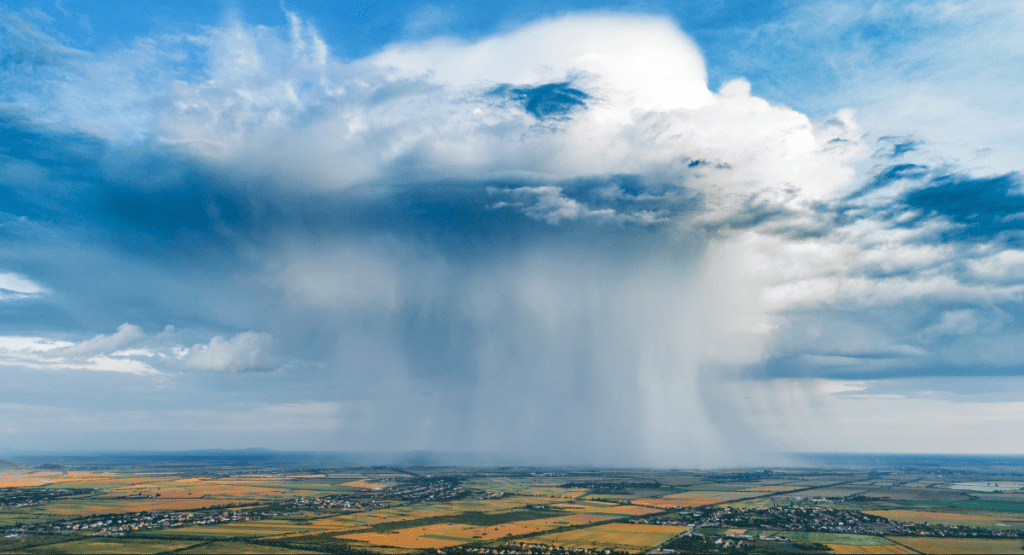
Healthy soil functions like a sponge, allowing rainfall to infiltrate into the ground rather than running off the surface. When water infiltrates properly, it replenishes soil moisture, supports biological growth and reduces erosion and nutrient loss. Degraded soils often become compacted and lose their ability to absorb and retain water, making farms more vulnerable to drought and flooding alike. Regenerative agriculture works to improve water infiltration, water-holding capacity and water use efficiency by restoring soil structure and biological activity.
The Nutrient Cycle
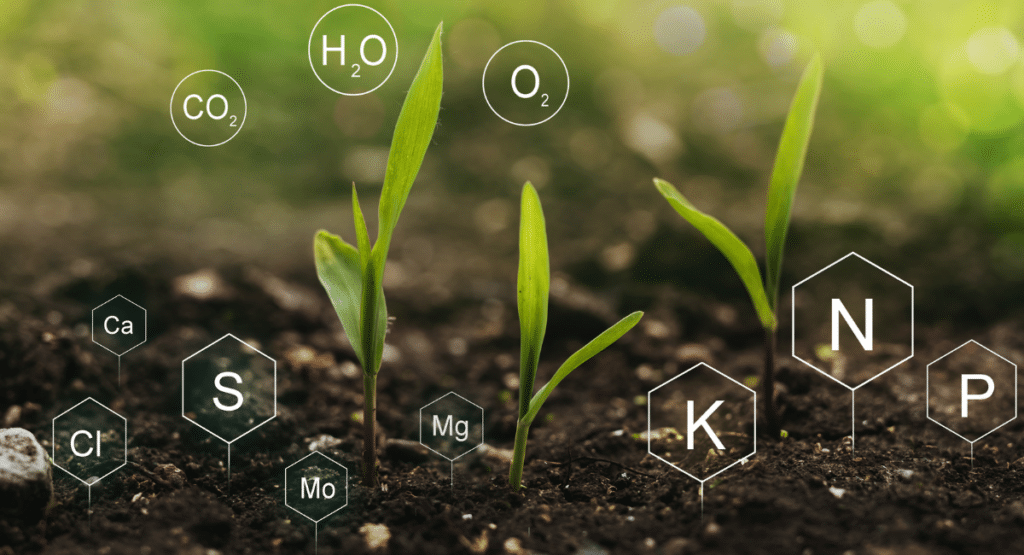
Nutrients are constantly recycled through air, water plants, animals, microbes and the soil. As biological activity increases, nutrients become more available to plants through natural processes instead of relying solely on outside inputs. This does not mean fertilizers are inherently bad, but regenerative agriculture asks how farms can improve natural nutrient cycling to create more efficient and resilient systems over time. Regenerative agriculture seeks to build healthy soils with active biology that are more efficient in storing, cycling and delivering nutrients when they are needed. To learn more about the nutrient cycle, read my blog series here.
The Cycle of Life (a.k.a. Community Dynamics)
Healthy ecosystems are built on diversity. Different plants, animals, insects and microorganisms all play important roles in keeping ecosystems functioning properly. When biological diversity declines, ecosystems often become more fragile and dependent on intervention. The more diverse and balanced the biological community becomes, the more resilient and efficient the entire system tends to be. Regenerative agriculture seeks to rebuild and restore biodiversity both above and below ground.

Understanding Ag’s Definition
In essence, the terms “regenerative” and “improvement” are synonymous. Farms and ranches making active changes that result in better energy, water, nutrient and life efficiencies are regenerative because they are headed in the right direction, and that’s a win for everyone.
The paramount importance of improving these processes is reflected in Understanding Ag’s personal definition of regenerative agriculture:
“Farming and ranching in synchrony with nature to repair, rebuild, revitalize and restore ecosystem function starting with all life in the soil and moving to all life above the soil.”
To help farmers, ranchers, and land managers put these concepts into practice, Understanding Ag has developed the 6-3-4 framework. The framework outlines Six Principles of Soil Health, Three Rules of Adaptive Stewardship, and the Four Ecosystem Processes that work together to guide management decisions toward improved ecosystem function and long-term resilience.
Rather than prescribing a rigid set of practices, the 6-3-4 framework provides a practical way to evaluate whether management decisions are moving the land in a regenerative direction. Whether managing a farm, ranch, pasture, cropland, or backyard, the principles remain the same: work with nature to improve ecosystem function over time.
You can learn more about the framework in our article, The 6-3-4 Explained.
Many people (rightfully) also include various cultural and societal aspects that can be regenerated in their definition. These include the regeneration of public health, rural communities and all kinds of social issues. While these are all causes worthy of our attention, their improvement ultimately depends upon the improvement of the four ecosystem processes listed above.
Why Regenerative Agriculture Matters
At the end of the day, we all want the same things:
- Profitable farms and ranches
- Healthy soils
- Clean water
- Clean air
- Nutritious food
- Resilient agricultural businesses
- Thriving rural communities, rural economics and public health.
There’s no doubt that we can (and will) argue about the “how-to’s” of achieving these goals ‘til the cows come home, but let’s not let (perceived) perfection get in the way of improving this shared home we call Earth.
Regenerative agriculture is about making meaningful improvements that restore ecosystem function, strengthen resilience, and leave the land better than we found it.
When the energy cycle, water cycle, nutrient cycle, and cycle of life are moving in the right direction, the entire system benefits, from the soil beneath our feet to the communities that depend upon it.
Start Your Regenerative Journey
If you’re ready to improve the health, productivity, and profitability of your operation, the Understanding Ag team is here to help. Our experienced consultants work alongside farmers and ranchers across North America to develop practical, profitable strategies tailored to their unique goals, resources, and environment.
Whether you’re just beginning your regenerative agriculture journey or looking to take your operation to the next level, we invite you to connect with one of our expert consultants and discover what’s possible for your land.
The post What is Regenerative Agriculture? appeared first on Understanding Ag.


