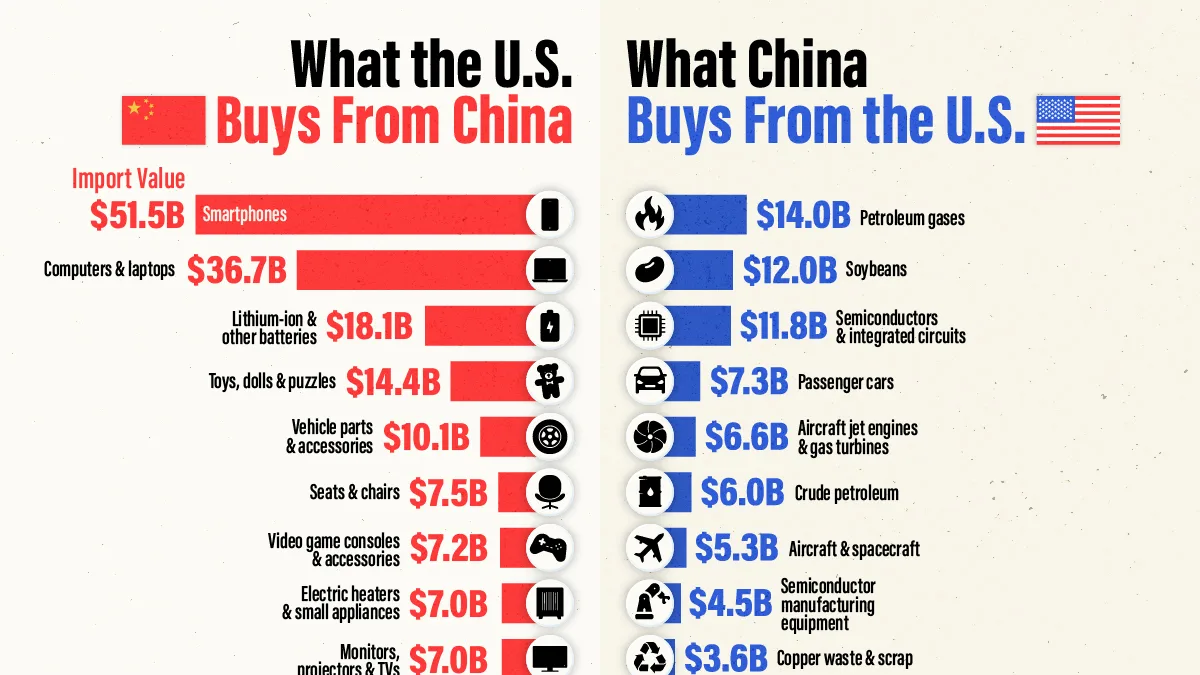
What the U.S. and China Depend On Each Other For
See visuals like this from many other data creators on our Voronoi app. Download it for free on iOS or Android and discover incredible data-driven charts from a variety of trusted sources.
Key Takeaways
- China supplies nearly half of all U.S. smartphone imports and over half of battery imports.
- The U.S. remains a critical supplier of aircraft technology, semiconductors, and energy products to China.
- Despite rising tensions, both economies still rely heavily on each other for key industries.
Despite years of tariffs, export controls, and geopolitical tension, the U.S. and China still depend heavily on each other for critical goods.
The U.S. relies on China for everything from smartphones and batteries to toys and gaming consoles, while China depends on American aircraft technology, semiconductors, and energy exports.
This graphic breaks down the top goods traded between the world’s two largest economies in 2024, using the latest available data from UN Comtrade.
Largest U.S. Imports From China
In 2024, smartphones and phone equipment made up the largest U.S. import category from China, totaling $51.5 billion. Nearly half (45%) of all U.S. smartphone imports came from China.
Smartphones were followed by computers and laptops ($36.7 billion) and lithium-ion and other batteries ($18.1 billion). Of these three, U.S. dependence on China was strongest in batteries, with 56% of U.S. battery imports sourced from China.
The data table below shows the largest U.S. imports from China in 2024 and China’s share of total U.S. imports by category.
| Rank | Top 10 U.S. Imports from China by Value | Imports from China ($B) | Share of Total Imports |
|---|---|---|---|
| 1 | Smartphones & telephone equipment | 51.5 | 44.7% |
| 2 | Computers & laptops | 36.7 | 26.0% |
| 3 | Lithium-ion & other batteries | 18.1 | 55.9% |
| 4 | Toys, dolls & puzzles | 14.4 | 76.3% |
| 5 | Vehicle parts & accessories | 10.1 | 11.2% |
| 6 | Seats & chairs | 7.5 | 27.4% |
| 7 | Video game consoles & accessories | 7.2 | 77.7% |
| 8 | Electric heaters & small appliances | 7.0 | 55.6% |
| 9 | Monitors, projectors & TVs | 7.0 | 33.1% |
| 10 | Plastic articles (misc) | 6.9 | 46.3% |
China’s dominance extends beyond consumer electronics. The U.S. imports over three-quarters of its toys, dolls, and puzzles as well as video game consoles and accessories from China.
In contrast, only 11% of U.S. imports of vehicle parts and accessories come from China. In the auto sector, North American neighbors like Canada and Mexico play a much larger role in U.S. supply chains.
Largest Chinese Imports From the U.S.
China depends on U.S. imports for not only commodities like natural gas ($14 billion) and soybeans ($12 billion), but also higher-tech products like semiconductors ($11.8 billion) and jet engines ($6.6 billion).
Chinese commodity imports from the U.S. have been affected in recent years by global trade tensions. For example, Brazil surpassed the U.S. as China’s largest soybean supplier following the 2018 trade war between Beijing and Washington.
| Rank | Top 10 Chinese Imports from U.S. by Value | Imports from U.S. ($B) | Share |
|---|---|---|---|
| 1 | Petroleum gases (LNG/LPG) | 14.0 | 15.9% |
| 2 | Soybeans | 12.0 | 22.8% |
| 3 | Semiconductors & integrated circuits | 11.8 | 3.0% |
| 4 | Passenger cars | 7.3 | 19.0% |
| 5 | Aircraft jet engines & gas turbines | 6.6 | 53.6% |
| 6 | Crude petroleum | 6.0 | 1.9% |
| 7 | Aircraft & spacecraft | 5.3 | 57.5% |
| 8 | Semiconductor manufacturing equipment | 4.5 | 9.5% |
| 9 | Copper waste & scrap | 3.6 | 20.3% |
| 10 | Vaccines, blood, antisera | 3.4 | 18.9% |
However, not all products are easy to source elsewhere. In the aircraft sector, for example, the U.S. accounts for over half of Chinese imports of aircraft and jet engines, highlighting a major area of dependence for China.
Where the U.S. and China Go From Here
Amid economic competition and tensions over issues like Taiwan and the Iran War, both Chinese and U.S. officials have sought to reduce dependence on the other. Yet decades of economic integration have made any effort at decoupling complex and costly for businesses on both sides.
The microchip sector remains a major point of contention, as China seeks to expand its domestic capabilities in an industry dominated by the U.S. and allies like Taiwan, South Korea, and the Netherlands.
Even as both governments push to reduce reliance on one another, the data shows how deeply intertwined the two economies remain. For many critical products, replacing these trade relationships could take years and come at significant cost.
Learn More on the Voronoi App 
Where do consumers have it cheaper? Find out with China vs US: The Cost of Everyday Things on Voronoi.Use This Visualization