
The rising cost of equipment has always been a concern for producers, but the past seven years have seen a rise so rapid that it has taken centre stage in politics in recent months.
In 2019, agriculture faced its share of challenges, including extreme weather, labour shortages and suppressed crop prices.
But when the challenges of 2019 are put in the context of what’s faced today, they almost seem comically simple. Pandemics, war, global trade upheaval and technology. These defining factors have supercharged the factors affecting equipment prices.
On March 27, U.S. President Donald Trump asked large farm equipment OEMs — that is, original equipment manufacturers, such as John Deere, CNH and Agco — to lower tractor prices as the administration looks for ways to offset challenges for farmers driven by trade and geopolitical volatility.
But is it that simple? Are equipment OEMs and dealers in a position to hold or reduce pricing while remaining financially viable themselves? To find the answer, we asked the opinion of players involved in the equipment industry.
Large OEMs have been speaking to increasing costs for some time now.
“There are two general factors driving equipment pricing: rising material and component costs and increasing technology and complexity,” says Torey Hadland, vice-president of Claas America.
“Material cost factors driven by tariffs, energy costs, inflationary pressure and supply chain disruptions are a well-known factor at this point,” says Hadland. “But stricter regulatory policy on emissions and material recyclability has also driven up cost.”
Covering ground faster costs more
Kurt Buehler is the president of Guelph-based Linamar Corporation’s agricultural equipment division — parent to the MacDon, Salford and Bourgault brands. Buehler agrees that technology is driving some of the cost increases seen recently.
“Our customers have been asking for larger equipment to cover more ground faster and advances in technology help operators extract the benefit. Pound-for-pound, the price is higher, but there is a clear ROI for the farmer.”
Aside from the increased content of new technologies, Buehler also points to the costs of manufacturing inputs. “We do a great job at finding manufacturing efficiencies to offset the rising costs of labour or overheads, but some purchased materials and energy inputs are simply outside of our control. As an example, we’ve seen increased freight surcharges in the past month due to rising fuel prices driven by the U.S.-Iran conflict. We are unable to offset those costs.”
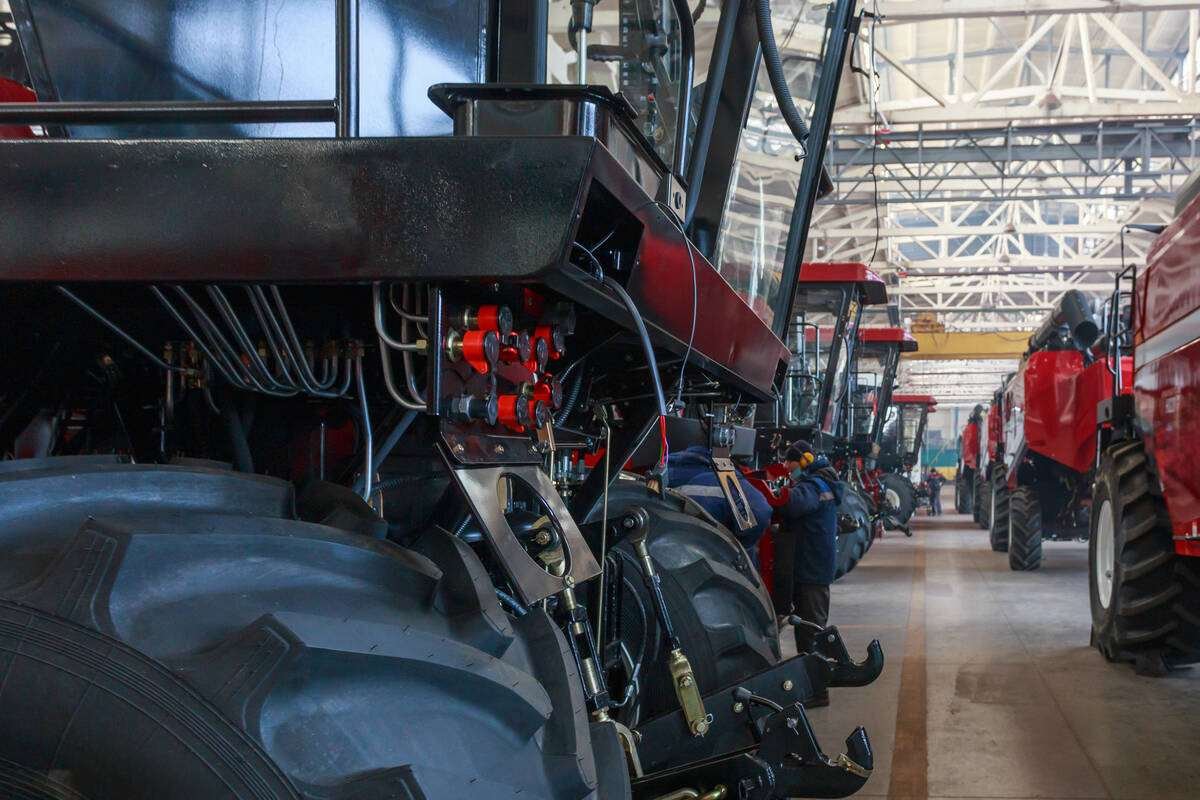
Farm equipment sold in the Canadian market can be affected by U.S. tariffs even if sourced from overseas. Photo: Elena Bionysheva-Abramova/iStock/Getty Images
Representatives of other manufacturers say that a weak Canadian dollar compared to the U.S. dollar and the euro is not helping either. The considerable disadvantage in Canadian buying power can hit at multiple levels in the supply chain, from Canadian manufacturers who must purchase components in U.S. dollars to dealers who must acquire product in U.S. dollars or euros.
A shortage of labour at all levels, including skilled workers at factories, to service technicians at dealerships, continues to push up overall labour premiums, a problem that has persisted far longer than some more recent circumstances.
Dealers in Canada continue to feel caught in the middle as they face increased pressure from OEMs to boost sales numbers while simultaneously listening to concerns from producers about ever-increasing costs.
Ben Voss, the president of Mazergroup — an 18-store New Holland dealer group based in Manitoba — says that most of their products are affected by U.S. tariffs even if sourced from overseas.
“Most product is imported into the U.S. before shipping to Canadian dealers, so there are more products affected than people think,” says Voss.
More rebuilding happening
Voss explained that current new pricing is driving new behaviour for customers who would traditionally flip their machinery every couple of years.
“We’re seeing more large farms invest in rebuilding equipment or purchasing low-hour used equipment,” he says. “This has bolstered pricing for some categories of first and second-tier used equipment, which has suffered from oversupply and weak pricing in the past couple of years. But these are the same customers that would typically buy new, so it’s shifting the problem elsewhere in a sense.”
Most industry players agree that a lot must happen to stabilize rising costs long-term. There is no single smoking gun driving cost increases — simply a variety of factors compounding the issue.
With a world constantly adjusting to changing geopolitics, supply chain structure, labour shortages, evolving technology and market volatility, a period of relative stability is needed. In the meantime, farmers are being forced to adapt by seeking further consolidation and more ways to improve efficiencies, knowing that if the last seven years has taught us anything, it’s that pricing volatility is here to stay.
The post What’s really driving farm machinery price increases? appeared first on Farmtario.


