

Heat waves in Europe are becoming the norm. Strong sunlight isn’t the problem. The critical factor is temperature. Solar modules are evaluated under standard test conditions: 1,000 watts per square meter of irradiance and a cell temperature of 25 degrees Celsius. In the field, cell temperatures on hot days are significantly higher. Modules can get considerably hotter than the ambient air temperature.
In crystalline solar cells, power output typically decreases with increasing temperature. If the cell temperature is not 25 degrees Celsius but 65 degrees Celsius, this corresponds to a power loss of approximately 16 percent compared to standard conditions, assuming a temperature coefficient of minus 0.4 percent per degree.
For operators, this distinction is crucial. Those who only look at raw yield figures are missing the bigger picture. The more important question is: did the photovoltaic system produce as it should under the actual irradiance and temperature conditions?
Extreme temperatures are rarely the sole cause of a problem. Often, they reveal existing weaknesses. These include, among other things, dirty modules, partial shading, vegetation, and damaged cell areas. Under high irradiance, current flows and thermal stresses increase. Small imbalances can therefore become more apparent.
A typical example is hotspots. These occur when individual cell areas are subjected to higher loads than the rest of the module. Under strong irradiance, a local electrical effect can turn into a thermal problem.
Battery storage makes the system question more complex
With battery storage, the issue of heat becomes even more relevant, as it changes the operating logic of the entire system. A storage system can absorb excess solar energy, smooth feed-in peaks, reduce curtailment, shift electricity to more valuable hours, provide grid services, and stabilize load profiles. This is precisely why storage is becoming increasingly important in markets with a high share of photovoltaics.
But energy storage devices have their own physics: lithium-ion batteries age through calendar aging and cycle aging. Temperature, state of charge, depth of discharge, C-rate, idle times, and operating strategy all influence how quickly capacity and performance decline. Studies clearly show that high temperatures, high states of charge, and deep cycles can accelerate aging.
Heat also affects storage systems on several levels. Cooling systems have to work harder, self-consumption increases, and thermal reserves decrease. Battery systems can reduce their performance when cell, rack, or container temperatures reach critical limits. At the same time, prolonged periods of high temperature and high state of charge can accelerate calendar aging.
This is particularly relevant in photovoltaic-coupled applications, where storage systems are quickly charged at midday and then remain at a high state of charge and high ambient temperature for hours.
Safety is also a key issue. Modern battery systems feature battery management systems, temperature sensors, fire protection concepts, and shutdown logic. Nevertheless, thermal runaway remains a significant risk. Studies indicate that an internal cell defect after leaving the manufacturing process cannot be completely ruled out by operational technology. Therefore, it is crucial to prevent propagation, measure off-gas, and design and operate systems in such a way that a single fault does not become a systemic event.
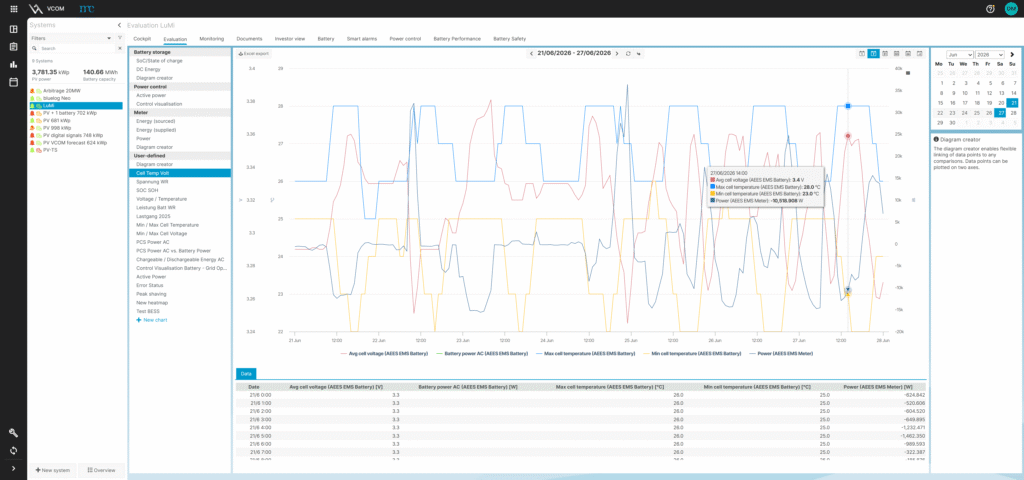
Photovoltaics and storage must be considered together.
In hybrid systems, two effects converge: the photovoltaic system produces substantial energy under high irradiance but loses some of its potential output due to high cell temperatures. The storage system is intended to absorb surplus energy, shift peak loads, and stabilize the power grid, but it too is subjected to greater stress due to high temperatures.
This creates conflicting objectives in operation. A storage system can be fully charged at midday, even though the ambient temperature is high. It can remain at a high charge level for hours. It can be heavily discharged in the evening while cooling, grid load, and price signals are all at play. Each of these decisions can be economically sound. Or it can become expensive in the long run.
Therefore, what matters is not a single operating mode, but the continuous evaluation of use cases. The potential gains from trading, optimizing self-consumption, or grid services must be constantly weighed against efficiency losses, thermal stress, and additional aging. Modern energy management systems perform this task and continuously reassess technical conditions, market and grid signals, and derive the appropriate operating strategy from this analysis. Here’s what operators should pay attention to:
1. Heat logic begins with plant design
Shading is generally detrimental to solar panels because it reduces yield, exacerbates mismatch effects, and can promote hotspots. However, targeted shading can be beneficial for battery storage systems because it reduces thermal stress and eases the load on the cooling system.
This sounds trivial, but in practice it quickly becomes a real conflict of objectives. What yields maximum output for the photovoltaic area is not automatically the best solution for storage containers, inverters, transformer stations or switch cabinets.
Therefore, the design of a system should also consider how the system behaves on hot days. Where do heat build-up occur? Which components are permanently exposed to direct sunlight? How well are storage systems, inverters, and electrical infrastructure ventilated or shaded? How easily accessible are critical components for maintenance, inspection, and fire department access?
2. Test regulatory capacity under stress conditions
For photovoltaic-plus-storage systems, it’s not enough to simply check whether individual components are functioning. The crucial factor is whether the system as a whole remains controllable when multiple demands are at play simultaneously: high irradiance, high temperatures, grid requirements, storage strategy, inverter limits, and economic operating schedules.
Operators should therefore not only evaluate the control concept on paper, but also validate it in operation. Are setpoints reliably adopted? Does the system react correctly to specifications at the grid connection point? Do active and reactive power control function even under high load? Are ramp rates maintained? Is storage operation adjusted if temperature, state of charge, or derating limits contraindicate it? And is it clearly documented when and why the system was regulated or curtailed?
3. Data quality is the basis of every evaluation.
The next step is a clean data foundation. Irradiance, ambient temperature, module temperature, wind, inverter data, string data, battery temperatures, state of charge and operating conditions must be plausible.
Faulty sensors lead to incorrect diagnoses. Incorrect diagnoses lead either to unnecessary call-outs or to overlooked problems.
4. Performance must be evaluated with temperature correction.
Operators should also use comparison logic. Individual strings, inverters, tracker sections, subsystems, or storage containers should be compared against similar units over the same period.
If all areas react similarly to heat, this suggests a general temperature effect. If individual areas differ significantly, this indicates a local problem.
5. Consistently prioritize local risks
Hotspots, shading, and pollution should be consistently prioritized. Especially under high solar irradiance, local effects can have a greater impact. Vegetation control, cleaning strategies, thermography, and visual inspection should therefore not be considered in isolation, but rather as part of a comprehensive risk management strategy. Electrical infrastructure also deserves more attention: connectors, cables, junction boxes, distribution boxes, switch cabinets, and transformers are all subject to stress during periods of heat.
6. Storage devices need thermal transparency
For battery storage systems, good operation begins with thermal transparency. Cell, module, rack, and container temperatures must not only be measured but also evaluated in context. Not only is the absolute maximum temperature is relevant, but also the temperature distribution. Large temperature variations within a system can indicate cooling problems, airflow issues, sensor malfunctions, or uneven load distribution.
7. Consciously control charge level and aging
State-of-charge (SOC) windows should be carefully selected. A storage system doesn’t need to be constantly maintained near 100 percent SOC just because a lot of photovoltaic energy is available. Especially at high ambient temperatures, it can be beneficial to design operating strategies so that high SOCs aren’t maintained unnecessarily long.
The cooling system must also be treated like a critical component. HVAC or liquid cooling systems are not secondary components. They ensure performance, lifespan, and safety. Filters, air ducts, refrigerants, compressors, pumps, sensors, and redundancies must be included in maintenance plans.
8. Take early indicators and alarms seriously
Important early indicators also include: increasing temperature differences between racks, noticeable cell voltage deviations, increasing internal resistance, decreasing round-trip efficiency, more frequent derating, unexpected SOC drifts, communication errors, or unusual HVAC runtimes.
A single signal does not constitute an emergency. Together, they can form a pattern.
9. Systematically follow up on heat waves
After a heat wave, the system should not automatically return to normal operation. Hot days provide valuable data: Which inverters derated first? Which strings showed deviations? Which sensor data was implausible? Which storage areas exhibited unusual thermal activity? Which alarms were helpful, and which were just noise? Such analyses lead to improved operation.
What we as an industry can learn from this
Heat waves are therefore more than just a seasonal extreme. They are a practical test of whether photovoltaic, storage, and hybrid systems can be understood and managed throughout their entire life cycle. Systematic evaluation of such phases provides insights not only into individual components but also into the quality of the overall operating model.
About the authors
Andreas Kern is a Senior Technical Consultant. His responsibilities include providing technical consulting services within the Technical Consulting department. These services include, for example, yield assessments, technical inspections, technical due diligence, and BESS yield assessments.
Philippe Staudinger is Technical Director at mc Energy and is responsible for building and developing the technical organization. He also shapes the operational structures in the C&I energy sector and focuses on the development and implementation of decentralized battery energy storage systems (BESS) for commercial and industrial customers.
The post When heat becomes a stress test: What extreme temperatures mean for photovoltaic systems and battery storage appeared first on pv magazine Global.


