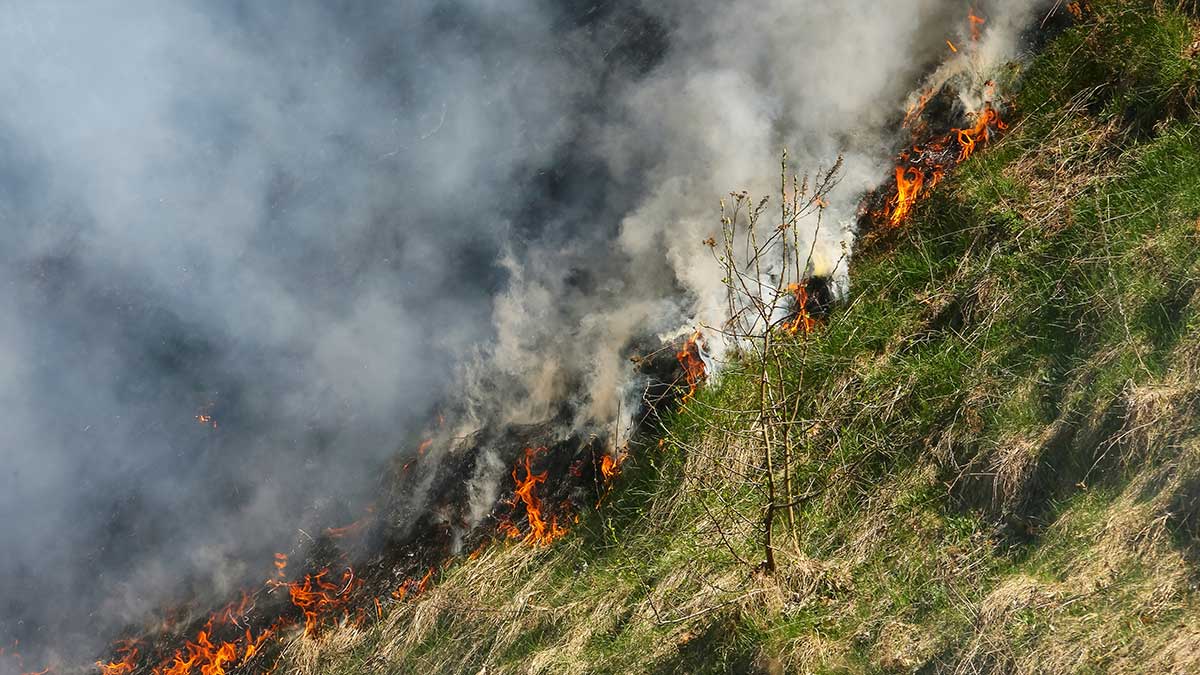
More than 25,000 square miles of the U.S. Great Basin, an area nearly twelve times the size of Yellowstone, has flipped from native sagebrush to invasive annual grassland over the past three decades, much of it without ever burning. The change is amplifying the Western fire season. Researchers using satellite data found that fire is no longer required to convert these landscapes; once the grasses arrive, the fire follows.
Grasses occupy a unique position in our climate. They are everywhere — pastures, lawns, prairies, savannas, roadsides — and they are easy to overlook precisely because they are so familiar. However, the world’s grasses are responding to warmer temperatures, shifting precipitation, and rising atmospheric carbon dioxide in ways that are reshaping ecosystems and fire regimes from the Mojave Desert to the slopes above the fire-scorched community of Lahaina in Hawaii.
The story of climate change and grass is, increasingly, a story about what burns, when, and how often.
A different kind of fuel
Wildfire science has long focused on forests, but the dominant fuel type driving change in the American West today is not timber. It is grass, particularly fine, dry, non-native annual grass that cures by early summer and carries flame between shrubs that would otherwise be too widely spaced to burn together.
Cheatgrass greens up earlier than native bunchgrasses, drawing down soil moisture and nutrients before native species start to grow. It then dies in early summer, leaving a continuous, dry, highly ignitable mat across landscapes that historically had patchy fuels and infrequent fires. The Bureau of Land Management found that areas invaded by cheatgrass (Bromus tectorum) are roughly twice as likely to burn as uninvaded land, and that cheatgrass now dominates or is a meaningful component of vegetation on roughly 52 million acres of the Intermountain West, up from roughly 31.5 million acres mapped in 2000 using satellite imagery.
A 2013 study, later supported by broader analyses, found that fire return intervals are now two to four times more frequent in cheatgrass-dominated landscapes than in intact sagebrush steppe. In 2019, ecologist Emily Fusco and her colleagues published the first national-scale analysis of the problem in Proceedings of the National Academy of Sciences. They looked 12 invasive grass species across 29 U.S. ecoregions, and found that eight significantly increased fire occurrence by up to 230 percent, and six increased fire frequency by up to 150 percent.
“This work shows that invasive species are one of the ‘big three’ ways that people are changing fire regimes,” senior author Bethany Bradley told reporters when the study was published. “Climate change more than doubles the likelihood of fire, human ignitions triple the fire season, and now we can add invasive species fueling fires.”
How climate change rewires the grass life cycle
Grasses are unusually responsive to climate change. Three variables — temperature, the timing and form of precipitation, and atmospheric CO₂ — interact in ways that often favor invasive annuals over the perennial natives they displace.
A decade-long warming experiment published in Frontiers in Plant Science by the U.S. Geological Survey tracked cheatgrass through three climate manipulations on the Colorado Plateau. Plots warmed by 4°C above ambient temperatures saw the vegetative growing season shorten by about 12 days; at 2°C, by about 7 days. Cheatgrass compressed its life cycle, finishing seed production and dying earlier in the summer. That sounds like bad news for cheatgrass, until you remember that an earlier, drier death means earlier, drier fuel, set down before the peak of the fire season.
Cheatgrass has another advantage native species lack: phenotypic plasticity. The Frontiers researchers concluded that the plant’s “phenotypic plasticity … may make the plant particularly adept at dealing with extreme interannual climate variation,” allowing it to respond to shifting climate cues that native bunchgrasses cannot. When native grasses fail to keep up with earlier springs and longer dry seasons, cheatgrass moves into the gap, adding fuel for fires.
Precipitation patterns matter as much as temperature. A long-term study in Global Change Biology of more than 10,000 wildfires across the Great Basin between 1980 and 2014 found that area burned in any given year was strongly predicted by precipitation in the previous one to three years. Wet years build fuel; the next dry year burns it. As the climate delivers more whiplash between wet winters and intense summer drought, the cycle accelerates.
Rising atmospheric CO₂ adds another wrinkle. Grasses use one of two photosynthetic pathways — C₃ (most cool-season grasses, including cheatgrass) or C₄ (most warm-season prairie grasses) — and both grow more efficiently as CO₂ climbs. A study in Nature examined a Wyoming CO₂ enrichment site, finding that elevated CO₂ improved water-use efficiency enough to partly offset the drying effect of warming;later research showed similar benefits for C₄ grasses. In short, more CO₂ means more grass, and more grass means more fuel.
Grasslands will not simply grow more biomass and burn more. Nature’s rules governing which grasses dominate where, and when each one cures, are being rewritten in real time. The species best equipped to exploit the new rules are, very often, the ones accelerating the grass-fire cycle.
Lahaina and the human-grass-fire cycle
On August 8, 2023, downed power lines sparked dry vegetation on a fallow hillside above Lahaina, Maui. By nightfall the fire had killed at least 102 people and become the deadliest U.S. wildfire in more than a century. A Washington Post investigation later confirmed the inferno began on land covered in non-native grasses, relics of sugar plantations that closed in the 1990s.
Hawaiʻi has experienced a roughly 400 percent increase in the typical area burned annually over the past century, and roughly a quarter of the state’s land area is now covered in flammable invasive grasses, according to the Hawaiʻi Invasive Species Council. Guinea grass (Megathyrsus maximus), buffelgrass (Cenchrus ciliaris), molasses grass, and fountain grass are the dominant culprits — all introduced for pasture or ornament, all now spreading on lands no one is actively managing.
“The main factor driving the fires involved the invasive grasses that cover huge parts of Hawaii, which are extremely flammable,” Clark University climatologist Abby Frazier told ABC News in the days after the fire. University of Hawaiʻi fire scientist Clay Trauernicht had been warning about exactly this scenario for years; in a 2018 letter referenced in Smithsonian Magazine, he wrote: “Just like with climate change, we know what steps will reduce the risk of wildfire. But actually taking these steps will require reinvesting in and, frankly, reimagining our individual and collective responsibility for the larger landscape.”
The Lahaina disaster is now considered a defining example of what ecologist Emily Fusco and her co-authors call the “human–grass–fire cycle,” the recognition that invasive grasses, human ignition sources, and a warming, drying climate are not separate problems but a single coupled system. People plant or spread the grasses (often inadvertently). The grasses build continuous fuel beds. Climate change extends the burn season. Human infrastructure provides the spark. The fire returns the landscape to grass-favored conditions, and the cycle tightens.
All the factors are rising, increasing the chance that a region will see a grass-fed fire.
Beyond the West
It would be reassuring if this were a regional problem. It is not. The U.S. Geological Survey has documented invasive grasses altering fire cycles in the Midwest, Northeast, and Southeast as well. Cogongrass (Imperata cylindrica) is reshaping fire behavior in Southern pine forests; silk reed (Neyraudia reynaudiana) more than tripled fire frequency in the South Florida areas Fusco’s team studied. Mediterranean grass (Schismus barbatus) tripled fire occurrence in the Sonoran Desert.
Native grasslands face their own pressures. C₄ tallgrass prairie species like big bluestem (Andropogon gerardii) differ markedly in drought tolerance from co-occurring species like little bluestem (Schizachyrium scoparium); during the Dust Bowl of the 1930s, little bluestem replaced big bluestem across much of the tallgrass prairie, driving the kind of species reshuffling that more frequent drought is likely to drive again.
A 2025 study used species distribution models for 37 grasses and projected that C₄ species will retain higher habitat suitability in a warmer future while many C₃ species will decline. Because the C₄ species projected to take over tend to be less flammable than the C₃ species they replace, the same study found elevated CO₂ raised water-use efficiency enough to lower leaf-level flammability for some species, a rare piece of cautious good news in a literature dominated by bad.
What can be done
There is no clean fix for a feedback loop, but there are well-tested intervention points in grasslands management. Federal agencies are scaling up restoration. The BLM launched the Restoration for Resilience program, funded through the Bipartisan Infrastructure Law and Inflation Reduction Act (both laws’ funding is under attack), is targeting 21 priority landscapes across the West for invasive species removal and native reseeding. Researchers at the University of Wyoming are leading the IMAGINE partnership to translate management science into guidance for land managers facing annual grass invasion.
On private land and at the wildland-urban interface, the highest-leverage actions are simpler than they sound: maintain native or low-fuel vegetation, remove invasive grass thatch before fire season, and create and maintain fuel breaks. Pre-emergent herbicides applied promptly after fires can give native perennials a fighting chance; without that intervention, burned landscapes in cheatgrass country tend to convert permanently to annual grassland.
What You Can Do
- Identify before you pull. Before treating any grass, confirm the species. Several U.S. states maintain online invasive plant atlases; the Hawaiʻi Invasive Species Council and USDA’s invasive grass list are good starting points.
- Maintain defensible space. If you live in a fire-prone area, keep grass mowed below four inches within 30 feet of structures and remove cured fuels before the dry season.
- Resist the urge to plant non-native ornamentals. Fountain grass, pampas grass, and several other landscape favorites are listed as moderate to high fire-hazard species and often escape cultivation.
- Replant natives after disturbance. Whether the disturbance is fire, construction, or removal of an invasive stand, native perennial bunchgrasses re-establish slowly and benefit from active reseeding.
- Support landscape-scale work. Most invasive grass control is too big for any single landowner. Support local fire-safe councils, conservation districts, and state-funded restoration programs that operate at the watershed or basin scale.
The post When the Lawn Becomes the Fuse: How Climate Change Is Rewiring Grass and Wildfire appeared first on Earth911.