Where $2.6T in Daily Cross-Border Currency Trades Happen
Key Takeaways
- Nearly $2.6 trillion in cross-border foreign exchange trades happen every day, according to the BIS.
- UK-based institutions execute almost 40% of these trades, making London the world’s largest FX hub.
Every day, trillions of dollars move across borders as banks, corporations, and investors exchange currencies.
Foreign exchange markets are the backbone of global trade and finance. They allow businesses to pay suppliers abroad, investors to move capital between countries, and financial institutions to manage currency risk.
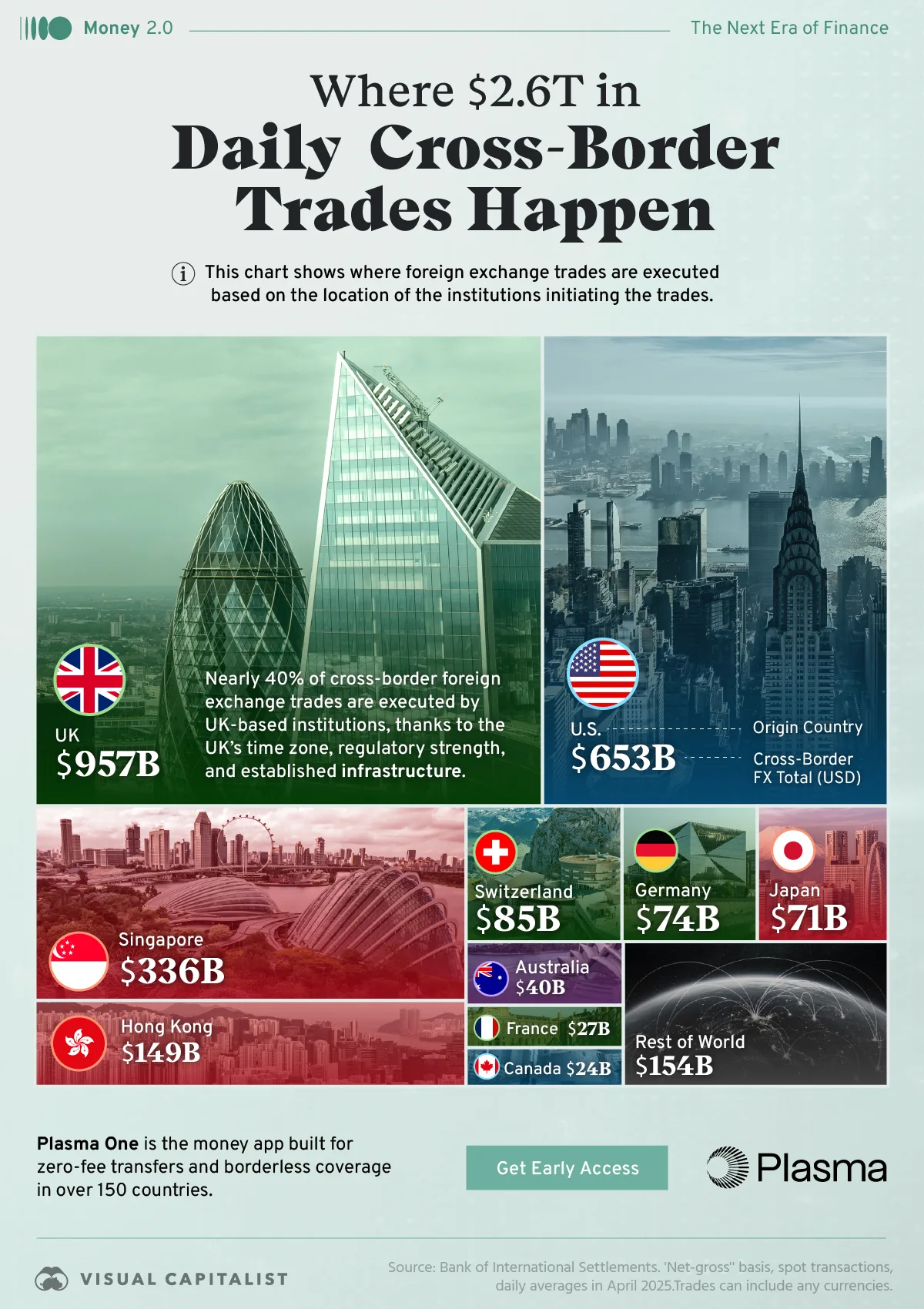
This graphic, created in partnership with Plasma, shows where $2.6 trillion in daily cross-border foreign exchange trades originate, based on the location of the institutions initiating the transactions. It’s part of our Money 2.0 series, where we highlight how finance is evolving into its next era.
The Global Centers of Currency Trades
Foreign exchange trading isn’t evenly distributed around the world. Instead, a handful of major financial hubs handle the bulk of global currency activity.
Using data from the Bank for International Settlements (BIS), the table below shows where cross-border FX trades are executed based on the location of the institutions initiating them.
The UK dominates global FX markets, with institutions initiating roughly $957 billion in cross-border trades per day, about 40% of the global total. London’s leadership comes from several advantages, including its time zone, deep financial markets, and long-established trading infrastructure.
| Country | Cross-Border FX Total ($ billions) |
|---|---|
 UK UK |
957 |
 U.S. U.S. |
653 |
 Singapore Singapore |
336 |
 Hong Kong Hong Kong |
149 |
 Switzerland Switzerland |
85 |
 Germany Germany |
74 |
 Japan Japan |
71 |
 Australia Australia |
40 |
 France France |
27 |
 Canada Canada |
24 |
| Other | 154 |
The U.S. ranks second ($653 billion), followed by major Asian financial centers such as Singapore ($336 billion) and Hong Kong ($149 billion). In fact, the top four jurisdictions—the UK, U.S., Singapore, and Hong Kong—collectively account for 80% of global FX trading activity.
The Rise of Borderless Finance
Traditional cross-border payments often involve multiple intermediaries, high fees, and settlement delays.
New financial technologies are changing that. By enabling faster and cheaper global transfers, digital money solutions are helping individuals and businesses move funds across borders more efficiently.
Plasma One is the money app built for zero-fee transfers and borderless coverage in more than 150 countries. Instead of navigating complex international payment systems, users can send and spend money globally from a single app.

Ready for 4% cash back and 10%+ yield? Get early access to Plasma One.
-
 Personal Finance4 months ago
Inflation Watch: Countries Losing the Most Purchasing Power in 2025
When prices rise, money’s value melts away. See how inflation could shrink the value of $100 by the end of 2025 in the hardest-hit countries.
-
 Technology4 months ago
Unbanked in a Connected World: Account Ownership vs Phone Ownership
In many unbanked countries, fewer than one in three adults have a financial account, but most own a mobile phone.
-
 Technology5 months ago
Ranked: The Biggest Buyers of U.S. Debt
Stablecoin Week: See how stablecoin issuers stack up against countries like Japan and Singapore as major buyers of U.S. debt.
-
 Technology5 months ago
Mapped: Stablecoin Regulation Globally
Which countries have stablecoin regulation proposed or in place, and which have no tailored laws? Find out in this Stablecoin Week piece.
-
 Technology8 months ago
Stablecoin Evolution: Milestones of the New Payment Rail
The GENIUS Act marks a turning point for stablecoin. Explore 8 key milestones in the digital dollar’s rise to mainstream finance.
-
 Technology8 months ago
Is the U.S. Dollar Primed for a Digital Rebound?
U.S. dollar influence is shrinking in some spaces, but stablecoins could give the currency a new chapter of global dominance.
-
 Money9 months ago
Ranked: The Biggest Currency Drops So Far in 2025
In the first half of 2025, one currency dropped over 50% against the U.S. dollar. What led to the decline?
-
 Technology9 months ago
Ranked: Countries With the Highest Remittance Costs
To send money across borders, workers can be charged high remittance fees—over 50% of the amount transferred in some cases.

- Source: https://www.visualcapitalist.com/sp/pla02-where-2-6t-in-daily-cross-border-currency-trades-happen/