Three Critical Minerals Behind the AI Supply Chain
Key Takeaways:
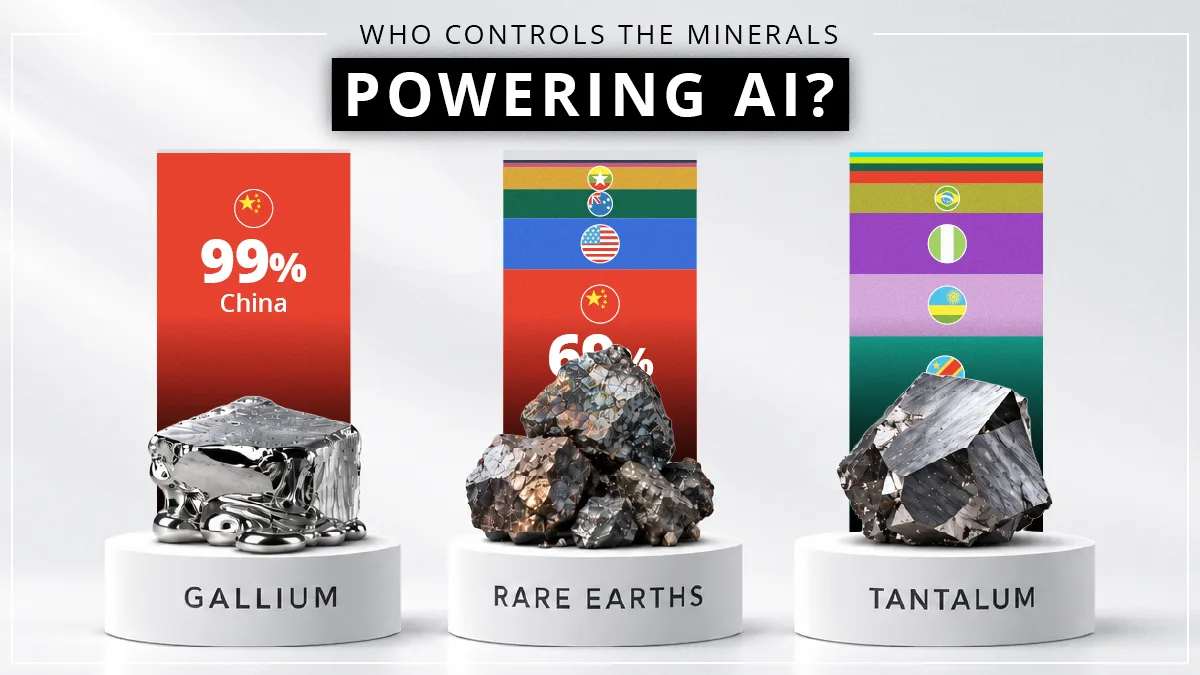
- China accounts for 99% of estimated global processed gallium production and 69.2% of rare earth mine production.
- The Democratic Republic of the Congo produces 52% of the world’s tantalum, followed by Rwanda and Nigeria.
- These lesser-known materials are used in high-performance semiconductors, magnets, and power-management components found across AI hardware.
AI infrastructure depends on far more than chips and electricity. It also relies on a range of critical materials, including gallium, rare earths, and tantalum, that are essential to semiconductors, magnets, and power-management systems.
These three materials are highlighted in Figure 2.3 of the World Bank’s World Development Report 2026 because their production is concentrated in a relatively small number of countries.
The figures here are 2025 estimates from the U.S. Geological Survey’s Mineral Commodity Summaries 2026, using processed production for gallium and mine production for rare earths and tantalum.
Gallium: China’s 99% Share
Here is the World Bank’s breakdown of estimated processed gallium production:
| Country/Economy | Share of World Production (%) |
|---|---|
 China China |
99.0 |
 Other countries Other countries |
1.0 |
China accounts for 99% of the total. However, that does not mean China holds 99% of the world’s gallium underground. Gallium is generally recovered as a byproduct of processing bauxite for aluminum, and China’s enormous aluminum industry has helped it develop gallium extraction at scale. Earlier oversupply and low prices also contributed to producers elsewhere exiting the market.
Gallium matters because compounds such as gallium nitride (GaN) can operate efficiently at high voltages and temperatures. These properties make gallium useful in high-performance semiconductors and power electronics, an increasingly important consideration as AI data centers require more computing power and electricity.
Rare Earths: More Than One Element
| Country/Economy | Share of World Production (%) |
|---|---|
| China |
69.2 |
 United States United States |
13.1 |
 Australia Australia |
7.4 |
 Myanmar Myanmar |
5.6 |
 Thailand Thailand |
1.2 |
 India India |
0.7 |
| Other |
2.6 |
China produces 69.2% of the total, followed by the United States at 13.1% and Australia at 7.4%.
Despite the name, “rare earths” are actually a group of 17 elements. Different members serve different roles across computing hardware. Neodymium and praseodymium, for example, are used in powerful permanent magnets found in hard drives and other equipment, while other rare earths have applications in semiconductors, displays, optics, and data storage.
Tantalum: Power Management for AI Servers
Tantalum production has a very different geographic footprint:
| Country/Economy | Share of World Production (%) |
|---|---|
 Congo, Dem. Rep. Congo, Dem. Rep. |
52.0 |
 Rwanda Rwanda |
16.0 |
 Nigeria Nigeria |
15.6 |
 Brazil Brazil |
7.6 |
| China |
3.2 |
| Australia |
2.0 |
 Ethiopia Ethiopia |
1.6 |
 Russian Federation Russian Federation |
1.2 |
| Other |
0.8 |
The Democratic Republic of the Congo supplies 52% of estimated mine production, while Rwanda and Nigeria contribute 16% and 15.6%, respectively. Together, those three countries account for 83.6%.
Tantalum’s AI connection is largely about capacitors. Polymer tantalum capacitors can provide high capacitance in a compact package along with stable electrical performance, making them useful in demanding power systems. Industry reporting in 2026 points to AI servers as a growing source of tantalum capacitor demand.
When Mineral Supply Becomes a Strategic Bottleneck
Production concentration does not automatically translate into an AI advantage. Advanced chips, fabrication capacity, energy infrastructure, and capital all matter. However, when one or a handful of countries dominate production of a critical material, export restrictions or other supply disruptions can ripple through global technology supply chains.
That risk is already visible. China has introduced export controls on gallium-related items and selected medium and heavy rare-earth items in recent years. Those measures have encouraged governments and companies elsewhere to pursue alternative suppliers and new production capacity. In Central Africa, concentrated tantalum production presents a different set of challenges, including potential supply disruptions and responsible sourcing concerns.
As AI infrastructure expands, securing the minerals behind chips, servers, and power systems could become increasingly important alongside securing the chips themselves.
Learn More on the Voronoi App
To see where the U.S. is most dependent on foreign mineral supplies, see Ranked: U.S. Import Reliance for 37 Critical Minerals on the Voronoi app.