The Countries Behind Global Diesel Supply
Key Takeaways
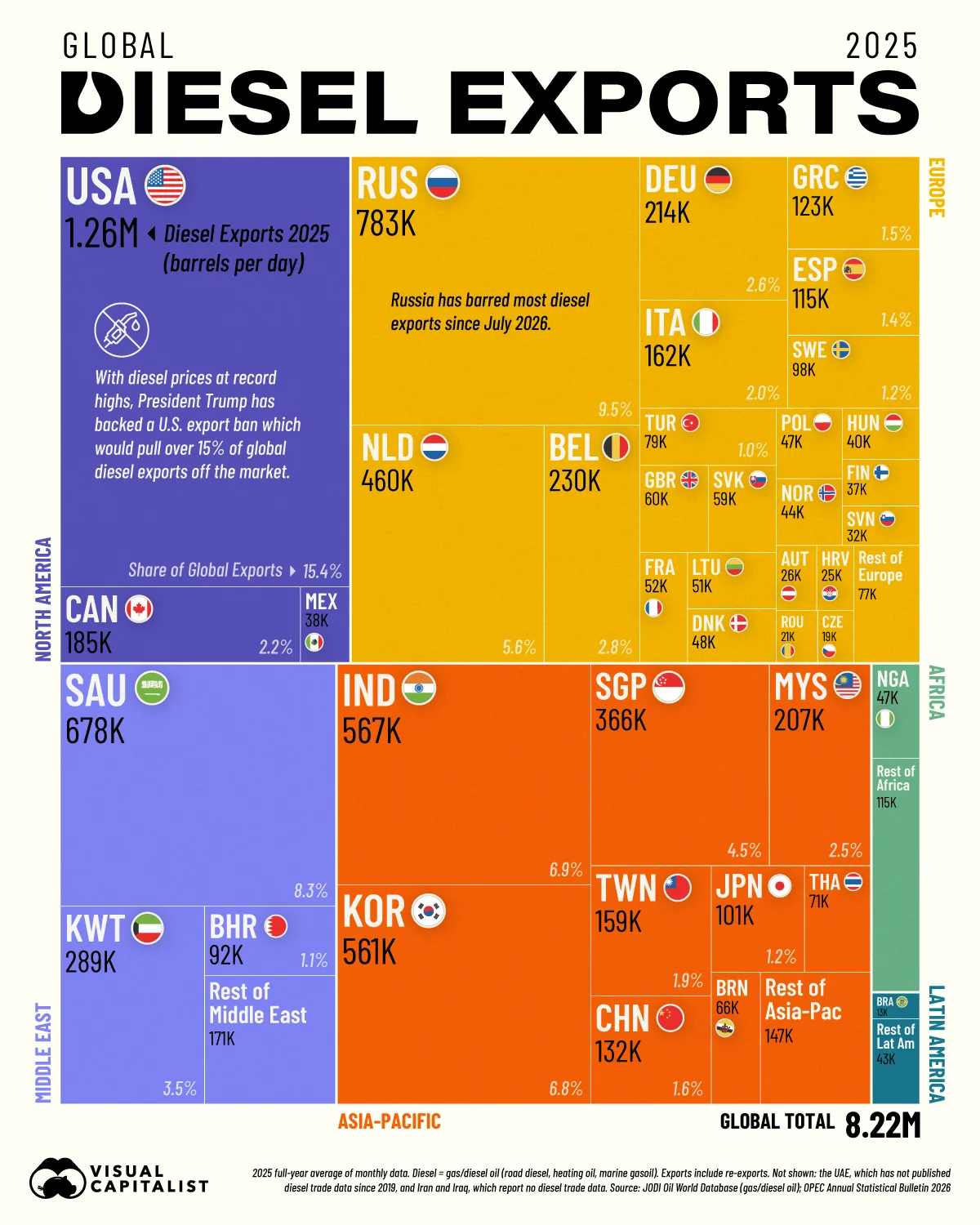
- The United States exported 1.26 million barrels of diesel per day in 2025, accounting for 15.4% of global exports.
- The five largest exporters supplied 46.9% of the global total, led by the U.S., Russia, and Saudi Arabia.
- The U.S. and Russia together accounted for nearly a quarter of global diesel exports in 2025, underscoring the significance of current export restrictions and proposals.
Diesel powers the trucks, farm equipment, and ships that keep goods moving, making its availability a concern far beyond the fuel pump.
The United States is the world’s largest diesel exporter, accounting for a significant share of global supply. Now, potential U.S. export restrictions are drawing attention as Russia has already moved to restrict its own diesel exports.
This graphic shows 2025 diesel exports by country, based on the annual average of monthly data from the Joint Organisations Data Initiative (JODI) and the Organization of the Petroleum Exporting Countries (OPEC).
Which Countries Export the Most Diesel?
The United States exported 1.26 million barrels per day, ahead of Russia’s 783,400 and Saudi Arabia’s 678,200. India and South Korea rounded out the top five, each shipping more than half a million barrels daily.
America’s large refining system helps underpin that lead. As of January 2026, the U.S. had 130 operable refineries with 18.2 million barrels per day of crude distillation capacity.
The table below shows the world’s top diesel-exporting countries in 2025:
| Rank | Country or region | Diesel exports in 2025 | |
|---|---|---|---|
| Thousand barrels per day | Share of global exports (%) | ||
| 1 |  United States United States |
1,264 | 15.4 |
| 2 |  Russia Russia |
783.4 | 9.5 |
| 3 |  Saudi Arabia Saudi Arabia |
678.2 | 8.3 |
| 4 |  India India |
567.1 | 6.9 |
| 5 |  South Korea South Korea |
561.1 | 6.8 |
| 6 |  Netherlands Netherlands |
459.8 | 5.6 |
| 7 |  Singapore Singapore |
365.9 | 4.5 |
| 8 |  Kuwait Kuwait |
289.2 | 3.5 |
| 9 |  Belgium Belgium |
230.5 | 2.8 |
| 10 |  Germany Germany |
214.3 | 2.6 |
| 11 |  Malaysia Malaysia |
207.1 | 2.5 |
| 12 |  Canada Canada |
184.8 | 2.2 |
| 13 |  Italy Italy |
161.8 | 2.0 |
| 14 |  Taiwan Taiwan |
159.2 | 1.9 |
| 15 |  China China |
132 | 1.6 |
| 16 |  Greece Greece |
122.8 | 1.5 |
| 17 |  Spain Spain |
115.3 | 1.4 |
| 18 |  Japan Japan |
101.2 | 1.2 |
| 19 |  Sweden Sweden |
97.8 | 1.2 |
| 20 |  Bahrain Bahrain |
92 | 1.1 |
| 21 |  Türkiye Türkiye |
78.9 | 1.0 |
| 22 |  Thailand Thailand |
71.4 | 0.9 |
| 23 |  Brunei Brunei |
66.3 | 0.8 |
| 24 |  United Kingdom United Kingdom |
60.4 | 0.7 |
| 25 |  Slovakia Slovakia |
59.4 | 0.7 |
| 26 |  France France |
52.3 | 0.6 |
| 27 |  Lithuania Lithuania |
51.1 | 0.6 |
| 28 |  Denmark Denmark |
48.4 | 0.6 |
| 29 |  Poland Poland |
46.7 | 0.6 |
| 30 |  Nigeria Nigeria |
46.6 | 0.6 |
| 31 |  Norway Norway |
44.4 | 0.5 |
| 32 |  Hungary Hungary |
39.9 | 0.5 |
| 33 |  Mexico Mexico |
38 | 0.5 |
| 34 |  Finland Finland |
36.8 | 0.4 |
| 35 |  Slovenia Slovenia |
31.6 | 0.4 |
| 36 |  Austria Austria |
26.4 | 0.3 |
| 37 |  Croatia Croatia |
24.6 | 0.3 |
| 38 |  Romania Romania |
21.4 | 0.3 |
| 39 |  Czechia Czechia |
18.7 | 0.2 |
| 40 |  Brazil Brazil |
12.6 | 0.2 |
| Rest of Latin America | 42.7 | 0.5 | |
| Rest of Europe | 77.4 | 0.9 | |
| Rest of Middle East | 170.8 | 2.1 | |
| Rest of Africa | 115.2 | 1.4 | |
| Rest of Asia-Pacific | 146.9 | 1.8 | |
| World | 8216.4 | 100.0 | |
The UAE, Iran, and Iraq are not listed separately because comparable 2025 data are unavailable.
Together, the Netherlands, Singapore, and Belgium account for 12.9% of exports, but much of that is re-exported fuel. All three are trading hubs that import diesel, store and blend it, then ship it onward, so their export totals overstate what their own refineries produce.
By region, Europe leads with 35.3% of global diesel exports, though Russia alone accounts for more than a quarter of that total.
| Region | Diesel Exports 2025 (Thousand Barrels per Day) | Share of World Exports |
|---|---|---|
| Europe | 2,904.1 | 35.3% |
| Asia-Pacific | 2,378.2 | 28.9% |
| North America | 1,486.8 | 18.1% |
| Middle East | 1,230.2 | 15.0% |
| Africa | 161.8 | 2.0% |
| Latin America | 55.3 | 0.7% |
| World | 8,216.4 | 100.0% |
Much of the rest is intra-European trade, with refiners in Germany, Italy, and Spain shipping to neighboring countries. The continent is still a net diesel importer overall, relying on cargoes from the U.S., India, and the Middle East to cover the gap.
Asia-Pacific follows at 28.9%, supported by export-oriented refiners in India, South Korea, and Singapore.
Why Diesel Export Restrictions Matter Globally
The U.S. lead has taken on new significance as Washington weighs export restrictions. President Donald Trump backed the idea on September 22, 2026, although a White House official disputed a reported 90-day ban plan the following day.
Russia, meanwhile, introduced broad diesel export restrictions in July, with the measures subsequently extended through September. Together, the two countries supplied nearly a quarter of global diesel exports in 2025.
For the countries buying American oil and fuels, U.S. export restrictions could reduce access to a major supplier. Analysts have also warned that losing export markets could prompt U.S. refiners to cut output, potentially reducing production of gasoline and jet fuel alongside diesel.
The debate highlights a potential trade-off: restricting exports could keep more diesel in the U.S. in the short term, but if weaker export demand leads refiners to process less crude, they would also produce less gasoline and jet fuel.
Learn More on the Voronoi App
If you enjoyed today’s post, check out The U.S. Exports 35% More Oil Than It Imports on Voronoi.