Who Has the World’s Oil, and Who Can Actually Produce It
See visuals like this from many other data creators on our Voronoi app. Download it for free on iOS or Android and discover incredible data-driven charts from a variety of trusted sources.
Key Takeaways
- Venezuela holds the world’s largest proven oil reserves, giving it the highest reserves-to-production ratio by far.
- The U.S. produces oil at almost twice the rate of major competitors Russia and Saudi Arabia, thanks to its booming shale industry.
The recent U.S. operation to capture Venezuelan President Nicolás Maduro reignited discussions this weekend about the Latin American country’s oil industry.
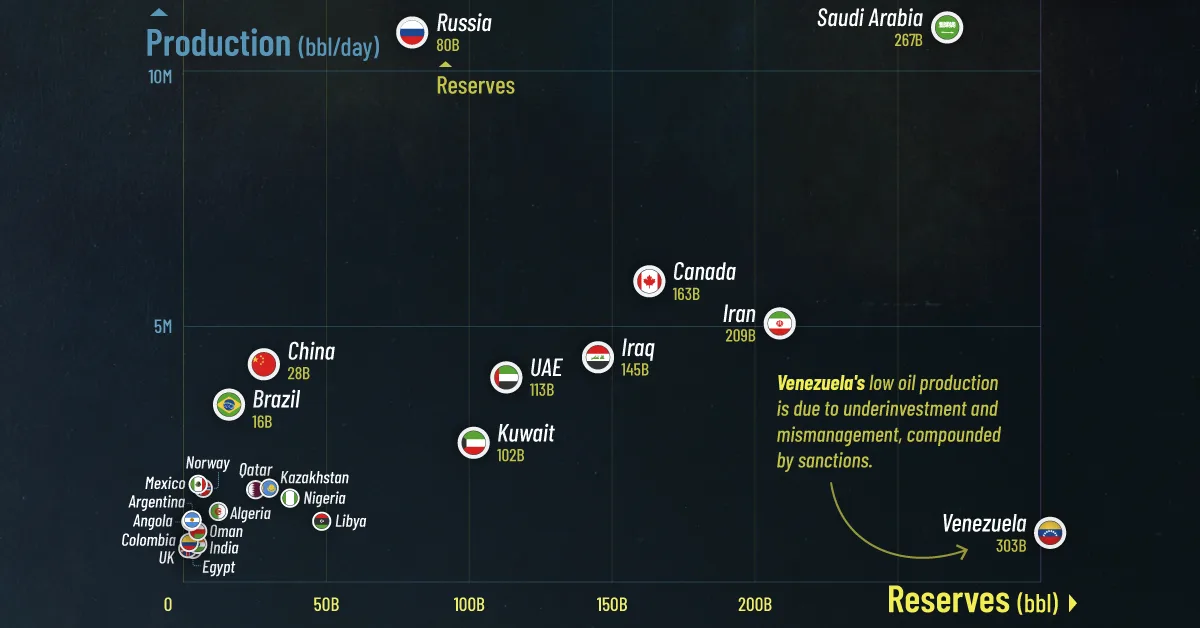
Venezuela currently holds the world’s largest oil reserves—about 303 billion barrels—but its oil industry has struggled in recent years due to mismanagement and U.S. sanctions.
Following Maduro’s capture, U.S. President Donald Trump stated that Venezuela’s oil industry would be revived through the entry of American companies into the country.
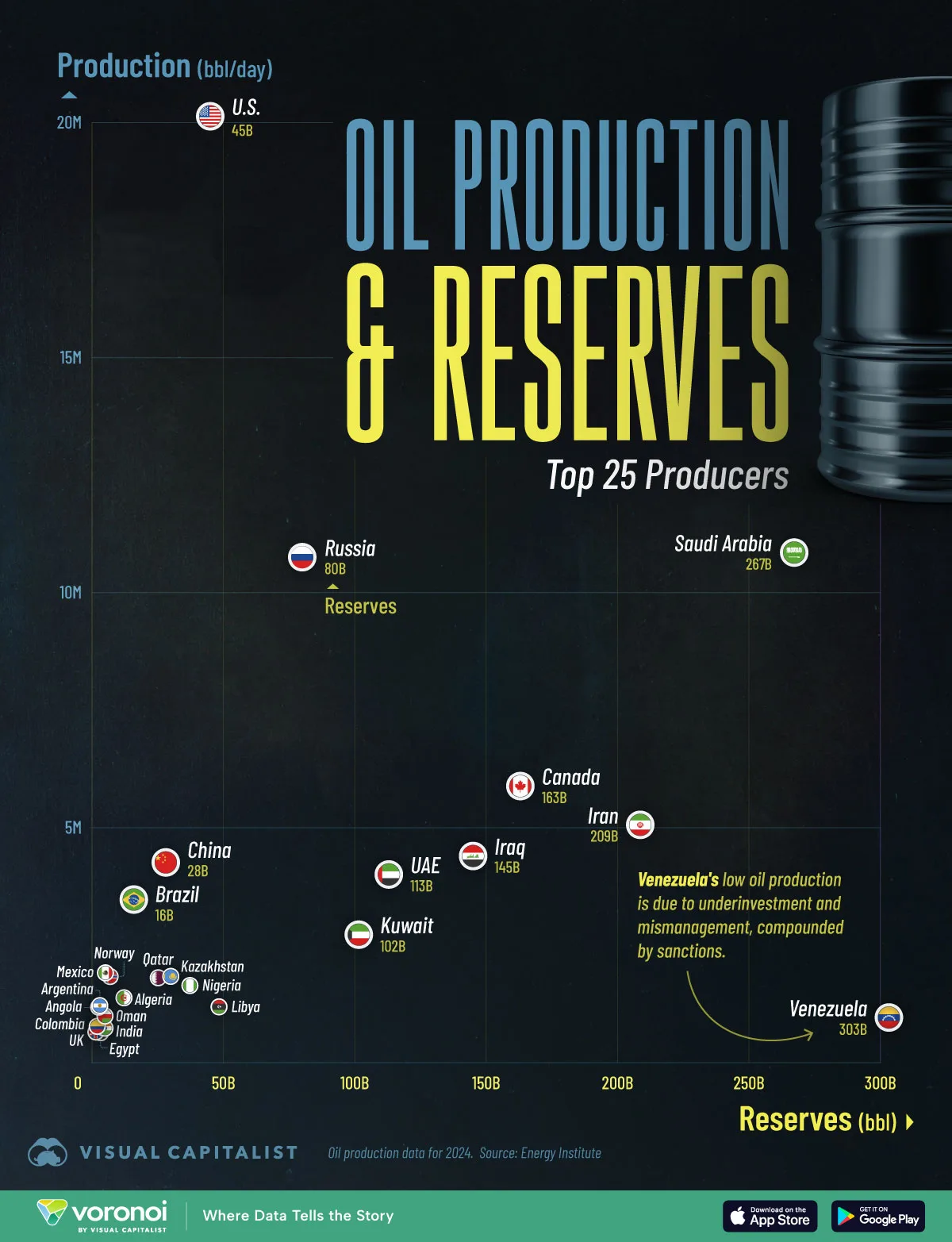
This chart compares proven oil reserves and daily production across the world’s top oil producers, revealing stark contrasts between output-heavy producers and those sitting on vast untapped resources.
The data for this visualization comes from the Energy Institute and reflects oil production levels in 2024.
Ranked: Top Oil Producers and Their Reserves
The United States tops global oil production, pumping more than 20 million barrels per day.
While America’s proven reserves seem low at first sight at just 45 billion barrels, this is due to U.S. shale producers’ short investment cycles which book only a few years of economically viable reserves at a time, and replace them through ongoing drilling.
| Rank (Production) | Country | Oil production in 2024 (barrels per day) | Proven oil reserves (billion barrels of oil) |
|---|---|---|---|
| 1 |  United States United States |
20,135,000 | 45.0 |
| 2 |  Saudi Arabia Saudi Arabia |
10,856,000 | 267.2 |
| 3 |  Russia Russia |
10,752,000 | 80.0 |
| 4 |  Canada Canada |
5,888,000 | 163.0 |
| 5 |  Iran Iran |
5,062,000 | 208.6 |
| 6 |  Iraq Iraq |
4,398,000 | 145.0 |
| 7 |  China China |
4,264,000 | 28.2 |
| 8 |  United Arab Emirates United Arab Emirates |
4,006,000 | 113.0 |
| 9 |  Brazil Brazil |
3,466,000 | 15.9 |
| 10 |  Kuwait Kuwait |
2,719,000 | 101.5 |
| 11 |  Mexico Mexico |
1,911,000 | 5.1 |
| 12 |  Kazakhstan Kazakhstan |
1,836,000 | 30.0 |
| 13 |  Norway Norway |
1,833,000 | 6.9 |
| 14 |  Qatar Qatar |
1,806,000 | 25.2 |
| 15 |  Nigeria Nigeria |
1,641,000 | 37.3 |
| 16 |  Algeria Algeria |
1,380,000 | 12.2 |
| 17 |  Argentina Argentina |
1,214,000 | 3.0 |
| 18 |  Libya Libya |
1,188,000 | 48.4 |
| 19 |  Angola Angola |
1,181,000 | 2.6 |
| 20 |  Oman Oman |
993,000 | 5.0 |
| 21 |  Venezuela Venezuela |
960,000 | 303.2 |
| 22 |  Colombia Colombia |
773,000 | 2.0 |
| 23 |  India India |
735,000 | 5.0 |
| 24 |  United Kingdom United Kingdom |
653,000 | 1.5 |
| 25 |  Egypt Egypt |
637,000 | 3.3 |
Countries like Mexico, Argentina, and the United Kingdom also have relatively modest reserves paired with sustained output, though each situation is unique.
Reserve-Rich, Output-Light Producers
Venezuela stands apart from every other producer. With more than 300 billion barrels in proven reserves, its reserves-to-production ratio exceeds 800 years—the highest in the world by a wide margin. Iran, Libya, Kuwait, and Iraq also post triple-digit reserve lifespans.
Countries like Saudi Arabia, Canada, and the United Arab Emirates strike a middle ground. Saudi Arabia’s reserves could last more than 60 years at current output, while Canada’s oil sands give it one of the longest reserve lifespans among high-production countries.
Learn More on the Voronoi App 
If you enjoyed today’s post, check out Saudi Aramco’s massive oil reserves on Voronoi, the new app from Visual Capitalist.