Who Supplies Every FIFA World Cup 2026 Kit?
This was originally posted on our Voronoi app. Download the app for free on iOS or Android and discover incredible data-driven charts from a variety of trusted sources.
Key Takeaways:
- Adidas outfits the most teams at the 2026 FIFA World Cup (14), followed by Nike (12) and Puma (11).
- The three sportswear giants supply kits for 37 of the tournament’s 48 nations, accounting for more than three-quarters of the field.
- Ten other manufacturers split the remaining 11 teams, with Kelme the only smaller brand supplying more than one nation.
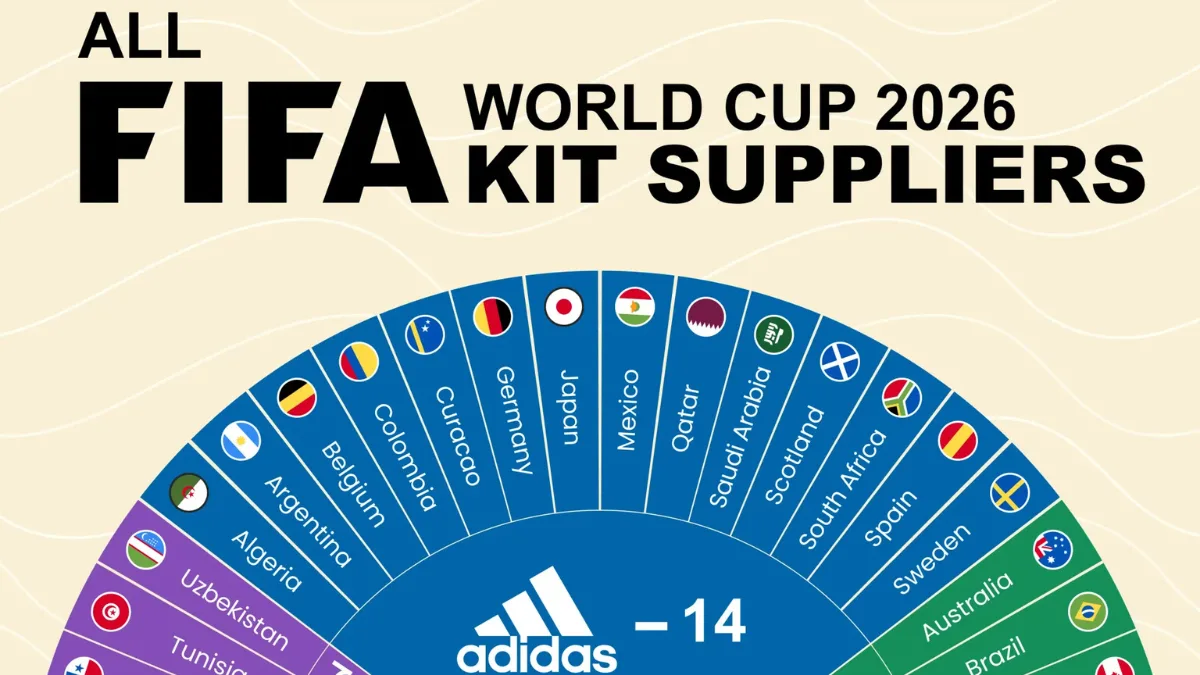
The competition to outfit national teams has become almost as fierce as the action on the pitch. This visualization, created by Harris Saleem using data from Tonton Sports, shows the kit supplier for each of the 48 nations competing at the expanded 2026 FIFA World Cup.
Beyond the dominant global brands, the tournament also features several regional manufacturers with national team partnerships.
The Big Three Continue to Dominate
Here’s the full breakdown of kit suppliers for all 48 nations:
| Brand | Teams Sponsored | Countries |
|---|---|---|
| Adidas | 14 |  Algeria Algeria Argentina Argentina Belgium Belgium Colombia Colombia Curaçao Curaçao Germany Germany Japan Japan Mexico Mexico Qatar Qatar Saudi Arabia Saudi Arabia Scotland Scotland South Africa South Africa Spain Spain Sweden Sweden |
| Nike | 12 |  Australia Australia Brazil Brazil Canada Canada Croatia Croatia England England France France Netherlands Netherlands Norway Norway South Korea South Korea Turkey Turkey United States United States Uruguay Uruguay |
| Puma | 11 |  Austria Austria Czech Republic Czech Republic Egypt Egypt Ghana Ghana Ivory Coast Ivory Coast Morocco Morocco New Zealand New Zealand Paraguay Paraguay Portugal Portugal Senegal Senegal Switzerland Switzerland |
| Kelme | 2 |  Bosnia and Herzegovina Bosnia and Herzegovina Jordan Jordan |
| Capelli | 1 |  Cape Verde Cape Verde |
| Umbro | 1 |  DR Congo DR Congo |
| Marathon | 1 |  Ecuador Ecuador |
| Saeta | 1 |  Haiti Haiti |
| Majid | 1 |  Iran Iran |
| Jako | 1 |  Iraq Iraq |
| Reebok | 1 |  Panama Panama |
| Kappa | 1 |  Tunisia Tunisia |
| 7Saber | 1 |  Uzbekistan Uzbekistan |
Adidas, Nike, and Puma have turned the World Cup into a three-brand contest. Together, they supply 37 of the tournament’s 48 teams, leaving just 11 nations spread across 10 other manufacturers.
Adidas leads with 14 teams, including Argentina, Germany, Spain, Japan, and Mexico. Nike follows with 12, including Brazil, England, France, the Netherlands, the United States, and co-host Canada. Puma ranks third with 11 teams, including Portugal, Morocco, Senegal, Switzerland, and Uruguay.
Among the smaller suppliers, Kelme is the only brand outfitting more than one nation, supplying Bosnia and Herzegovina and Jordan. Regional manufacturers such as Marathon in Ecuador, Majid in Iran, and Saeta in Haiti retain prominent partnerships in their home markets.
Changing Partnerships Reflect a Shifting Market
National team sponsorship deals are constantly evolving. Germany’s decision to switch from Adidas to Nike after decades of partnership marked one of the sport’s biggest commercial shake-ups and illustrated how fiercely brands compete for international visibility.
World Cup sponsorship gives apparel companies access to a vast global audience. Many of the participating nations also feature athletes associated with the world’s most commercially powerful clubs, reflecting the broader economics behind the world’s most valuable sports teams.
More Than Just a Jersey
Modern World Cup kits combine performance features with national storytelling. Colors, historical references, Indigenous motifs, and cultural symbols can turn each jersey into both athletic apparel and an expression of national identity.
That symbolism can also spark debate over flags, cultural imagery, and national messaging. Equipment worn by individual players can attract similar attention, as seen in the discussion surrounding bright pink boots worn across multiple brands during the tournament.
The expanded 48-team World Cup has created the largest kit-supply field in the competition’s history. Adidas, Nike, and Puma remain firmly in control, but the presence of 10 smaller manufacturers gives regional brands a place on football’s biggest stage.
Learn More on the Voronoi App 
Want to explore more World Cup history? Check out All FIFA World Cup Winners (1930–2022) on the Voronoi app.