
Wildfires and forest fires are a major source of carbon emissions. When vegetation and organic matter burn, they release large amounts of carbon dioxide (CO2), methane (CH4), and black carbon into the atmosphere. These gases trap heat and accelerate climate change. The intensity of a fire, the type of vegetation, and how long it burns determine how much carbon is released.
Wildfire Emissions Complicate Climate Mitigation Efforts
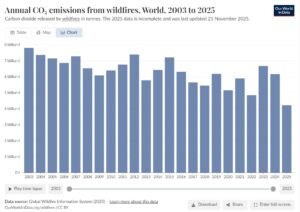
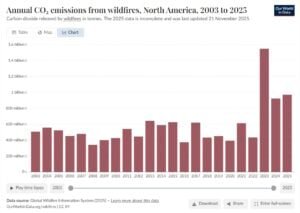
A study showed that since 2001, global carbon emissions from forest fires have risen by about 60%, especially in the boreal forests of North America and Eurasia. Hotter and drier conditions have made fires more severe, increasing carbon combustion by nearly 50% per unit area burned. Beyond emissions, wildfires reduce the ability of forests to absorb CO2, weakening one of the planet’s natural carbon sinks.
Black carbon, a byproduct of wildfire smoke, worsens global warming. It absorbs sunlight, accelerates ice and snow melting, and intensifies heatwaves. Recent large fires in Australia and Siberia show how black carbon can impact both local and global climates. Rising wildfire frequency creates a dangerous cycle: hotter climates trigger more fires, which release more greenhouse gases and pollutants.
The effects of wildfires go beyond climate. They degrade soil, destroy forest resources, and harm human health through smoke and air pollution. They also impose heavy economic costs, including firefighting, recovery, and lost productivity. With these challenges, accurate carbon accounting and climate mitigation become harder, as wildfires release carbon that forests had previously stored.
AI Enters the Firefight: How Technology Helps Protect Forests and Communities
Artificial intelligence (AI) has emerged as a powerful tool in wildfire management. Modern AI systems can predict fire risk, behavior, and spread more accurately than traditional methods. This gives fire crews and emergency managers an edge in making fast, effective decisions to protect people, property, and forests.
An article by the Western Chief Fire Association (WCFA) has explained how Wildfire modeling helps predict fire behavior. These models consider weather, terrain, vegetation, and other data to estimate fire size, intensity, spread rate, and spotting distance. Organizations like fire services, insurance companies, utility companies, and emergency planners all use wildfire modeling to prepare for and respond to fires.
AI enhances these models by analyzing vast amounts of data quickly and spotting errors that traditional models might miss. It can also use historical patterns when new data is missing. For example, the Behave Fire Modeling System relies on mathematical calculations and data on weather, fuel, and topography to forecast fire behavior accurately.
A 2024 study by USC researchers combined generative AI with satellite data to predict wildfire spread. The AI analyzed real-time satellite images to forecast a fire’s path, intensity, and growth rate. The study highlighted how weather, terrain, and vegetation influence fire patterns. Such advancements show AI’s potential to save lives and reduce environmental damage.
Overstory: Using AI to Prevent Fires Before They Start
Overstory, a company specializing in vegetation intelligence, recently raised $43 million to expand its AI wildfire prevention tools. Utilities often face wildfires caused by trees near power lines, and vegetation management is one of their largest operational costs. Overstory uses high-resolution satellite imagery and AI to pinpoint risks tree by tree, helping utilities prevent outages and fires while keeping power safe and reliable.
Fiona Spruill, CEO, Overstory, said:
“Utilities are on the front lines of keeping communities safe, and they’re eager to use the best data available. When we talk about how satellites and remote sensing can identify dying trees and wildfire risk, they lean in. We’re grateful to our forward-thinking investors for supporting this next chapter – expanding our intelligence product to address storms and wildfires to help utilities build a more resilient and reliable grid.”
The company serves six of the ten largest utilities in the Americas. Its team includes experts in machine learning, data science, arboriculture, and wildfire management. Under new COO Tamara Mendelsohn, the company plans to scale its operations and expand globally.
Pinpointing Risk with Precision
Overstory’s AI tools go beyond generic fire risk maps. The company’s Wildfire Intelligence product now includes a proprietary Fuel Detection Model that identifies areas with the highest risk fuels—the vegetation most likely to ignite a fire if sparked.
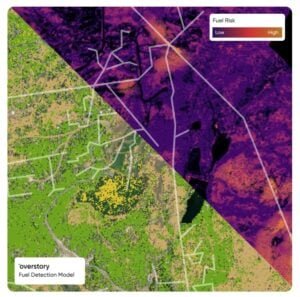
Most catastrophic wildfires start when vegetation meets power lines. Overstory helps utilities focus on the 10-meter zone around assets, where a spark is most likely to spread into a wildfire. By combining tree risk with fuel risk across thousands of miles of power lines, utilities can plan mitigation work efficiently and reduce the chances of fire ignition.
The Fuel Detection Model works at an extremely high resolution—10,000 times higher than publicly available maps. It identifies fuels directly in the right-of-way and updates routinely to reflect vegetation growth. This ensures that mitigation strategies are based on current conditions, not outdated data. The system is grounded in established fire science and validated by experts.
AI Helps Utilities Reduce Wildfire Liabilities
Utilities face massive liabilities when their equipment causes wildfires. In the U.S. and Europe, companies increasingly partner with AI startups to manage wildfire risks. By analyzing satellite imagery and real-time data, AI can detect dying trees, weak branches, and other potential ignition points near power lines.
This data-driven approach allows utilities to prioritize maintenance and vegetation management. Compared to burying power lines, which can cost over $3 million per mile, AI-based risk mitigation is far more cost-effective. Utilities can act faster, prevent fires, and reduce both financial and environmental risks.
The Bigger Picture: AI and Climate Resilience
AI’s role in wildfire management is part of a broader effort to tackle climate change. By predicting fire behavior, identifying high-risk areas, and helping utilities mitigate potential sparks, AI reduces the frequency and severity of wildfires. This, in turn, helps limit carbon emissions, protects communities, and preserves forest carbon storage.
As climate change makes fires more frequent and intense, AI provides tools to respond effectively and proactively. It allows decision-makers to act before fires ignite, preventing a cycle of destruction and emissions. Emerging AI technologies, combined with satellite data and advanced modeling, are transforming wildfire management from reactive firefighting to proactive prevention.
Companies like Overstory are protecting both lives and the environment. In a world where wildfires are becoming a growing threat, AI offers a smarter, more precise, and cost-effective way to manage risks, protect communities, and build climate resilience.
The post Wildfire Carbon Emissions Climb 60% While Overstory Secures $43M to Shield Utilities with Smart AI appeared first on Carbon Credits.


