

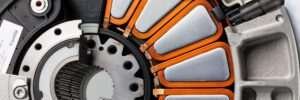
YASA will develop two axial flux motor designs that reduce or eliminate rare-earth magnet content, under a UK government-funded program called Project Resilience. The grant comes through the DRIVE35 Demonstrate competition, and the work will be delivered from YASA's UK engineering and development facilities.
Heavy-rare-earth-free permanent-magnet designs are the route for high-performance battery-electric and hybrid vehicles, YASA says, and are intended to maintain power density without increasing motor mass or package size. In parallel, the company will develop fully rare-earth-free axial flux technology for vehicle applications with different performance, cost and manufacturing requirements.
The two development routes will be built around common YASA stator technology, creating the potential for a modular motor architecture in which different rotor technologies can be selected according to the requirements of each vehicle program. YASA says the shared stator also lets it carry engineering, design, development and manufacturing knowledge across both pathways while broadening the range of applications its axial flux technology can address.
YASA says supply chains for rare-earth permanent magnets are highly concentrated geographically, which can expose automotive manufacturers and suppliers to export restrictions, price volatility and potential disruption. Heavy rare earths, according to the company, are commonly used to help permanent magnets withstand the high temperatures and demanding operating conditions inside electric motors, and can be particularly difficult and carbon-intensive to extract and process.
DRIVE35 is delivered by the Department for Business, Innovation, Science and Trade in partnership with the Advanced Propulsion Centre UK (APC) and Innovate UK. The program forms part of the UK government's Advanced Manufacturing Sector Plan, which makes £4 billion in grant funding available to 2035 for automotive R&D, scale-up and transformation.
Project Resilience is one of 10 Demonstrate projects announced together, sharing £9 million of government funding, and the APC puts combined government and industry investment across the 10 at more than £18 million. Projects funded through Demonstrate must build a product or process demonstrator within 12 months, according to the APC. The size of YASA's individual award was not disclosed.
"Project Resilience is about creating credible alternatives without losing sight of what vehicle manufacturers need from an electric motor," said Tom Hillman, YASA's Head of Motor Simulation. "Different applications require different balances of performance, efficiency, packaging, cost and production volume, which is why we are developing two complementary technology routes rather than pursuing a single universal solution."
Source: YASA


