
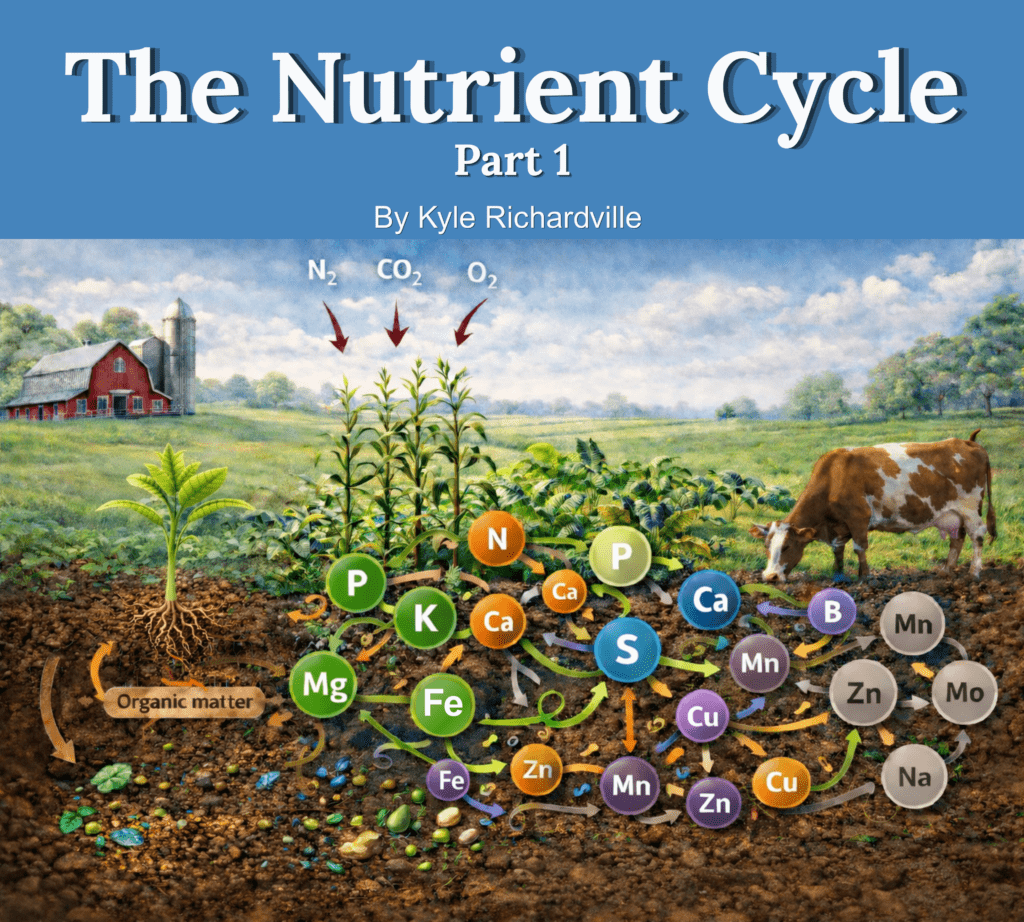
The nutrient cycle is one of the four foundational ecosystem processes, along with the energy cycle, water cycle, and cycle of life. It’s also one of the most overlooked drivers of farm profitability and long-term resilience. Just think about what you spend on ag inputs every year. Whether you’re a farmer, rancher, gardener or “yardener”, few things will deliver a bigger return than spending a little time each day trying to understand how nutrients move through the ecological system under your care.
In this blog series, we’ll break down how nutrients move through your soils, plants, livestock, and microbes so you can better understand what’s already happening beneath your feet. From basic chemistry and the biological players that drive nutrient transformation, to the role of organic matter and carbon-to-nitrogen ratios, we’ll connect science to practical, on-farm decisions.
Our goal is simple: help you observe the nutrient cycle in real time on your own land—so you can improve its efficiency, reduce unnecessary inputs that are eating away at your profits.
Think Small: The Power of Decomposers
What do you think would happen if microbes that decompose stuff suddenly disappeared?
Do we really need them? Would we even miss them?
The answer to the last two questions is a resounding YES! Without them, our world would quickly be buried under layers of dead microbial, plant, and animal material. We would eventually drown under a mountain of energy and nutrients because higher animals don’t have the right equipment to break down most of it into a usable form. Food, food everywhere, nor any bite to eat.
Life as we know it would rapidly cease to exist. Lucky for us, we live in a world where we are vastly outnumbered by creatures that get their sustenance from roadkill, dead leaves, manure, and other sources of nutrients we aren’t capable of utilizing. These microscopic marvels are the nexus between the living and the dead, resurrecting nutrients and energy back into the living. We certainly owe these unsung heroes a large debt of gratitude. At the very least, we should recognize their service to life on the planet.
In his influential book, Entangled Life, Merlin Sheldrake describes the moment he recognized the importance of decomposers. His father ran an experiment by cutting off the top of a clear plastic bottle and placing alternating layers of soil, sand, and dead leaves inside the bottle. Next, they added earthworms and observed what happened. After a while, the distinct lines between the layers melted away. His father explained that the earthworms were not the only creatures disturbing the layers. Far from it. There were hoards of microscopic worms and smaller yet microbes that were consuming, mixing, and stirring the layers.
Sheldrake writes the following about the experiment, “Composers make pieces of music. These were the decomposers, who unmake pieces of life. Nothing could happen without them. This was such a useful idea. It was as if I’d been shown how to reverse, how to think backwards. Now there were arrows that pointed in both directions at once. Composers make; decomposers unmake. And unless decomposers unmake, there isn’t anything that the composers can make with. It was a thought that changed the way I understood the world.”1
A Living System, Not a Fertility Problem
While their importance may be unmatched, decomposers represent only a portion of a complex web of transformative interactions we call the Nutrient Cycle. Nutrients cycle efficiently in the presence of an abundant diversity of life. After all, who spreads fertilizer on the Amazon to get it to grow abundantly year–after–year? What about the African savannahs or the great diversity of life in the oceans?
Before you say anything, I understand that we’ve got to feed the world. I understand that agriculture is unique compared to natural landscapes. What I hope to show is that regenerative agricultural systems can improve the health of a crop field or pasture, particularly in terms of the cycling of nutrients, to the point where the need for fertilizers is at the very least diminished or even eliminated altogether, just like in the forest, prairies, and oceans.
Imagine how great it would be to not worry about how wars, weather, or politics beyond the farm gate dictate the price of fertilizer? Regenerative practitioners are proving this cut in fertilizer application is possible, all while producing the same or more calories and nutrient density per acre. It’s a big claim that demands big evidence, and I believe the evidence is there for those open to the concept.
The Real Problem: Cycling, Not Supply
The reality is that nutrients on most farms and ranches are cycling at a very unhealthy pace. Some nutrients are set in stone like Han Solo, while other nutrients are streaming away like the Millennium Falcon at lightspeed into the air, surrounding streams, lakes, and rivers. (Didn’t think you’d get a Star Wars reference in here, did you?)

Most farms and ranches do not struggle with the absence of nutrients. It’s the cycling and availability of nutrients that is the issue. Getting the Nutrient Cycle running at a Goldilocks-level pace will make more nutrients available for plants and livestock, which will build healthier, more resilient, and more profitable farms and ranches while maintaining or increasing production.
Optional Deep Dive
If you want to better understand why nutrients behave the way they do in soil, this quick deep dive breaks it down to the simplest level. Think of nutrients like “atomic Legos”—constantly connecting, breaking apart, and recombining. Once you see how these basic building blocks interact, it becomes much easier to understand fertilizer, plant uptake, and how natural systems can do more of the work for us. Follow the link below to take the deep dive.
Think Small: What Is a Nutrient, Really?
Atoms that are deemed important for the growth, survival, and reproduction of living organisms are called “nutrients”. In agriculture, it’s widely cited that there are roughly 16 or 17 essential nutrients plants need in varying amounts.
“Essential” means that a deficiency in the nutrient makes it impossible for the plant to complete its lifecycle.
Essential nutrients needed in larger amounts are called “macronutrients”. The three nutrients needed in the largest amount are Nitrogen (N), Phosphorus (P), and Potassium (K). Scientists call N, P, and K the “primary macronutrients”.
Some universities are beginning to call Carbon (C), Oxygen (O), and Hydrogen (H) primary macronutrients as well.2 Calcium (Ca), Magnesium (Mg), and Sulfur (S) are also needed in large amounts, but not as large as NPK, so they are called the “secondary macronutrients”.
Finally, certain nutrients are needed in tiny amounts, so they are called “micronutrients”. These include Chlorine (Cl), Zinc (Zn), Copper (Cu), Manganese (Mn), Iron (Fe), Boron (B), Molybdenum (Mo), Selenium (Se), Iodine (I), and Nickel (Ni). Some sources also list Silicon (Si), Sodium (Na), and Vanadium (V) as essential nutrients. Bored yet? Me too.
The Problem with “Macro vs. Micro” Thinking
I personally find this arbitrary caste system of nutrients nice to have, but unhelpful in many ways. The focus becomes less about understanding the fascinating ways they behave and more about memorizing long lists of abstract facts of a topic that we’re discovering we know less about than we thought. Maybe that’s your thing. More power to ya, but most people don’t have the time or interest to memorize a zillion different facts about nutrition, whether we’re talking about crop nutrition, livestock nutrition or human nutrition.
My contention is that this “zillion fact” strategy has created a confused population—one that’s told to rely on experts for fertilizer recommendations, feed rations, and even dietary guidelines—and it ultimately leaves us with outcomes like the abysmal Food Guide Pyramid of old. The results from handing over the reins to these experts have been disappointing, to put it nicely.
I also find the categorization of some nutrients as macro- or micro- to be unhelpful. These labels lead to the obligatory disclaimer in the beginning of any decent plant nutrition article that reads something like this: “micronutrients are just as important as macronutrients even though they’re needed in much smaller quantities.” This is nice, but ask most consultants and farmers which nutrients are most important to manage, and the majority would respond with N, P, and K.
What happened to “micros are just as important”? There’s no judgement here, it’s just what has been taught, especially since World War II.
A Better Way to Think About Nutrition
Farmers and ranchers would greatly benefit from a new curriculum on nutrition that leveled the playing field. Allow me to illustrate.
Imagine a group of professionals building a house. There are obviously going to be some materials that are needed in larger quantities by weight and volume than others, like concrete, wood, and drywall.
Other materials like electric wires, nails, screws, and adhesives are needed in far fewer quantities.
These professionals would never pour the foundation, build the frame, put up the drywall, and leave thinking it’s a job well done. You might say that the “health” of the house is very poor at this stage. No food can be cooked, no clothes can be washed, there’s no Wi-Fi (the horror!), and burglars can break in with no locks on the doors.
This is similar to what happens when nutrient management only focuses on certain nutrients. We produce crops or forage using fertilizer to make them look tall and green from the outside, but they’re really just a bunch of empty houses susceptible to weather, insect, and pest pressure.
You might say that the “health” of the plant is poor. We then train these unhealthy plants to funnel enough energy to produce fruits and grain in large quantities, but they also lack important contents. The “health” of the food is poor.
Finally, livestock and humans consume these foods as the building material for their bodies. The result is that we become like a house built with only concrete, wood, and drywall. The “health” of livestock and humans is poor. It’s very hard to debate the decline in American public health.4 There are various factors to this decline, of course, but food quality is undeniably one of them.
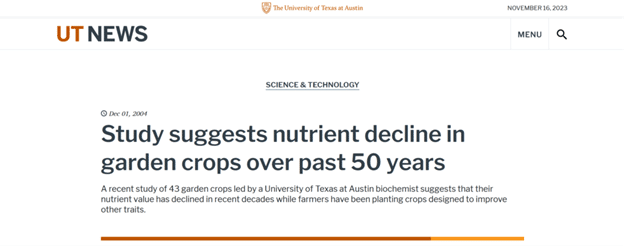
The N, P, and K hegemony is slowly losing its grip on power, there’s no doubt about that.
More fertilizer reps and university extension workers are discussing the importance of other nutrients, like calcium, sulfur, zinc, and boron. The cynic out there might say they discovered new products to sell. The optimist might say this is a step in the right direction. Either way, the zillions of facts on nutrition science are mostly produced through a reductionist lens, and this is the crux of the issue. (Make sure to punch the “reductionism” square on your Regen Ag Bingo card if you haven’t already.)
It’s true, reductionism has become a common target for regenerative speakers, but there is a very good reason for this. Living organisms are complex systems of endlessly interacting moving parts. This makes them really, really difficult to study in a laboratory, but it’s what science has attempted to do for the past century and a half, or more.
This is like taking a car off the road, disassembling every single part, studying the individual parts, and concluding what job each part had. In the process of disassembling it, they might, for example, shred the tires into tiny chunks of rubber, study the rubber, and come to a false conclusion.
Just as an aside, this is exactly why the leading theory on humus for roughly 150 years was incorrect. Soil treated with harsh laboratory chemicals created humic acid, fulvic acid, and humin, which probably don’t exist naturally in the soil.5 Skip to minute 21 of this brilliant presentation by soil scientist Ray Weil to learn more.
Back to the car. Studying individual parts is useful in many cases, but society has relied almost exclusively on reductionistic conclusions in the past 150+ years. Trouble arises when we don’t pair these results with research that observes how whole systems operate. In other words, there is a lot to learn from observing the assembled car driving down the road, seeing where each part is located, and discovering how the parts work together when the whole system is moving. This type of systems-based research is much more difficult, time-intensive, and in many cases impossible.
You can begin to see how the mainstream scientific community broke a plant down into a pile of atoms, discovered that nitrogen, phosphorus, and potassium were found in large quantities, and deemed them the most important nutrients.
Further experiments showed conclusive plant growth and yield increases with NPK fertilizer application, which reinforced the emphasis on the holy trinity of nutrients. Once again, I feel compelled to say that I have no judgement for those involved because reductionistic scientific research is a worthy endeavor and it has brought advancements to society of which I am forever grateful.
Learning from the Past, Improving the Future
Not so long ago, the world was a very different place—communicable diseases still ravaged populations in the early 20th century, the world experienced the horrors of two world wars, and people knew, from first or secondhand experience, that Famine could gallop into town at any moment.
As a result, yield was the top priority. Who could blame them?
Since then, reductionist research, with its emphasis on NPK and plant breeding, has led to mind-boggling increases in food production over the past few decades, which has allowed the human population to skyrocket. I’m a fan of life, and I believe humans can improve the health of the planet, so I believe this is a good thing.
However, we’re now discovering that there are many negative unintended consequences from the methods used to increase food production, particularly regarding nutrient management. Acknowledging this fact does not denigrate the progress that our ancestors made. To close our eyes and plug our ears to the negative effects that have come as a result of modern agriculture is denigrating, both to ourselves and future generations.
Our job as land managers in today’s world is very different from what past generations had to do.
In some ways, our objectives are much more difficult as we must increase food production on less land to feed a growing world population and do it in a way that improves the environment, all while turning a profit.
On the other hand, we have increasingly better technology at our disposal which can help us work more efficiently and gather important information faster. For example, DNA analysis and computer modeling technology allow soil scientists to undertake desperately needed systems-level research in a timely and cost-effective manner. One day soon we’ll have a large database of systems-level research to pair with the mountain of reductionist research, especially as it concerns the Nutrient Cycle.
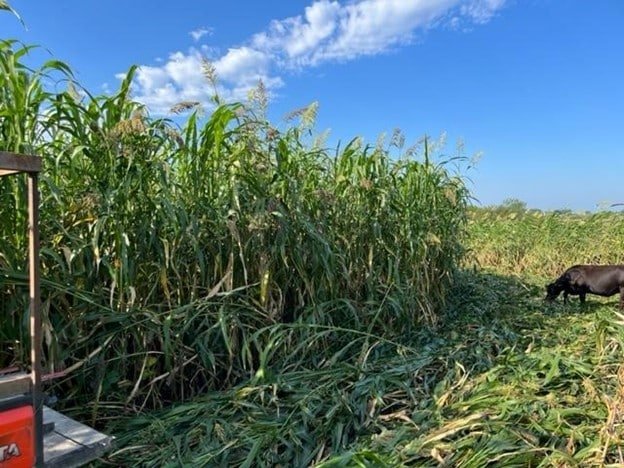
The best news of all, though, is that there’s no need to wait until every single process is understood before producers begin taking advantage of natural nutrient cycling. Many producers have already proven it’s possible to understand the Nutrient Cycle, apply it to their own operation and decrease their need for purchased fertility, while raising abundant quantities of healthy crops and animals. It can be done. All it takes is convincing the living organisms on a farm or ranch to start moving electrons again and connect the right Legos at the right time.
Next time
Before we can truly learn to manage nutrients, we must learn a little bit more about them. Not as a list to memorize, but as characters in a living story. In next week’s installment, we follow atoms from rock, water, and air into the bodies of plants and microbes, uncovering how oxygen bonds, nitrogen locks itself away, and photosynthesis performs near-miraculous chemistry. You’ll see how CHNOPS build the foundation of life, why metals act like electrical wiring inside living systems, and how biology, not just chemistry, drives nutrient availability.
If you’re ready to reduce fertilizer costs, improve soil health, and build a more resilient operation, we’d love to help. Reach out to one of our Understanding Ag consultants to learn how improving your nutrient cycle can transform your farm from the ground up.

The post 4 Ecosystem Processes: Nutrient Cycle (Part 1) appeared first on Understanding Ag.


