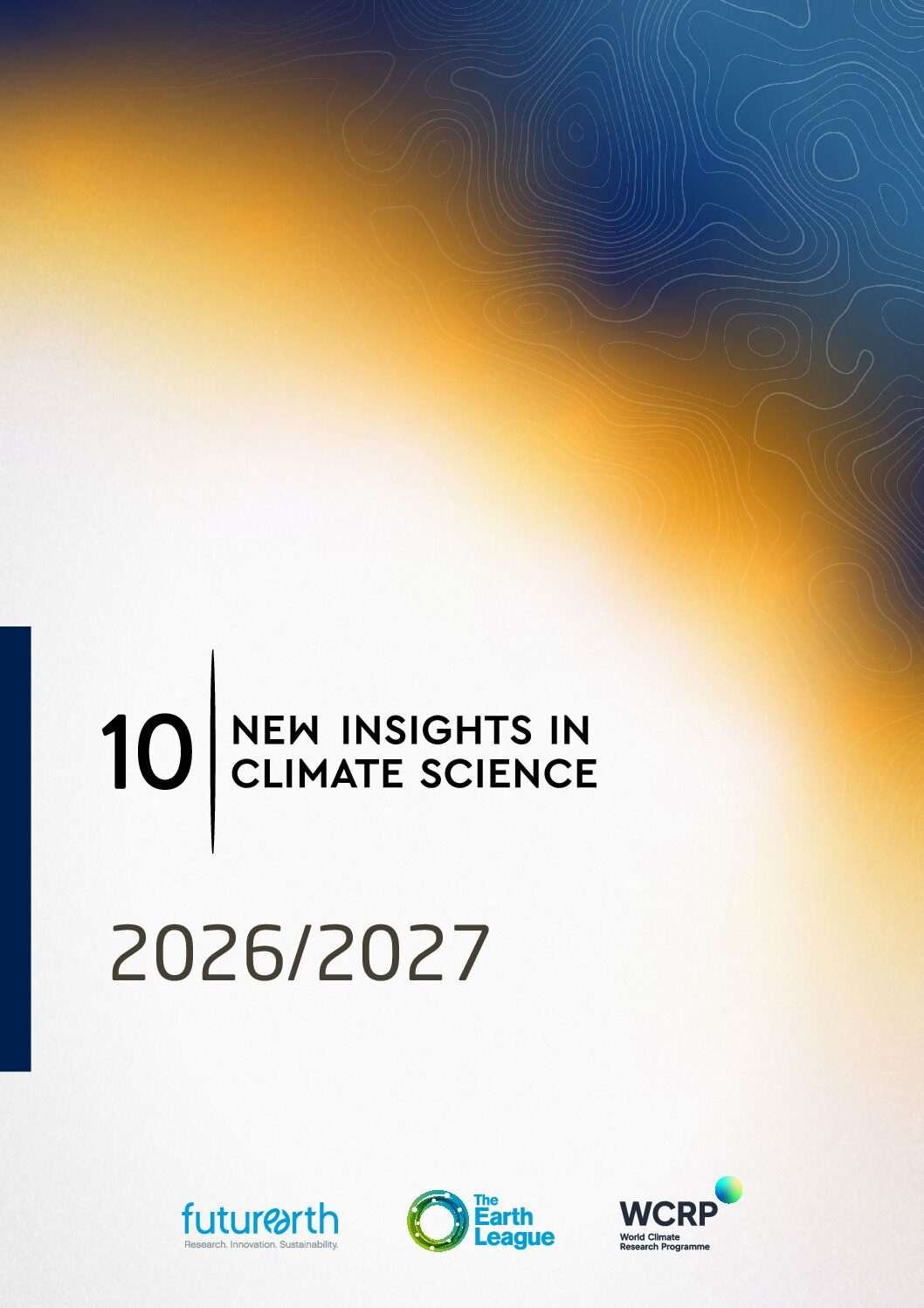
Rising greenhouse gas emissions have already locked in some climate impacts, but how severe they become still depends on the choices made today.
That is a central warning of this year’s 10 New Insights in Climate Science report, launched today by Future Earth, The Earth League and the World Climate Research Programme (WCRP).
Bringing together more than 70 researchers from nearly 30 countries, the annual report distills significant advances in climate research published over the past 18 months into ten concise insights for policymakers, business leaders and the scientific community.
The 2026/2027 Insights
This year’s insights span changes in the physical climate system, the growing costs and consequences of warming, and the political and economic forces shaping climate action.
Several findings underscore the lasting consequences of today’s emissions. The ocean continues to absorb record amounts of heat, while melting ice glaciers and ice sheets are accelerating sea-level. At the same time, freshwater is rapidly disappearing across continents as climate change compounds pressure from human water use. Some of these changes are already irreversible on human timescales, but rapid emissions reductions can still limit their ultimate scale.
“The ocean has been our planet’s shock absorber. Because heat takes decades to penetrate ocean depths, today’s emissions effectively lock in further warming and sea level rise,” said Wendy Broadgate, Global Hub Director at Future Earth and a member of the report’s editorial board. “Deep, rapid emissions cuts are the only way to limit these risks”
The 10 New Insights also examines the consequences of exceeding 1.5°C of warming. The higher and longer temperatures overshoot this threshold, the greater the risk of irreversible impacts, and the greater the need for emissions reductions, carbon removal and adaptation. Returning temperatures below 1.5°C later would not simply reverse the damage caused during an overshoot.
The report is not only a warning; it also points to opportunities for action. Shifts toward healthier, more plant-rich diets, supported by changes across food production and supply chains and carefully designed social policies could deliver benefits for climate, biodiversity and health. International cooperation through so-called “climate clubs” could also encourage stronger climate action, though their design will be critical to avoid imposing disproportionate costs on developing economies.
Other insights focus on intentional climate obstruction as a major barrier to action as well as how geopolitical instability and fragmentation could deepen inequalities in the global energy transition.
How the insights are developed
Each year, leading natural and social scientists review recent climate change research to identify emerging findings with strong scientific evidence and relevance for policy. An international editorial board guides the selection and development of the ten insights.
Since 2020, the scientific synthesis underpinning the insights has also been published as an open-access, peer-reviewed review article, providing a deeper examination of the evidence behind each finding.
The report is released annually ahead of the UN climate negotiations to help bring the latest climate research into discussions among policymakers, scientists and other decision-makers.
Contact