Inflation Watch: Countries Losing Purchasing Power in 2025
Key Takeaways
- When inflation is high, money stops holding its value and turns into a melting asset instead.
- In Venezuela, the purchasing power of $100 could drop to just $15 by the end of 2025.
Imagine earning $100 in January, only to have it buy less than $80 worth of goods or services by December. That’s how fast inflation is eating away at purchasing power in some countries.
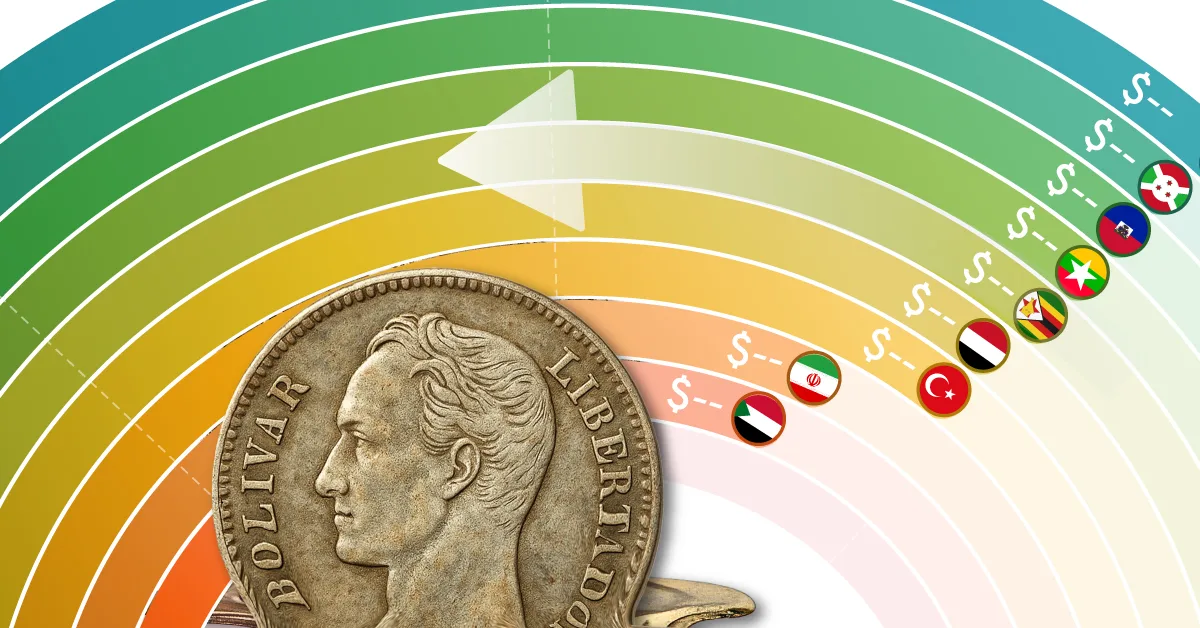
This graphic, created in partnership with Plasma, highlights countries with the highest inflation rates and what $100 could be worth by the end of 2025. It’s part of our Money 2.0 series, where we highlight how finance is evolving into its next era.
The Declining Value of $100 Due to Inflation
Some countries are facing high inflation rates, which means that prices are rising very quickly. As prices rise, money you already hold will buy you less than it did before.
What does this look like in dollar terms? Using projected 2025 inflation rates from the International Monetary Fund (IMF), we estimated what the equivalent of $100 at the start of the year will be worth by the end of 2025.
| Country | Purchasing Power of $100 by End of 2025 |
|---|---|
 Venezuela Venezuela |
$15 |
 Sudan Sudan |
$67 |
 Iran Iran |
$69 |
 Türkiye Türkiye |
$76 |
 Yemen Yemen |
$76 |
 Zimbabwe Zimbabwe |
$77 |
 Myanmar Myanmar |
$77 |
 Haiti Haiti |
$77 |
 Burundi Burundi |
$77 |
 Argentina Argentina |
$78 |
Source: IMF World Economic Outlook, Oct. 2025.
The IMF expects Venezuela will have an inflation rate of nearly 549% in 2025. In practical terms, this means $100 saved at the start of the year would only buy goods worth $15 by December. Economic sanctions from the U.S. have worsened the financial crisis in the country.
Even outside this extreme example, many countries are on track to see the local currency lose about a quarter of its purchasing power over the course of the year. This means wages and savings lose value quickly, making everyday essentials like food and rent harder to afford.
How to Protect Purchasing Power
When local money is rapidly losing purchasing power, residents can move their savings into a currency experiencing much lower inflation and more stability.
For instance, stablecoins are primarily pegged to the U.S. dollar and can help people preserve the value of their money. With Plasma One, a global U.S. dollar card, people can quickly sign up on their phone and use their stablecoin balance in more than 150 countries.

Ready for 4% cash back and 10%+ yield? Get early access to Plasma One.
-

 Technology2 weeks ago
Unbanked in a Connected World: Account Ownership vs Phone Ownership
In many unbanked countries, fewer than one in three adults have a financial account, but most own a mobile phone.
-

 Technology2 months ago
Ranked: The Biggest Buyers of U.S. Debt
Stablecoin Week: See how stablecoin issuers stack up against countries like Japan and Singapore as major buyers of U.S. debt.
-

 Technology2 months ago
Mapped: Stablecoin Regulation Globally
Which countries have stablecoin regulation proposed or in place, and which have no tailored laws? Find out in this Stablecoin Week piece.
-

 Technology4 months ago
Stablecoin Evolution: Milestones of the New Payment Rail
The GENIUS Act marks a turning point for stablecoin. Explore 8 key milestones in the digital dollar’s rise to mainstream finance.
-

 Technology5 months ago
Is the U.S. Dollar Primed for a Digital Rebound?
U.S. dollar influence is shrinking in some spaces, but stablecoins could give the currency a new chapter of global dominance.
-

 Money5 months ago
Ranked: The Biggest Currency Drops So Far in 2025
In the first half of 2025, one currency dropped over 50% against the U.S. dollar. What led to the decline?
-

 Technology6 months ago
Ranked: Countries With the Highest Remittance Costs
To send money across borders, workers can be charged high remittance fees—over 50% of the amount transferred in some cases.