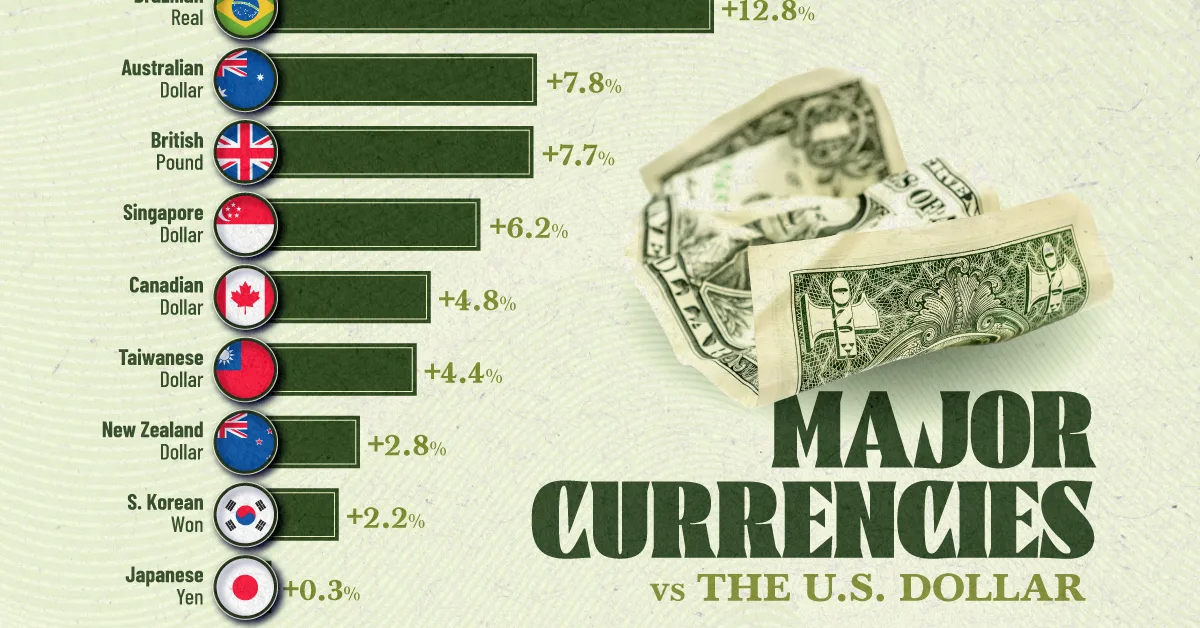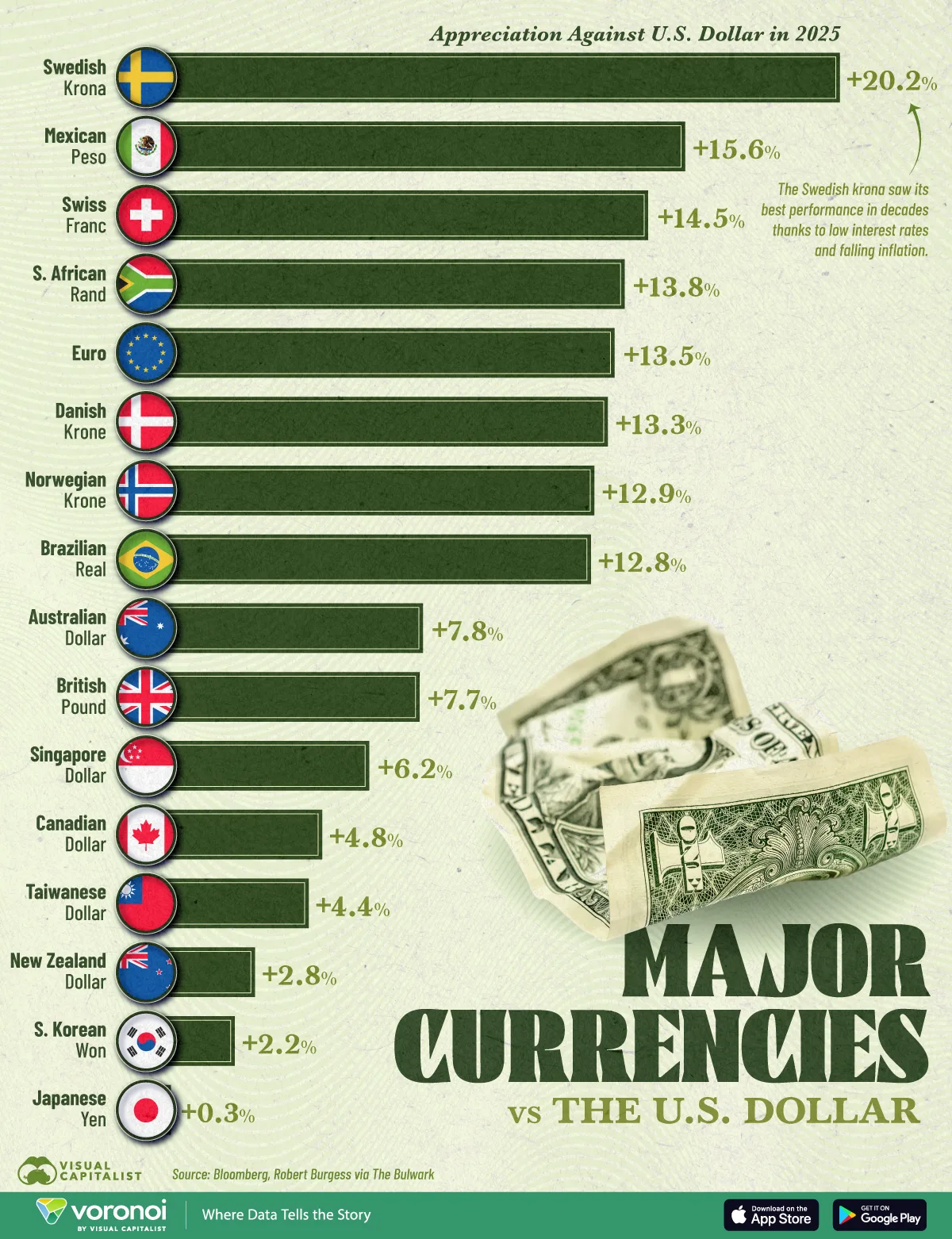
Chart: The Rise of Major Currencies Against the U.S. Dollar in 2025
See visuals like this from many other data creators on our Voronoi app. Download it for free on iOS or Android and discover incredible data-driven charts from a variety of trusted sources.
Key Takeaways
- The Swedish krona gained 20.2% against the U.S. dollar in 2025, marking its biggest year of appreciation in decades.
- Many major currencies appreciated against the dollar last year given steep policy uncertainty and increasing central bank reserve diversification.
Donald Trump’s trade war was a major driver of U.S. dollar weakness in 2025, pushing trade policy uncertainty to historic levels.
At the same time, U.S. dollars held in foreign central bank reserves fell to 20-year lows. Given these dynamics, several major currencies, from the Swedish krona to the Brazilian real saw double-digit gains against the U.S. dollar amid lower global demand.
This graphic shows the appreciation of major currencies against the greenback in 2025, based on data from Bloomberg via The Bulwark.
The Performance of Major Currencies Against the U.S. Dollar
Below, we show how numerous currencies strengthened against the U.S. dollar in 2025:
| Currency | Appreciation in 2025 |
|---|---|
 Swedish Krona Swedish Krona |
20.2% |
 Mexican Peso Mexican Peso |
15.6% |
 Swiss Franc Swiss Franc |
14.5% |
 South African Rand South African Rand |
13.8% |
 Euro Euro |
13.5% |
 Danish Krone Danish Krone |
13.3% |
 Norwegian Krone Norwegian Krone |
12.9% |
 Brazilian Real Brazilian Real |
12.8% |
 Australian Dollar Australian Dollar |
7.8% |
 British Pound British Pound |
7.7% |
 Singapore Dollar Singapore Dollar |
6.2% |
 Canadian Dollar Canadian Dollar |
4.8% |
 Taiwanese Dollar Taiwanese Dollar |
4.4% |
 New Zealand Dollar New Zealand Dollar |
2.8% |
 South Korean Won South Korean Won |
2.2% |
 Japanese Yen Japanese Yen |
0.3% |
With 20.2% gains, the Swedish krona saw its strongest performance against the dollar in decades.
The U.S. dollar weakened on softer economic data and policy expectations, and investors rebalanced into currencies like the krona amid relatively stronger Swedish growth prospects and economic fundamentals.
The Mexican peso had the second highest gains, strengthening 15.6% in 2025. This marked the best year since 1994, defying expectations given U.S. trade tensions. Among the factors underpinning the peso’s rise are resilient growth and macroeconomic stability.
Meanwhile, the South African rand rose 13.8% and the Brazilian real appreciated 12.8%.
Across Asian countries, the Singapore dollar increased 6.1%, serving as a “quasi safe haven” across the region. The global financial hub is known for its institutional strength and significant current account surplus, further supporting demand.
Learn More on the Voronoi App 
To learn more about this topic, check out this graphic on the top 50 countries by central bank reserves.