
A fight over the future of farmland is intensifying in Wellington County as rapid population growth and provincial housing targets push urban boundaries deeper into prime agricultural land.
The area is in high demand due to its proximity to the Highway 401 corridor and growing industrial hubs such as the Greater Golden Horseshoe and the Greater Toronto Area and there are lessons to learn as Ontario urban areas continue to grow into farmland.
WHY IT MATTERS: Significant pressure to grow housing and industrial areas comes into conflict with the need to maintain high-quality farmland.
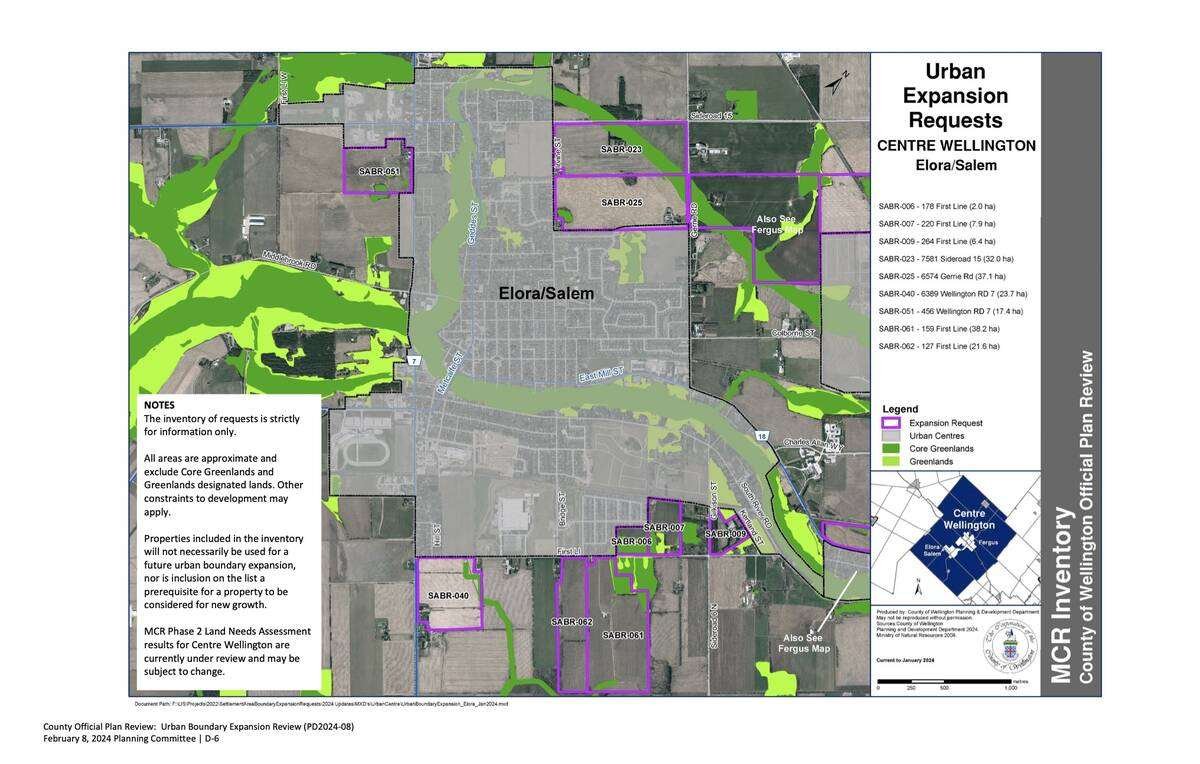
In February 2024, the County of Wellington launched an urban boundary expansion review and received settlement area boundary expansion requests totalling more than 973 hectares.
One of the most affected municipalities within the county is Centre Wellington, home to the communities of Fergus, Elora, Belwood and Salem.
According to Township of Centre Wellington data, the municipality is expected to grow to a population of 58,200 by 2051, with total employment reaching 25,100. The majority of this growth will take place in the Fergus and Elora–Salem urban centres.

Under the More Homes Built Faster Act, the government of Ontario has mandated a residential construction acceleration of 1.5 million new homes in 10 years across the province.
The province has stated that, to accommodate the land needs assessment for this area, a settlement area boundary expansion of 398 hectares of residential and employment lands will be required in Centre Wellington.
In a community with a strong history of opposing rural development, farmers and politicians are making their concerns known to the province. A social media campaign has been launched to raise awareness of the risks of expanding into prime agricultural lands.
Land on the brink of development
Janet Harrop owns Harrcroft Acres with her husband, Ian, and their family just north of Fergus. She is also the past president of the Wellington Federation of Agriculture.
Harrop was among the participants in videos shared on Facebook. She believes that once land is rezoned for future development, investment in that land declines significantly.
“When farmers are unsure how long they will be able to rent land, they are less likely to invest in drainage or other improvements that would increase the land’s agronomic value,” she said.
She is concerned that land around the edge of Centre Wellington already approved for inclusion within the urban boundary, along with several parcels developers are seeking to include through the Ontario Land Tribunal, consists largely of prime agricultural land.
Harrop notes that only 0.5 per cent of Canada’s total land base comprises Class 1 soil, the highest quality classification. She adds that Wellington County accounts for three per cent of Ontario’s prime agricultural land.
She fears the expansion will affect more than access to farmland, driving up both land costs and rental prices.
“If farmers have a long-term lease with certainty, they are more willing to pay more for the land. Parcels next to the urban boundary will be viewed by the development community as long-term investments for future development and will inflate farmland values,” she said, adding that municipalities must plan a “buffer” when expanding urban boundaries.
Harrop believes the plan will not only fragment farmland but also introduce non-farming residences through surplus farm dwelling severances or additional severances on secondary agricultural land. She said this can disrupt farm equipment movement, limit future expansion due to minimum distance separation (MDS) requirements and increase conflicts with non-farm neighbours.
Also, she says, this type of expansion places strain on communities that lack infrastructure to support large-scale development.
The value of Wellington County’s soil must be recognized to keep farmers in the area, she says, noting the loss of quality farmland will drive up prices and threaten generational farming.
Harrop said growth can instead be managed through intensification.
“For example, a four-storey apartment building with 40 units versus 40 homes built on 0.5-acre lots would save 20 acres of farmland,” she said. “There also needs to be weighting based on the type of farmland being developed. Prime agricultural land should not be used to grow homes; it should be used to grow food.”
Protecting land a “societal responsibility”
Bronwynne Wilton is the Ward 5 councillor in Centre Wellington and a rural-urban planning consultant. Her ward includes one of the largest areas of farmland in the township.
She says protecting farmland should be a societal responsibility, noting residents in mixed urban-rural communities may not fully understand the impact of expansion.

Wilton acknowledges farmers face moral and financial pressure from developers.
“To ask a farmer to turn down a fairly lucrative offer is difficult,” she said, noting much farm equity is tied to land rather than the operating business. “I think a lot of farmers struggle with it, but on the other hand, that’s probably their retirement income — something passed down to their children and grandchildren.”
Wilton notes municipalities’ hands are often tied because urban boundary expansion guidelines are set by the province, including farmland classification systems that may not align with local priorities.
In a community known for civic engagement, Wilton believes awareness of farmland risks is strong.
“I think people are recognizing that we do have really good farmland, and many feel a connection to the farm community in one way or another,” she said. “People are realizing that we can’t just keep paving over farmland.”
Mike Schreiner, leader of the Green Party of Ontario, has been closely monitoring expansion plans in Wellington County. He has lived in Guelph for many years and says municipalities are pushing back against what he calls “the Ford government’s sprawl agenda” because of costs and farmland loss.
He argues the province has increasingly intervened to force boundary expansions that benefit developers.
“Wellington County is one of the Ford government’s targets despite strong local pushback,” he said. “I’ve spoken with planners, farmers and residents who want to see farms and the agricultural sector protected from expensive sprawl.”
Schreiner added that amid global trade instability, protecting rural economies is essential to safeguarding jobs and food security.
“As I developed the Protect Our Food Act, experts, planners and farmers all agreed that loss of farmland is more than just loss of land. It threatens food sovereignty, jobs, prosperity and access to fresh local food,” he said. “We need to build more affordable homes in the communities people love — and it is more affordable to do so without paving over farmland.”
He noted previous rules required comprehensive reviews before settlement boundaries could be expanded, but said the provincial government has weakened those safeguards and overridden local decisions.
“To protect Ontario’s precious farmland, this government needs to reintroduce stronger checks and balances, make it easier to build within existing urban boundaries and allow public servants to do their jobs without ministerial interference,” he said.
Schreiner added that his bill has already received support from the Township of Centre Wellington, which he says demonstrates municipalities “do not want to see their farmland paved over for expensive, low-density sprawl.”
The post Wellington County farmers push back as urban expansion threatens prime farmland appeared first on Farmtario.


