

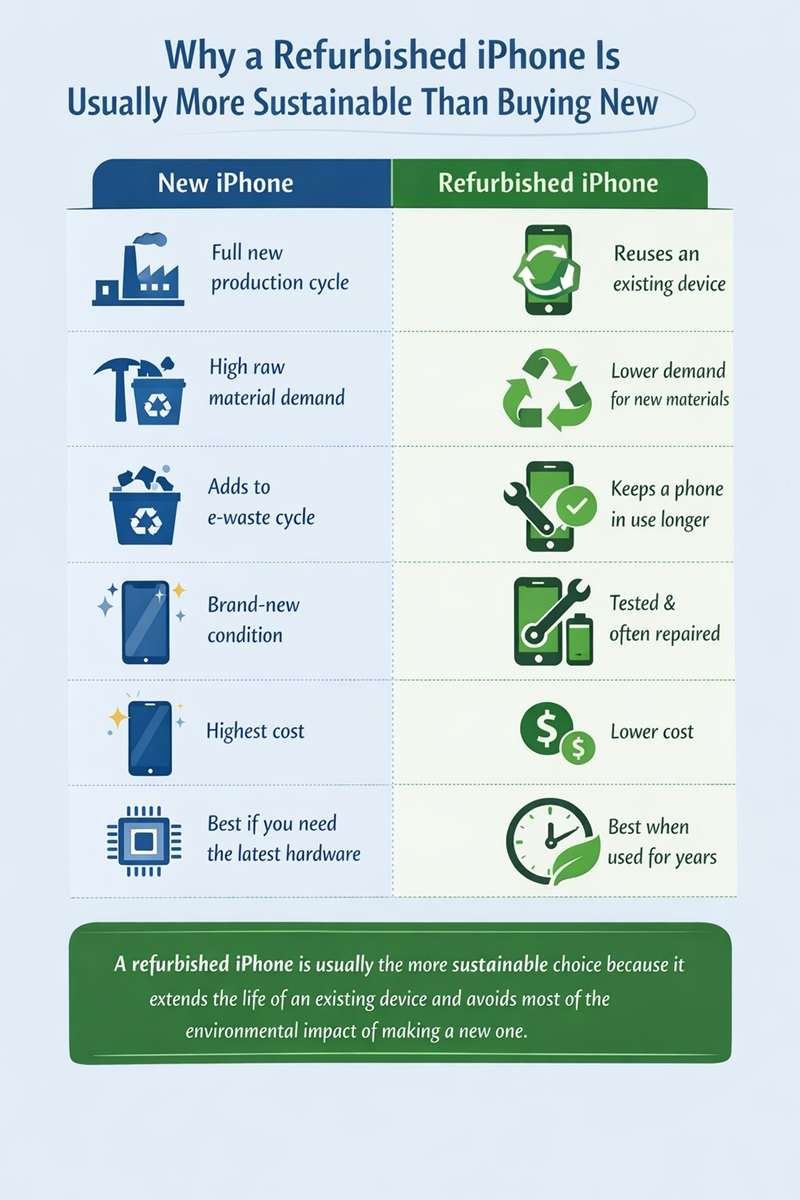
The answer’s yes, in most cases a refurbished iPhone is a more sustainable option than buying a brand-new one. The main reason is a pretty simple one: if you re-use a existing phone, you avoid most of the negative environmental impact that comes from having to manufacture a whole new device from scratch. And that matters bigtime because the biggest share of a smartphone’s footprint is usually laid down before you ever turn it on for the first time – through raw-materials being ripped from the earth, the manufacturing process itself, and all the transport that comes with it. Apple’s environmental reporting continues to show that product manufacturing is still the biggest part of its footprint, even with the company making a push to use more recycled and renewable materials in their newer devices.
But just because a refurbished iPhone is, in general, the greener choice doesn’t mean that it’s automatically the better option every single time. The environmental benefit depends on a few different factors. How long the phone stays in use, for one thing. Does it end up replacing a brand-new device purchase? And is it still practical to repair and support for several more years down the line. Recent research on second-hand smartphones found that people who use these types of products can reduce their average annual carbon footprint by as much as 34% – but that benefit is entirely wiped out if the phone only gets used for a short time.
What’s the deal with ‘refurbished iPhone’ anyway?
A refurbished iPhone is basically a pre-owned device that’s been given a once-over; it’s been inspected, tested, cleaned up, and put back up for sale. In some cases, people may replace faulty components before selling it off again. That makes refurbished iPhones different from your average used phone, which might just get resold as-is with little or no testing done beforehand. Apple says its certified refurbished iPhones get a full functional test as well as any necessary genuine Apple replacement parts, a new battery, a new outer shell and a one-year warranty.
And that’s kind a a big deal – because when it comes to sustainability, it’s not just about whether a phone is second-hand or not, it’s also about whether the phone has been restored well enough to stay useful for years to come rather than just a few months.
Why refurbished iPhones usually make the greener choice
The strongest environmental argument for a refurbished iPhone is that it extends the life of a device that already exists. A brand-new phone, even one that’s been made with more recycled content, is still going to require new materials, energy-intensive production, packaging and shipping. A refurbished phone gets to keep the value of those already spent resources in circulation for a lot longer.
There’s also a bigger waste issue at play here. The world generated 62 million tonnes of e-waste in 2022 – and only 22.3% of that got formally collected and recycled. We’re looking at a projected total of 82 million tonnes by 2030. Extending the life of phones won’t solve the problem on its own but it will certainly cut down on the pressure that keeps e-waste growing at such a crazy rate.
What the Latest Research is Actually Saying
A lot of older writing on refurbished phones makes a pretty big environmental splash. The truth is that used smartphones generally do tend to lower emissions, but just how much of a benefit you see depends entirely on how you plan to use the thing. Recent research in Nature found that second-hand use can have a real impact in reducing emissions over the course of a year – but it also pointed out that the biggest benefit comes when the old device sticks around for a good long while and stops some new device from being made in the first place.
Its for that reason a refurbished iPhone is really most sustainable when there’s still a bit of juice left in the battery, and it still has enough get up and go to keep you going for a few more years.
Are New iPhones Becoming Greener Too?
Yes, things are getting a bit better for the environment in that department but that doesnt mean refurbishment is no longer worth considering. Apple is slowly but surely incorporating more recycled and renewable materials into their phones, and has started to make a real push to make sustainability a central part of its design and supply chain thinking. And that is genuinely something to be proud of, but it still doesnt change the basic fact that a new iPhone is still just that – a newly made phone. If you really dont need new hardware, you’re still likely to come out ahead by using an existing device.
Refurbished vs Used vs Apple Certified Refurbished iPhones
Now this is where things can get really confusing for lots of buyers. A used iPhone might just be some individual or reseller selling it off as is, with no promises or guarantees. A refurbished iPhone is supposed to have been checked over, tested, cleaned and fixed if it needed it before being sold on. And then there’s Apple Certified Refurbished – which goes a step further by throwing in full functional testing, a brand new battery and outer shell for iPhones, and a one year warranty.
The actual state of the device matters, whether its for sustainability or reliability. A used phone that’s been poorly checked and maybe even has some hidden problems may start to go wrong sooner, cutting its second life short. On the other hand, a well refurbished phone has a much better shot at staying in use for years to come and delivering the environmental payoffs people are hoping to get from reusing an old device.
Should you Trust Refurbished iPhones?
You can, but only if the seller is upfront about what they’re doing. Buyers need to look for clear information about the warranty, battery life, return terms, cosmetic condition, and more importantly confirmation that the phone has been properly tested and isnt some dodgy activation-locked thing. Apple’s refurbished program is a pretty good benchmark to go by because it includes full testing and a one year warranty.
And another thing to think about is how long the phone can still be supported. Apple says that for up to seven years after a product was last sold, repairs and new parts should still be available – dependant on availability and all the usual caveats. Its not a guarantee that every repair will be possible forever but its still worth bearing in mind when choosing a model, especially if you can see it starting to look a bit long in the tooth.
When a Refurbed iPhone May Not Be The Greenest Choice
It is a misconception that a refurbished iPhone is always the most eco-friendly option. There are certain scenarios where it might not be the best bet. For one, if the battery has seen better days or the model is so outdated that it won’t last long, the environmental benefits of buying second-hand start to dwindle. Furthermore, if you end up upgrading again before the year is out, the whole idea of reusing something gets a lot less appealing. And let’s be honest, the latest research suggests that the longer a second-hand device sticks around, the more genuine the carbon savings are.
The same principle applies when you’re only buying a refurbished iPhone as a stopgap measure. If it doesn’t effectively replace the purchase of a brand new phone, then you’re not getting the full benefits of reuse. The real value comes from genuinely putting off or preventing another whole manufacturing cycle.
Final Verdict
In most instances, yes: buying a refurbished iPhone is still a more sustainable option than buying new. It gives an old device a new lease on life, lessens the demand for raw materials, and reduces the amount of electronic waste we churn out – and all this while potentially saving real emissions. But it’s not a simple case of “buy refurbished, be green”. No, the smart thing to do is to look for a refurbished iPhone that’s been thoroughly checked out – ie, one with decent battery life, a clear warranty, and enough oomph left in it to stay useful for years to come.
When you tick those boxes, you’re not just saving some cash – you’re also one of the most straightforward ways to make your next phone purchase more environmentally friendly, without having to compromise on how it performs in your daily life.


